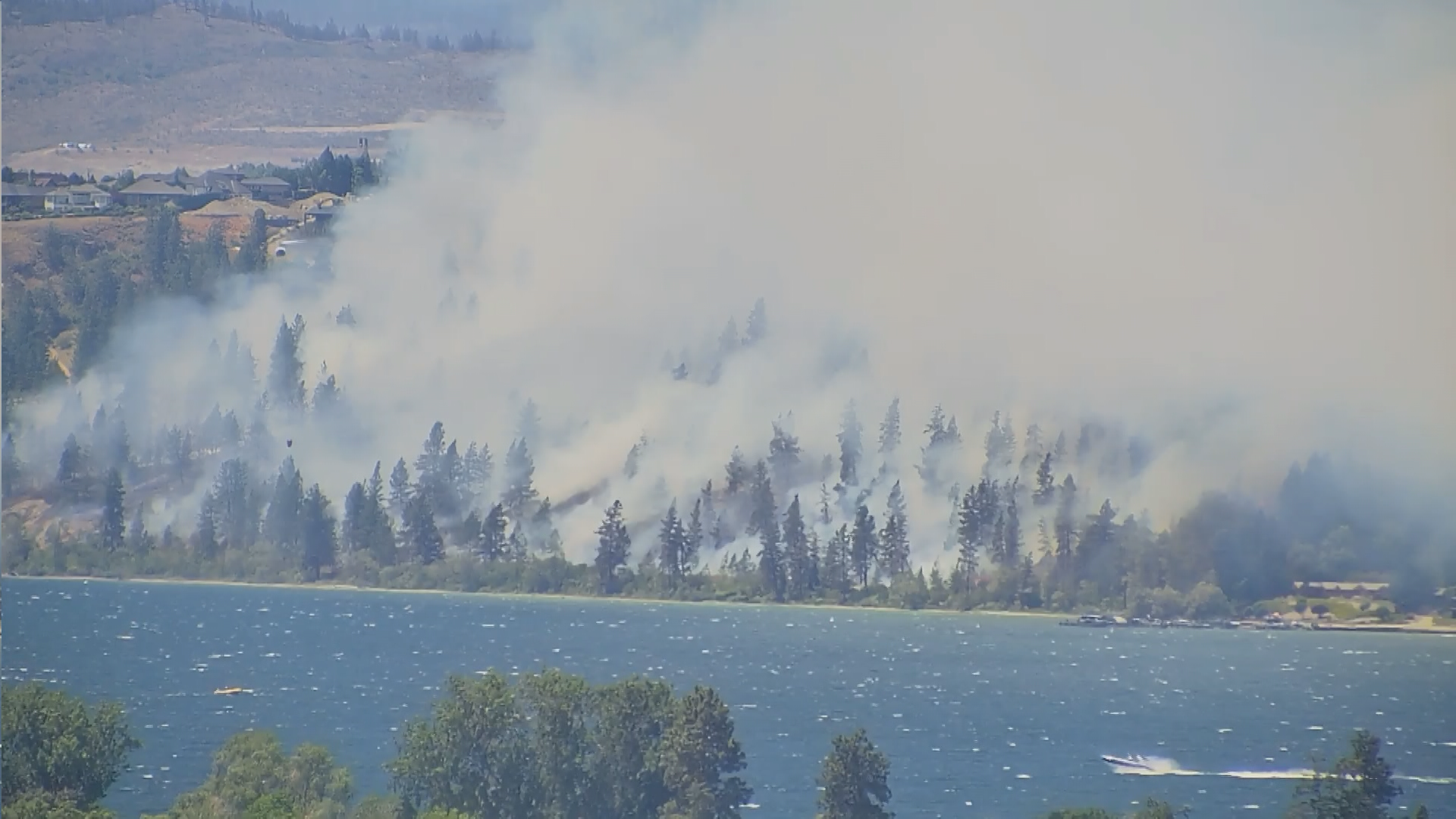
The containment of an out-of-control wildfire within six hours inside a vulnerable Wildland-Urban Interface (WUI) is not an accident of meteorology; it is a metrics-driven triumph of proactive civil engineering and resource staging. When the Kalamoir Park wildfire ignited in West Kelowna, burning through eight hectares under wind gusts of up to 50 kilometers per hour, it threatened a high-density residential zone comprising the Casa Loma and Lakeview Heights neighborhoods. The rapid transition of this blaze from "out of control" to "being held," followed by the immediate downgrade of 357 tactical evacuation orders to evacuation alerts, underscores a critical blueprint for modern emergency management.
To evaluate how this asset protection succeeded where other WUI fires fail, we must look past the standard media narrative of emergency response. The outcome was dictated by a specific equation: the intersection of micro-mitigation infrastructure investments, tactical evacuation routing, and strict definitions of containment boundaries.
The Tri-Pillar Framework of WUI Containment
Evaluating the operational success of the Kalamoir Park response requires dissecting the strategy into three distinct operational mechanisms. Each pillar independently altered the fire's rate of spread or reduced the civilization risk profile, creating a compounding stabilization effect.
1. Fuel Modification and Proactive Silviculture
The fire initiated inside Kalamoir Regional Park, an ecosystem historically prone to high fuel loads. The structural reason the fire did not achieve catastrophic crown fire dynamics—where flames leap across the tops of trees—is rooted in long-term wildfire mitigation work conducted by the Regional District of Central Okanagan.
By systematically applying fuel modification techniques, such as spacing tree crowns, removing low-hanging ladder fuels, and clearing dead organic matter from the forest floor, engineers altered the fire's convective heat transfer. When the head of the fire encountered these pre-treated zones, the lack of continuous fuel forced the open flame back down to the ground layer. This lowered the overall fire intensity, reducing the thermal radiation reaching nearby structures to a level that municipal hose lines could successfully defend.
2. Dual-Channel Egress Engineering
A primary point of failure in historical WUI disasters is choke-point congestion during tactical evacuations. In a high-stress scenario, a single ingress/egress corridor inevitably creates a bottleneck, trapping residents and blocking emergency vehicles.
In the Casa Loma neighborhood, this vulnerability was mitigated by a specialized $1 million emergency egress road constructed two years prior, in 2024. During this active incident, unified command implemented a reverse-flow traffic strategy. By routing evacuating residents out through the secondary emergency egress, the primary arterial roads remained entirely unobstructed. This allowed 20 RCMP ground officers and West Kelowna Fire Rescue apparatus to achieve rapid, frictionless positioning at the fire's perimeter.
3. Integrated Aerospace-Terrestrial Attack Dynamics
High winds of 45 to 50 kilometers per hour accelerate the spotting mechanism, where embers are lofted ahead of the main fire front to ignite secondary fires. To counteract this, BC Wildfire Service used an aggressive, dual-layered suppression strategy. Air tankers and rotary aircraft dropped sustained-yield retardant lines along the upper ridges to cool the advancing head, while ground crews simultaneously executed a direct attack on the flanks. This tight synchronization limited the total burn area to eight hectares, preventing the fire from establishing the critical mass required to create its own localized weather systems.
Defining the Risk Horizon: 'Being Held' vs. Active Alerts
Media reports frequently misinterpret emergency declarations, conflating a reduction in immediate danger with a complete elimination of risk. For municipal planning and risk assessment, the parameters must be precisely defined.
The transition of the Kalamoir Park fire to a status of "being held" is a technical metric utilized by the BC Wildfire Service. It indicates that under current meteorological conditions, fuel moisture levels, and deployed suppression resources, the fire is mathematically projected to remain within its established perimeter. It does not mean the fire is extinguished.
This technical distinction explains why all 742 properties within the incident zone remain under an active evacuation alert despite the removal of the mandatory evacuation order. The structural risk function remains volatile due to two specific variables:
- Micro-Climate Wind Shifts: In the Central Okanagan basin, localized wind vectors can shift rapidly due to thermal gradients caused by the lake. A sudden reversal in wind direction can re-intensify smoldering root structures, causing a breach of unfortified containment lines.
- Sub-Surface Combustion: Wildfires burning through heavy organic duff layers frequently transition to subterranean combustion. These hot spots can burn undetected for days, threatening to ignite surface fuels if wind speeds breach containment thresholds.
Structural Constraints and Operational Limitations
While the response serves as a model for WUI defense, executing these strategies involves severe trade-offs and structural limitations that limit their scalability.
First, fuel modification infrastructure is highly capital-intensive and requires perpetual maintenance. The silviculture work that saved homes by inches in West Kelowna must be repeated every five to seven years as undergrowth regenerates. For larger municipal regions, the cost-to-benefit ratio of treating thousands of hectares of contiguous forest becomes a fiscal bottleneck.
Second, tactical evacuations place an immense, non-scalable strain on regional administrative infrastructure. The activation of the Emergency Operations Centre and the establishment of the Emergency Support Services muster centre at Westbank Lions Hall require the immediate reallocation of municipal personnel from standard civic operations. This logistical drag limits a municipality's capacity to handle simultaneous, multi-point ignitions.
The Post-Incident Playbook
Managing the aftermath of a contained WUI event requires a shift from active suppression to systemic stabilization. The immediate operational priority inside Kalamoir Regional Park centers on comprehensive damage and safety assessments before the public can be reintroduced.
Suppression crews must first execute an extensive mop-up operation, systematically drenching all hot spots within 30 meters of the fire’s perimeter. Concurrently, geotechnical engineers must assess the structural integrity of the terrain. High-intensity burns destroy the subterranean root networks that bind the soil matrix together. In sloped regions like Kalamoir Park, this sudden loss of structural cohesion creates a high probability of slope instability and localized landslides during subsequent precipitation events.
Furthermore, arborists must identify and fell "hazard trees"—specimens whose root systems or core structures have been structurally compromised by fire, presenting an unpredictable fall risk across established park trails. The park must remain closed until these environmental liabilities are fully mitigated.
The definitive trajectory for WUI communities requires moving away from reactive emergency response and shifting entirely toward predictive infrastructure engineering. Municipalities bordering volatile fuel beds must mandate secondary egress routes, implement strict FireSmart building materials policies, and establish recurring capital funds dedicated exclusively to edge-zone fuel modification. Relying on favorable weather shifts or heroic, late-stage suppression tactics is an unsustainable strategy for asset protection.