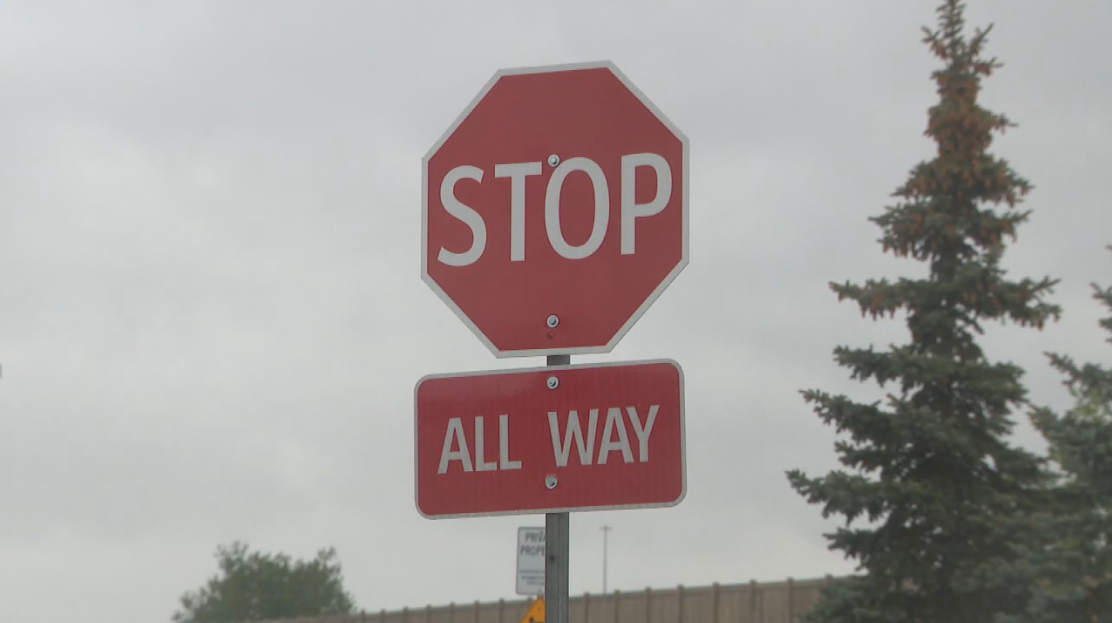
Municipal traffic management often operates under the flawed premise that isolated safety interventions can be executed without destabilizing systemic capacity. The rapid failure of the all-way stop sign implementation at the intersection of Maple Road and 12th Street in southeast Edmonton's Maple Crest neighbourhood provides a textbook case study in localized optimization triggering system-wide degradation.
By converting a low-delay, two-way stop configuration into an all-way (four-way) stop control on June 1, 2026, planners attempted to resolve a localized conflict: facilitating safer left turns and access onto Maple Road for vehicles exiting minor north-south approaches. The intervention survived less than 72 hours before massive commuter delays forced its immediate removal. Deconstructing this breakdown requires analyzing the structural bottleneck of the corridor, the mathematical failure of multi-way stops under highly asymmetric flow conditions, and the cascading risk vectors introduced by uncoordinated multi-modal infrastructure.
The Structural Bottleneck: Single-Point Corridor Vulnerability
The primary constraint governing the Maple Crest transport network is a severe lack of redundancy. Maple Road represents the sole paved arterial connecting the residential interior of the neighbourhood to the broader regional network via 17th Street and Whitemud Drive.
[Neighbourhood Core] ---> (12th St Intersection) ---> [CN Rail Crossing] ---> [17th St / Whitemud Drive]
                                                            ^
                                                   (Recurrent Blockage)
When an urban community relies entirely on a single paved conduit for ingress and egress, the corridor functions as a strict linear series system. In reliability engineering, the total capacity of a series system is governed entirely by its most restrictive bottleneck. Under baseline conditions, this bottleneck is an active Canadian National (CN) rail crossing situated mere hundreds of metres west of the 12th Street intersection. The rail corridor introduces recurrent, stochastic disruptions to vehicle flow, temporarily reducing arterial capacity to zero.
Alternative routes, such as West Railway Street, do exist but remain unpaved gravel paths characterized by severe washboard degradation. This lack of structural quality diverts virtually 100% of standard passenger vehicle traffic onto Maple Road. Consequently, any traffic control mechanism applied to this road must possess the mathematical capacity to absorb not only peak-hour commuting volume but also the massive upstream queues generated during rail-blocking events.
The Mathematics of Capacity Degradation under Asymmetric Flow
The fundamental error in deploying an all-way stop control at Maple Road and 12th Street lies in ignoring the degree of flow asymmetry. Multi-way stop signs function acceptably only when entering volumes on all approaches are relatively balanced, and total intersection volume is low.
To quantify why this intervention triggered an immediate transition from stable flow to severe gridlock, we must look at the capacity formulations defined in highway capacity engineering. The maximum throughput ($C_i$) of a specific approach $i$ at an all-way stop-controlled intersection is calculated based on the departure headway ($h_d$), which is the time gap required between successive vehicles clearing the conflict zone:
$$C_i = \frac{3600}{h_d}$$
Crucially, the departure headway for an approach is not constant. It increases non-linearly based on the presence and volume of conflicting traffic on the opposing and cross approaches. At 12th Street, the east-west flow along Maple Road represents the dominant volume, while the north-south flow from 12th Street is a minor stream.
When the intersection operated as a two-way stop, the dominant east-west stream possessed absolute right-of-way. It experienced zero control delay, meaning its departure headway was determined solely by the safe following distance between vehicles, typically between 1.5 to 2.0 seconds. This yielded a theoretical capacity of 1,800 to 2,400 vehicles per lane per hour.
By introducing a four-way stop, the city legally mandated that every single vehicle in the dominant east-west stream bring its velocity to zero, regardless of whether a cross-street vehicle was present. This artificial deceleration alters the baseline departure headway. A single vehicle accelerating from a complete stop requires a minimum headway of approximately 4.0 to 4.5 seconds to clear the intersection. By replacing free-flowing movement with a mandatory stop condition, the theoretical capacity of the main arterial lane dropped instantaneously:
$$C_{\text{new}} = \frac{3600}{4.5} = 800 \text{ vehicles per hour}$$
This represents a structural capacity reduction of over 50% on the only paved exit from the community. When cross-street traffic from 12th Street actually arrived, the physics of right-of-way negotiation dictated that the headway for the main street increased even further—often exceeding 6.0 to 7.0 seconds per vehicle as drivers navigated the four-way rotation.
Because the peak commuting demand originating from the expanding residential density of Maple Crest exceeded this newly capped threshold of 800 vehicles per hour, the intersection immediately transitioned into a state of permanent oversaturation. The arrival rate surpassed the service rate, causing the queue length to grow exponentially. This mathematical reality transformed an ordinary 5-to-8-minute neighborhood exit into a prolonged 40-minute delay, backing up traffic all the way to Whitemud Drive.
The Micro-Routing Dilemma and Cascading Risk Vectors
Beyond the raw degradation of throughput, the intervention created a severe safety paradox. The stated rationale for installing the all-way stop was safe mobility—specifically, mitigating high-severity broadside collisions for vehicles turning onto Maple Road. However, by solving a localized, low-frequency safety risk, the configuration introduced high-frequency systemic dangers.
The Spillback and Rail-Crossing Trap
Due to the close proximity of the active CN rail line, the massive queues generated by the 4-way stop rapidly spilled backward across the tracks. In standard traffic networks, drivers are legally required to keep rail crossings clear. However, under conditions of severe, unexpected gridlock, human behavior degrades. Drivers began stopping directly on the tracks, trapped between the upstream rail barrier and the downstream four-way stop queue. This created an immediate, catastrophic risk vector for train-vehicle collisions—an irony given that the intersection had already seen a pedestrian fatality near the tracks in 2021 and a fatal vehicle crash nearby in 2025.
Emergency Vehicle Blockage
The single-lane architecture of Maple Road lacks a dedicated shoulder or median. When the all-way stop induced gridlock across the entire length of the corridor, it physically immobilized emergency response platforms. Fire engines and ambulances trying to enter or exit Maple Crest were trapped in the single-lane queue, unable to bypass civilian traffic.
Forced Route Diversion
The sudden, severe delay forced commuters to seek alternative paths, shifting traffic onto the unpaved, unmaintained gravel infrastructure of West Railway Street. This sudden volume shift on roads unsuited for high-capacity transit accelerates structural road damage and increases the risk of single-vehicle loss-of-control incidents due to loose gravel and washboard corrugation.
The Political Economy of Infrastructure Underfunding
The rapid reversal of the traffic plan within three days highlights a deeper structural failure in municipal governance and developer-funded infrastructure frameworks. The City of Edmonton previously evaluated comprehensive structural upgrades for the area in 2022, including the potential construction of a grade-separated overpass or a secondary paved arterial to eliminate the single-point failure liability.
However, city council declined to fund the $11 million project. The refusal was justified through two mechanisms:
- Fiscal Restraint: Budgetary limits prevented allocating millions toward a localized community access point.
- Precedent Avoidance: Municipal policy dictates that secondary access roads and internal arterial connections are the financial responsibility of the private land developers who profit from the neighborhood's expansion, not the municipality.
This creates a structural impasse. The developer delays infrastructure spending to maximize short-term capital returns, while the city refuses to step in to avoid setting a costly precedent. The Safe Mobility Team's installation of a four-way stop was an attempt to deploy a low-cost, capital-saving solution ($10,000 in signage and paint) to fix a systemic capacity problem that actually required an $11 million structural capital intervention.
Strategic Alternatives for the Corridor
Reverting the intersection back to a two-way stop restored the baseline flow, but it did not solve the original problem of unsafe access from 12th Street. To address both safety and capacity without re-inducing gridlock, municipal engineers must evaluate interventions using dynamic traffic flow principles rather than static sign installations.
Actuated Smart Signaling with Rail Preemption
A standard, fixed-time traffic light would replicate the failures of the four-way stop during peak hours. However, an actuated traffic signal equipped with inductive loop sensors or radar detection on 12th Street could maintain a permanent green light for Maple Road, changing only when a vehicle minor-street approach is detected.
Crucially, this signal must be integrated with the CN rail crossing gates via hardwired preemption circuits. The moment a train approaches, the traffic signal must transition into a continuous green flush mode for the west-bound exit lanes, clearing the track zone and preventing spillback before the train reaches the crossing.
[CN Rail Gates Close] ---> [Triggers Signal Preemption] ---> [12th St Light: Red] ---> [Maple Road Light: Continuous Green]
                                                                                           (Clears Track Zone)
Single-Lane Modern Roundabout
A modern roundabout represents the optimal geometric solution for highly asymmetric intersection flows where safety and capacity must coexist. Unlike a four-way stop, a roundabout does not require the dominant flow to drop its velocity to zero when the intersection is clear. Vehicles enter via yield control, maintaining momentum.
More importantly, roundabouts naturally self-regulate. If a downstream queue forms due to a train crossing, the roundabout safely holds the queue without locking up the perpendicular movements, allowing minor-stream traffic to circulate and exit away from the blockage zone.
Immediate Structural Upgrades to West Railway Street
Until an $11 million permanent arterial or grade-separated overpass is approved, the city must eliminate the single-point failure of the network by paving West Railway Street. Applying a basic asphalt lift to the existing gravel pathway removes the washboard friction point, immediately establishing a viable, high-velocity secondary route that distributes peak commuter load away from the Maple Road bottleneck.