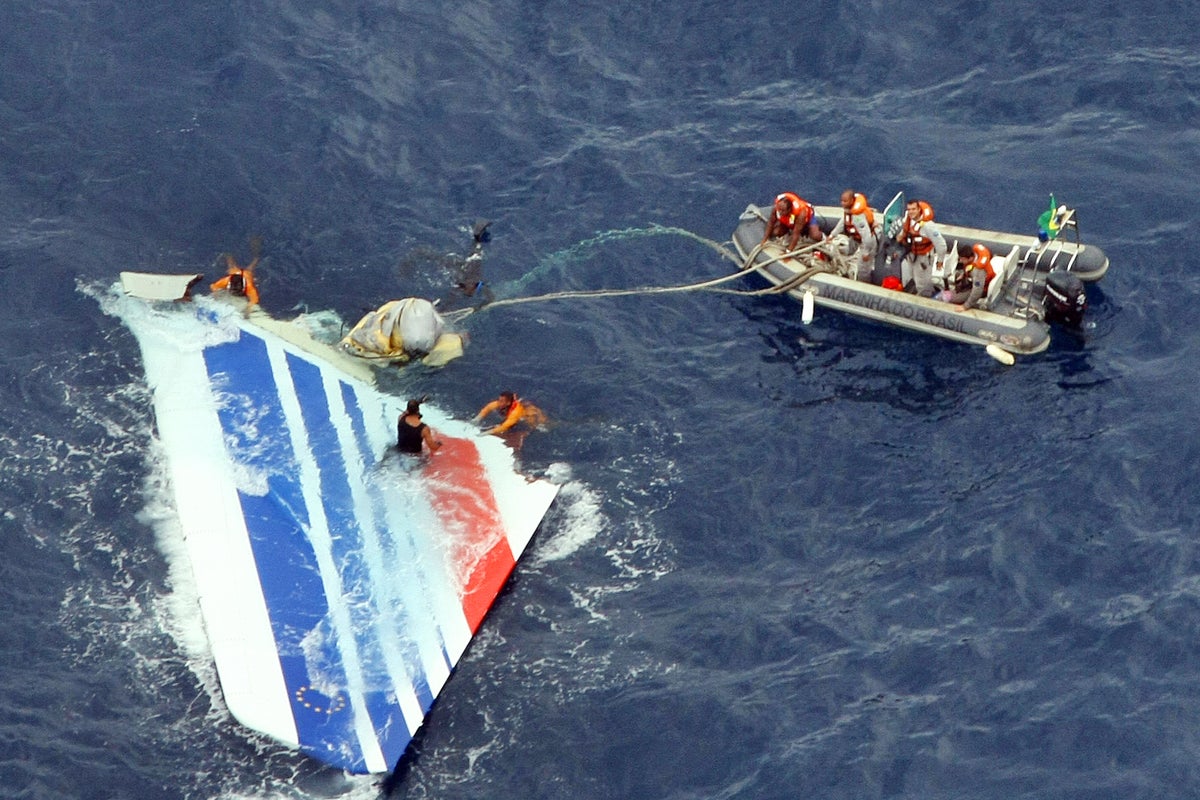
The Paris Court of Appeal verdict finding both Air France and Airbus guilty of corporate manslaughter for the 2009 crash of Flight AF447 exposes a fundamental truth about complex socio-technical systems: disasters are rarely the result of a single isolated failure. By reversing the 2023 lower-court acquittal and imposing the maximum corporate fine of €225,000 against both entities, the judiciary shifted the accountability framework from localized pilot execution to systemic operational and design negligence. While a traditional post-incident analysis often attributes 70% to 80% of aviation accidents to human error, this structural breakdown demonstrates how organizational decisions create the latent conditions that make human error inevitable.
To understand the mechanics of the Rio-Paris disaster, one must deconstruct the event using the Reason "Swiss Cheese" model of accident causation. Under this framework, defenses against failure are modeled as a series of barriers. Each barrier has holes, and a catastrophe occurs only when the holes in every single layer line up. In the case of Flight AF447, the holes were engineered years prior by design oversights at Airbus and operational training gaps at Air France.
The Triad of Latent Systemic Vulnerabilities
The failure chain began not in the cockpit over the Atlantic, but within the engineering and regulatory ecosystems that governed the Airbus A330-200. Three distinct pillars of vulnerability intersected on June 1, 2009.
1. Hardware Vulnerability: Sensor Degradation Dynamics
The technical catalyst for the incident was the temporary icing over of the aircraft’s Thales-manufactured pitot probes while flying through an Intertropical Convergence Zone (ITCZ) storm at 35,000 feet. Pitot tubes measure total pressure to calculate indicated airspeed, a critical metric for flight control systems. The high-altitude ice crystals overwhelmed the internal heating elements of the probes, creating a data-void environment.
The design vulnerability lay in a known hardware defect. Airbus and regulatory bodies had documented multiple previous incidents of Thales pitot tubes icing over at high altitudes, leading to temporary losses of airspeed data. The organizational failure occurred in the lag between identifying this trend and mandating hardware replacements. This created a predictable bottleneck where an aircraft could enter a severe weather system with sensors highly susceptible to environmental failure.
2. Automation Degradation: The Control Law Matrix
When all three pitot probes produced inconsistent or absent airspeed measurements, the flight control computer could no longer cross-verify the inputs. The system did not simply shut down; it underwent an automated structural degradation designed to protect the airframe but complex for human operators to diagnose under stress.
The flight control software switched from "Normal Law"—where internal computer protections prevent the aircraft from stalling, overspeeding, or overstressing the airframe—to "Alternate Law." Under Alternate Law, almost all automatic envelope protections are stripped away. The aircraft handles differently, requiring highly precise manual inputs.
The critical interface failure occurred because the system’s flight director crossbars, which provide visual steering guidance on the primary flight display, disappeared when the autopilot disconnected due to unreliable data, but then repeatedly reappeared as the system attempted to recalculate metrics. These intermittent visual cues prompted pitch-up inputs from the pilot flying, reinforcing a false mental model of the aircraft's state.
3. Operational Training Gaps: High-Altitude Aerodynamic Realities
Air France’s defense layer failed at the level of pilot training and procedural preparedness. Crew training models historically focused heavily on low-altitude, low-speed stall recovery during takeoff and landing approaches. Manual handling of a wide-body aircraft in Alternate Law at high altitudes (above Flight Level 350) requires vastly different aerodynamic inputs due to reduced air density and narrow margins between stall and overspeed.
Air France corporate leadership acknowledged during the legal proceedings that while they possessed the technical capability to conduct high-altitude manual flight training, they did not execute it because they believed it was unnecessary. This created a profound cognitive deficit when the crew faced an unexpected automation degradation.
The Flight Deck Cognitive Trap
The interaction between these hardware and software failures triggered a fatal cognitive overload inside the cockpit. The cause-and-effect relationship between sensor failure and aerodynamic stall can be mapped across a rapid sequence of events:
- 02:10:05 UTC: Pitot tubes freeze. Indicated airspeed drops sharply.
- 02:10:06 UTC: Autopilot and autothrottle automatically disengage. Control reverts to Alternate Law. A master caution alarm sounds.
- 02:10:07 UTC: The pilot flying executes a rapid, nose-up side-stick input, pulling the aircraft into a steep climb.
- 02:10:10 UTC: The stall warning sounds for the first time as the angle of attack exceeds the maximum allowable threshold for the current speed.
The rapid climb caused the aircraft to shed kinetic energy in exchange for potential energy (altitude), driving it into a high-altitude stall. The primary human factor failure was a complete breakdown in situational awareness, catalyzed by competing sensory alarms and lack of training.
The stall warning sounded more than 70 times as the aircraft descended from its peak altitude of 38,000 feet at a rate exceeding 11,000 feet per minute. Yet, the crew never initiated the standard "unreliable airspeed" or "stall recovery" memory items, which require pushing the nose down to reduce the angle of attack and regain airflow over the wings. Instead, the pilot flying maintained back-pressure on the side-stick, holding the nose up for almost the entire descent.
The human-machine interface created a cognitive trap. Because the airspeed data had fallen below a minimum threshold of 60 knots, the flight computer deemed the data invalid and automatically silenced the stall warning. Whenever the pilot briefly pushed the nose down, the airspeed increased above 60 knots, reactivating the data stream and causing the stall warning to sound again. This paradoxical feedback loops suggested to the highly stressed crew that pushing the nose down was worsening the situation, when it was actually the exact step required to break the stall.
Structural and Legal Precedents
The Paris Appeals Court ruling marks a departure from traditional aviation litigation. Historically, criminal trials in aviation disasters focus on immediate proximate cause, which often defaults to pilot error because the flight crew made the final, incorrect inputs. By assigning criminal liability to the corporation, the French legal framework establishes that corporate negligence in risk management is directly causal to operational catastrophe.
The prosecution successfully demonstrated that Airbus failed to issue rapid, unambiguous technical updates and hardware retrofits despite knowing the failure rates of Thales pitot tubes. Simultaneously, Air France failed to adapt its training curriculum to match the known technical realities of automation degradation on its long-haul fleet.
The financial penalty of €225,000 per passenger is minor for multi-billion-dollar global enterprises. The real impact is reputational and systemic. The verdict establishes a legal precedent that shields flight crews from being the sole scapegoats when corporate risk-mitigation strategies fail to address known design vulnerabilities.
Systems Engineering Best Practices
Organizations managing high-risk infrastructure must extract clear architectural principles from the AF447 failure chain to minimize systemic risk.
- Graceful Automation Degradation: Automated systems must not fail catastrophically or drop users into high-workload states without clear, un-ambiguous status telemetry. When switching control regimes, the interface must explicitly state what protections are lost and what rules now apply.
- Sensor Redundancy and Heterogeneity: Relying on three identical sensors (homogeneous redundancy) leaves a system vulnerable to common-mode failures, where environmental factors affect all three units identically. Modern architectures require heterogeneous redundancy, combining disparate data collection methods to ensure a single environmental variable cannot blind the system.
- Cognitive Load Allocation: In high-stress scenarios, human operators suffer from sensory tunneling. System designers must prioritize aural and visual alerts, suppressing non-critical information to prevent cognitive saturation. Alarms must never operate on inverted logic where correct corrective actions trigger further warnings.
The ultimate lesson of the Rio-Paris crash is that complex systems require proactive, continuous evaluation of technical debt and training efficacy. When an enterprise allows a known hardware vulnerability to persist without updating its operator training frameworks to mitigate that specific vulnerability, it constructs the very failure pathway it relies on its human operators to avoid.


