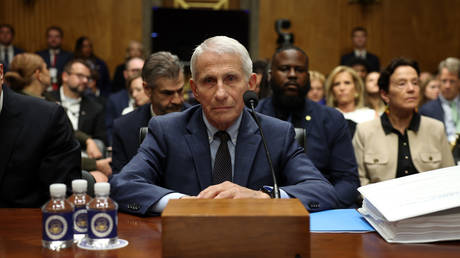
Senator Rand Paul moved his long-running feud with Dr. Anthony Fauci from verbal sparring matches into formal legislative penalties when a Senate committee advanced a criminal contempt referral against the nation's former top infectious disease official. This escalation marks a major inflection point in Capitol Hill oversight battles, focusing directly on transparency, government transparency, and the limits of executive branch accountability during public health emergencies.
For years, the ideological friction between the Kentucky Republican and the veteran immunologist played out through televised committee hearings, dueling medical journal citations, and sharply worded correspondence. What began as intense debates over mask mandates, school closures, and the origins of SARS-CoV-2 has now metastasized into a structural conflict over federal record-keeping and congressional subpoena compliance. The core accusation centers on whether specific communications regarding pandemic origins were intentionally concealed or deleted to evade public scrutiny through the Freedom of Information Act.
Congressional oversight operates on a delicate constitutional pivot. The legislative branch possesses the inherent authority to investigate, subpoena, and demand testimony to inform future lawmaking. When an executive branch official or former official allegedly stonewalls these inquiries, the resulting standoff threatens the institutional balance of power. Understanding this clash requires looking past the partisan shouting matches and examining the mechanics of federal investigations.
The Paper Trail and the Private Email Allegations
At the center of the contempt push lies a specific set of allegations concerning official communications conducted through private channels. Investigators working for the Senate Homeland Security and Governmental Affairs Subcommittee on Emerging Threats and Spending Oversight claim that high-ranking federal health officials utilized personal email accounts or encrypted messaging applications to conduct government business.
Transparency advocates have long argued that routing public business through non-official channels constitutes an evasion of statutory record retention requirements. Federal law mandates that correspondence concerning public policy and agency operations must be preserved as permanent government records. When investigators uncover instances where emails were allegedly deleted or labeled as personal to circumvent public disclosure, a red flag goes up.
Fauci's legal representation and supporters have consistently maintained that the former director of the National Institute of Allergy and Infectious Diseases complied with all applicable federal guidelines. They point to thousands of pages of documents already turned over to various congressional panels, arguing that the volume of material produced demonstrates good-faith cooperation rather than obstruction. Yet, for committee investigators, the existence of missing gaps or unindexed private communications remains a glaring point of contention that justifies extreme measures.
Proving intentional evasion in a court of law is a steep legal hurdle. Federal prosecutors reviewing a criminal contempt referral must establish beyond a reasonable doubt that an individual willfully and deliberately defied a lawful congressional directive. That standard separates political theater from actionable criminal liability. Committees can make noise, but securing an indictment from the Department of Justice against a prominent public health figure remains a statistically rare and politically fraught endeavor.
The Institutional Machinery of Contempt
When a congressional committee votes to hold a witness in contempt, the action triggers a formalized, multi-step process that rarely ends in handcuffs. The mechanics of this procedure are rooted in parliamentary rules and statutory law established decades ago.
Once a committee approves a resolution, the matter typically moves to the full chamber for a floor vote. If the full Senate or House passes the resolution, the presiding officer is legally required to certify the paperwork and transmit it to the United States Attorney for the District of Columbia. From there, the executive branch prosecutor evaluates whether to present the case to a grand jury.
Historically, the Department of Justice exercises broad prosecutorial discretion when handling congressional contempt citations originating from partisan disputes. When the executive branch prosecutes a former or current official from its own administrative apparatus, institutional self-preservation often takes precedence over legislative demands. This structural reality creates a frustrating loop for lawmakers who view contempt votes as their only remaining teeth against uncooperative witnesses.
Consider the historical precedent. Contempt citations against executive branch officials—ranging from executive privilege disputes during the Iran-Contra affair to Fast and Furious investigations—frequently result in stalemates. The courts are occasionally asked to referee, but the judiciary is historically reluctant to insert itself into internal political battles between Congress and the executive branch unless a clear constitutional violation is manifest.
The Broader Implications for Public Health Governance
Beyond the immediate political friction between Rand Paul and Anthony Fauci, this confrontation exposes deeper vulnerabilities in how the United States manages public health crises. The erosion of public trust in federal institutions did not happen overnight. It was forged in an environment of shifting guidelines, contradictory pronouncements, and a perceived lack of institutional humility.
When public health officials are perceived as treating legislative oversight as an adversarial annoyance rather than a constitutional check, the credibility of scientific guidance suffers. Conversely, when legislative hearings transform into partisan circuses designed primarily for media soundbites, the underlying policy questions get lost in the noise.
The debate over pandemic origins—specifically the scientific arguments surrounding natural zoonotic spillover versus laboratory-associated incidents—exemplifies this dysfunction. Instead of a rigorous, depoliticized inquiry into biosafety protocols and gain-of-function research funding, the discourse became inextricably linked to personal vendettas and political positioning. Investigators claim that transparency was sacrificed to protect institutional reputations. Defenders argue that scientists were subjected to relentless harassment that chilled open academic inquiry.
Both assertions contain elements of truth. The modern bureaucratic state has grown so vast and insulated that holding individuals accountable for institutional missteps is exceptionally difficult. At the same time, the weaponization of oversight committees can discourage talented professionals from entering public service, fearing that decades of dedicated work could be retroactively dismantled in a televised tribunal.
The Limits of Legislative Vengeance
As the legal and political maneuvering continues, the practical outcomes of the contempt referral remain limited. Even if the Department of Justice takes up the case, a conviction is far from guaranteed. More importantly, a legal battle will do little to resolve the fundamental questions of pandemic preparedness that originally sparked the investigation.
Congress retains the power of the purse and the authority to restructure federal agencies through legislative reform. Yet, structural reorganization of bodies like the National Institutes of Health or the Department of Health and Human Services requires bipartisan consensus—a commodity in short supply in Washington. Relying on punitive measures like contempt citations provides momentary political satisfaction for aggrieved lawmakers, but it substitutes for the hard work of drafting comprehensive statutory reforms that prevent future abuses of emergency authority.
The public watches these spectacles with a mixture of cynicism and exhaustion. They see two entrenched factions fighting a proxy war over the legacy of the COVID-19 pandemic, while the systemic vulnerabilities that allowed bureaucratic miscommunication, supply chain failures, and conflicting mandates to occur remain largely unaddressed.
Until lawmakers shift their focus from retroactive retribution to proactive structural reform, these high-stakes showdowns will continue to yield plenty of headlines and very little structural change.