The ordinary world breaks without warning. On November 23, 2023, the sky over Dublin was the color of wet slate, the kind of heavy, damp Irish afternoon where people hurry along the pavement with heads bowed against the chill. Outside a primary school on Parnell Square East, the rhythm of the day was utterly predictable. It was 1:30 p.m. A line of small children emerged from a creche, their chatter filling the cold air. They were five and six years old, navigating the world with the innocent, stumbling gravity of the very young.
Nearby, a man waited.
His name was Riad Bouchaker. He was 52 years old, an Algerian national who had lived in Ireland for two decades and held Irish citizenship. Hours earlier, he had learned that a social welfare payment had been refused. He had gone back to his hostel, packed a backpack, and retrieved a twelve-inch kitchen knife. Now, he stood by the school railings, watching the children line up.
Then, he moved.
What followed was not an argument, or a robbery, or a calculated political act. It was a sudden, chaotic explosion of violence directed at the most vulnerable targets imaginable.
Bouchaker struck a five-year-old girl first, driving the blade into her upper body, piercing her heart. Leanne Flynn, a childcare worker standing with the children, did not run. Instead, she threw her own body between the attacker and the kids, absorbing the fury of the knife. Bouchaker stabbed her repeatedly, collapsing both of her lungs and tearing through her diaphragm, stomach, and spleen. He turned on the others, wounding a five-year-old boy and a six-year-old girl.
Blood pooled on the gray concrete. Shouts rent the afternoon.
But just as quickly as the horror began, the human instinct to protect took over. Passers-by did not look away. Warren Donohoe, a man from County Wicklow, lunged forward and grabbed the attacker. Caio Benicio, a Brazilian delivery driver on a motorcycle, saw the madness unfolding, hopped off his bike, swung his helmet with everything he had, and cracked it against Bouchaker’s head, knocking him to the ground. Alan Loren-Guille, a seventeen-year-old French trainee chef, risked his own life to wrestle the twelve-inch blade from the man’s grip. Together, the crowd subdued the attacker, leaving him unconscious on the street until the authorities arrived.
The physical attack was over in minutes. But the ripple effect was only beginning.
The Fire in the Streets
As ambulances raced toward Parnell Square, another kind of poison began to circulate. It didn’t travel by blade; it traveled through screens. Within an hour, messaging apps and social media feeds were ablaze with rumors. Digital whispers claimed the attacker was an illegal immigrant, that children were dead, and that the incident was part of a coordinated campaign.
By nightfall, the grief and shock of a city were hijacked.
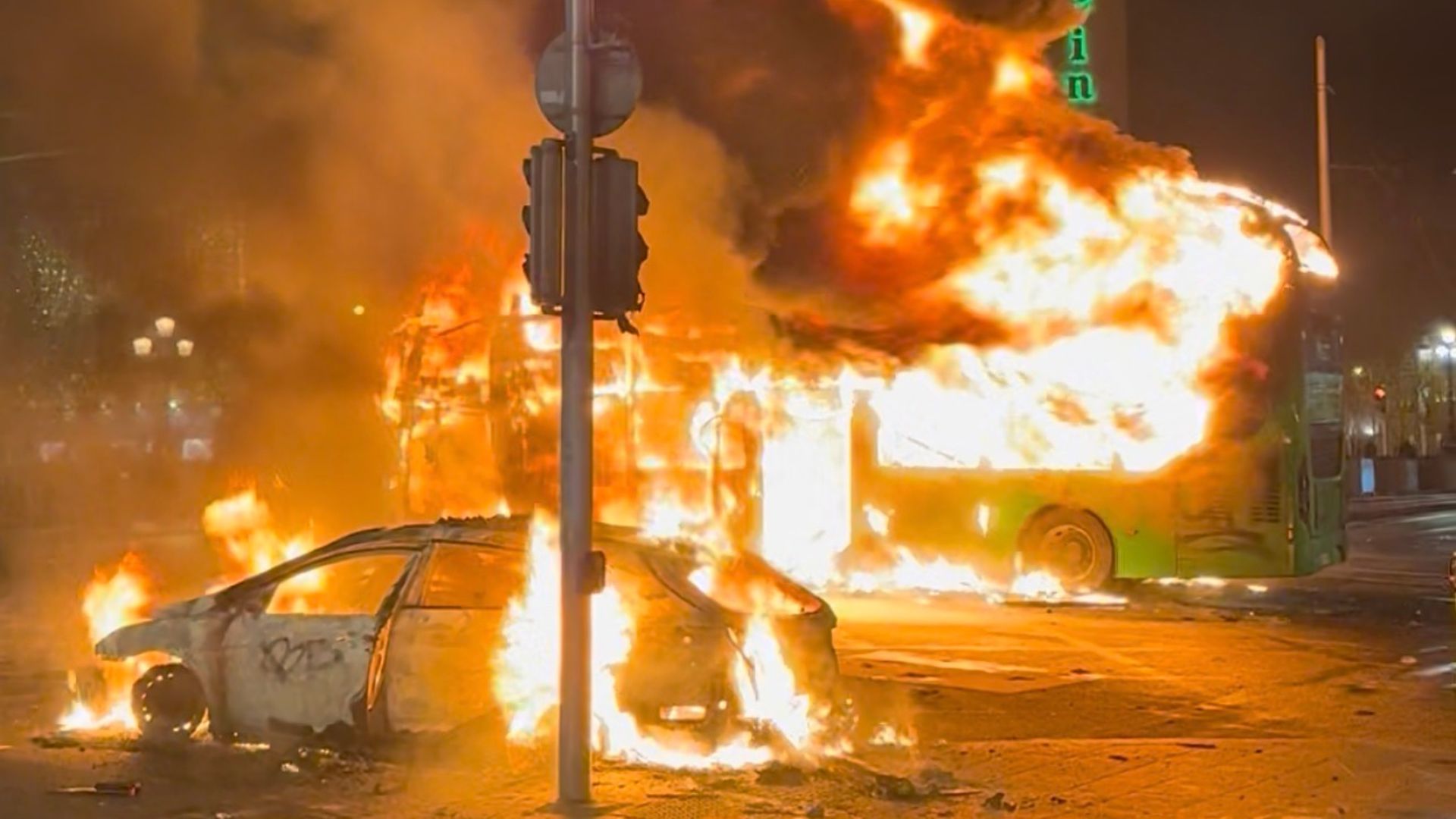
Dublin erupted into its worst civil unrest in modern memory. Rioters poured into the city center, chanting anti-immigrant slogans. They weren’t thinking about the five-year-old girl fighting for her life in a hospital bed, or the childcare worker whose lungs had collapsed while shielding toddlers. They torched a tram. They set fire to double-decker buses and police cars. Shops were looted, windows smashed, and fireworks fired directly at police lines.
The capital city burned, wrapped in a fury that claimed to be about justice, but looked exactly like opportunistic chaos.
The Quiet Reality of the Courtroom
Fast forward to the summer of 2026. The smoke from the riots had long cleared, the burnt-out chassis of the buses replaced, but the true reckoning was taking place inside the quiet, wood-paneled walls of the Central Criminal Court.
There were no microphones, no roaring crowds, no political slogans. There was only evidence.
Bouchaker sat in the courtroom, assisted by an interpreter and an intermediary due to an acquired brain injury sustained partly during his subdual on the street. He pleaded not guilty to all eight charges, including the attempted murder of three children. His defense team tried to argue a desperate angle: perhaps he only intended to "terrify and intimidate," not to kill.
The prosecution blew that argument apart with devastating simplicity. You do not bring a twelve-inch kitchen knife to a primary school to scare people. You do not aim for the heads, necks, and upper bodies of toddlers unless your objective is to end their lives.
The trial lasted three weeks. On July 1, 2026, a jury of three women and nine men returned their verdict. Guilty on all counts. Guilty of attempting to murder three innocent children. Guilty of causing serious harm to the heroic Leanne Flynn.
Judge Tony Hunt thanked the jury, noting that their decision aligned perfectly with the overwhelming evidence. Sentencing was set for September.
"No more needs to be said today," the judge remarked.
The Invisible Stakes
It is easy to look at this story as a sequence of headlines: a stabbing, a riot, a trial, a verdict. But the real weight of this tragedy exists far from the courtrooms and the political talking points.
Consider the five-year-old girl who was stabbed in the heart. She survived the blade, but the attack left her with a catastrophic brain injury. Today, she is non-verbal. She uses a wheelchair. She is fed through a tube in her stomach. Her life, and the lives of her parents, were fundamentally re-routed on that November afternoon. There is no verdict, no prison sentence, and no political ideology that can undo the daily, quiet reality of her recovery.
Then there is the city itself. The riots exposed a fragile seam in the social fabric, a willingness for digital malice to translate into physical destruction within hours. Yet, the antidote to that hatred was also on display on Parnell Square. The people who saved those children were a microcosm of the city they inhabited: an Irish father, a French teenager, and a Brazilian immigrant working a delivery shift. They didn’t ask for passports or checking accounts before they ran toward the danger. They just saw children in peril and acted.
The legal case is closed, the guilt established beyond doubt. But the true story remains with a little girl learning to navigate a silent world, and a city left wondering how a single afternoon could reveal both the very worst, and the very best, of humanity.