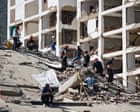
The occurrence of a magnitude 4.6 aftershock north of Caracas on June 29, 2026, exemplifies the physics of seismic decay following a doublet event. Five days prior, on June 24, northwestern and north-central Venezuela experienced an immediate sequence of two major strike-slip ruptures: a magnitude 7.2 foreshock followed 39 seconds later by a magnitude 7.5 mainshock. While media descriptions focus heavily on the psychological terror generated by these subsequent tremors, an engineering and macroeconomic assessment reveals that aftershocks operate as physical accelerators of structural failure and operational bottlenecks within a heavily compromised infrastructure grid.
When a magnitude 7.5 earthquake strikes a urban topography built on complex sediment layers, the primary damage function is determined by peak ground acceleration and the resonant frequency of local structures. However, when an aftershock follows, its capacity for destruction is disproportionately amplified by a variable known as structural hysteresis—the progressive degradation of a building's capacity to absorb energy due to prior deformation. The June 29 aftershock did not merely shake the capital and the coastal state of La Guaira; it systematically tested hundreds of buildings whose internal concrete cores and rebar matrices had already entered a state of plastic deformation during the initial doublet event.
The Dual-Shock Structural Degradation Mechanism
To quantify the vulnerability of the built environment in northern Venezuela, it is necessary to decouple the destruction caused by the initial $M_w 7.5$ event from the compounding risk introduced by the $M_w 4.6$ aftershock. The structural integrity of the affected infrastructure can be evaluated through a three-stage structural decay framework:
- Elastic Capacity Exhaustion: During the initial 39-second interval between the twin quakes, most unreinforced masonry and informal concrete structures completely exhausted their elastic limits. Internal steel supports yielded, and concrete walls suffered extensive micro-cracking.
- The Residual Strength Deficit: Structures that remained standing after June 24 did so with a highly diminished safety margin. The structural load-bearing capacity was transferred from compromised shear walls to internal frames that were never engineered to sustain long-term lateral loads.
- Resonant Amplification via Aftershocks: Although a magnitude 4.6 aftershock releases thousands of times less energy than the mainshock, its seismic waves travel through the same localized geology. For buildings with altered fundamental periods due to initial damage, even minor ground motion can induce resonance, triggering sudden catastrophic failure in elements suffering from progressive plastic fatigue.
Official reports indicate that the number of collapsed or partially collapsed structures escalated to over 770 by the fifth day of operations. This statistical doubling of structural failures within 48 hours is directly attributable to the mechanical failure of weakened foundations under the influence of continuous seismic triggers, including subsequent magnitude 4.2 and 4.5 tremors.
Search and Rescue Logistics: The Survival Probability Decay Function
The operational management of urban search and rescue (USAR) operations obeys a strict time-dependent probability curve. The likelihood of extracting live victims from collapsed reinforced concrete follows an exponential decay function, commonly modeled as:
$$P(t) = P_0 e^{-\lambda t}$$
Where $P(t)$ represents the probability of survival at time $t$, $P_0$ is the initial survival rate immediately post-collapse, and $\lambda$ is the mortality decay constant dictated by environmental factors, compression injuries, and dehydration.
Survival Probability (%)
100 |==================
 80 | \
 60 |   \  [The 72-Hour Phase Transition]
 40 |     \
 20 |       \____________________
  0 |___________________________
    0     24    48    72    96   120 (Hours)
The transition across the 72-hour threshold marks a fundamental shift in the nature of disaster response operations. Beyond this point, the primary cause of mortality shifts from immediate physical trauma to acute systemic failure, notably crush syndrome (rhabdomyolysis leading to acute renal failure) and severe dehydration.
The deployment of international assets—comprising more than 2,700 personnel and 86 specialized canine units from 24 countries—faces acute logistical friction points that diminish the efficiency of this survival window. The operational bottleneck is structured by three independent friction variables:
Geomorphic and Structural Obstacles
The physical composition of the rubble dictates the extraction velocity. The collapse of multi-story buildings in La Guaira primarily manifested as "pancake" collapses, where floor slabs stack directly atop one another. Extracting victims from pancake collapses requires heavy hydraulic breaching tools, shoring equipment, and precision lifting cranes, rather than standard surface-clearing mechanisms.
Spatial and Telecommunications Disconnection
The widespread failure of regional telecommunications infrastructure immediately decoupled local municipal response units from centralized command structures. This informational asymmetry resulted in the emergence of conflicting casualty databases. While formal state reports enumerated roughly 1,450 fatalities, decentralized civic tracking platforms registered tens of thousands of missing persons reports, reflecting a profound baseline accounting error caused by localized isolation.
Transport Grid Congestion and Restriction
The immediate convergence of thousands of civilian volunteers onto primary transit corridors connecting Caracas to the coastal littoral created severe traffic saturation. This saturation slowed the deployment of heavy engineering machinery. The subsequent operational decision by state security forces to restrict access to major routes solved the immediate traffic friction but introduced an administrative layer that slowed the transit of secondary supply lines.
Macroeconomic Shock Amplification and Infrastructure Constraints
The physical destruction wrought by the 2026 seismic sequence interacts directly with a pre-existing baseline of macroeconomic and industrial vulnerability. Initial United Nations estimates place the direct asset damage at approximately $6.7 billion, a figure representing roughly 6% of the state's gross domestic product.
The real economic impact, however, is governed by a long-term cost function that extends far beyond immediate capital destruction. The recovery trajectory is constrained by systemic bottlenecks within three critical infrastructure sectors:
- The Power Generation and Distribution Matrix: While electricity grid restoration in La Guaira reached approximately 75% within five days, the remaining 25% represents localized distribution nodes that require complete physical reconstruction. The electrical grid's fragility limits the continuous operation of high-voltage industrial equipment required for structural stabilization.
- The Healthcare Capital Deficit: The regional hospital network was operating at diminished capacity prior to the disaster due to long-term capital underinvestment. The sudden influx of over 3,150 trauma patients immediately exhausted local ICU capacities and surgical supply inventories, forcing a heavy reliance on ad-hoc international field hospitals and public donations to bridge the basic material deficit.
- The Industrial Machinery Shortage: The velocity of debris clearance and structural evaluation is strictly limited by the domestic inventory of heavy earthmoving equipment, mobile cranes, and structural scanning technology. The state’s immediate acceptance of external aid—such as the 100 million yuan allocation from Beijing, which includes dedicated satellite radar imagery—highlights an acute deficit in localized technological and material leverage.
The Strategic Path for Structural Risk Mitigation
The immediate operational priority requires shifting from an emergency rescue posture to a systematic urban stabilization strategy. This transition must be governed by an empirical framework rather than political expediency.
The immediate next step demands the deployment of an automated, algorithmically driven structural triage system. Every standing structure within the high-intensity shaking zone must be categorized using a three-tier tagging methodology based on residual lateral load capacity. Green indicates structural safety; yellow indicates restricted access pending detailed forensic engineering analysis; red indicates imminent collapse risk requiring controlled demolition.
Simultaneously, the administration must establish localized logistical sub-halls outside the primary seismic impact zone. This step is essential to decouple international material supply chains from the congested transit bottlenecks of the Caracas-La Guaira corridor.
The long-term reconstruction phase cannot rely on historical building codes. The seismic profile of northern Venezuela has been fundamentally altered by the stress redistribution along the underlying strike-slip fault networks. Future construction models must mandate ductile concrete detailing and base-isolation technologies for all public infrastructure, recognizing that the doublet event of 2026 has reset the baseline for regional seismic risk management.