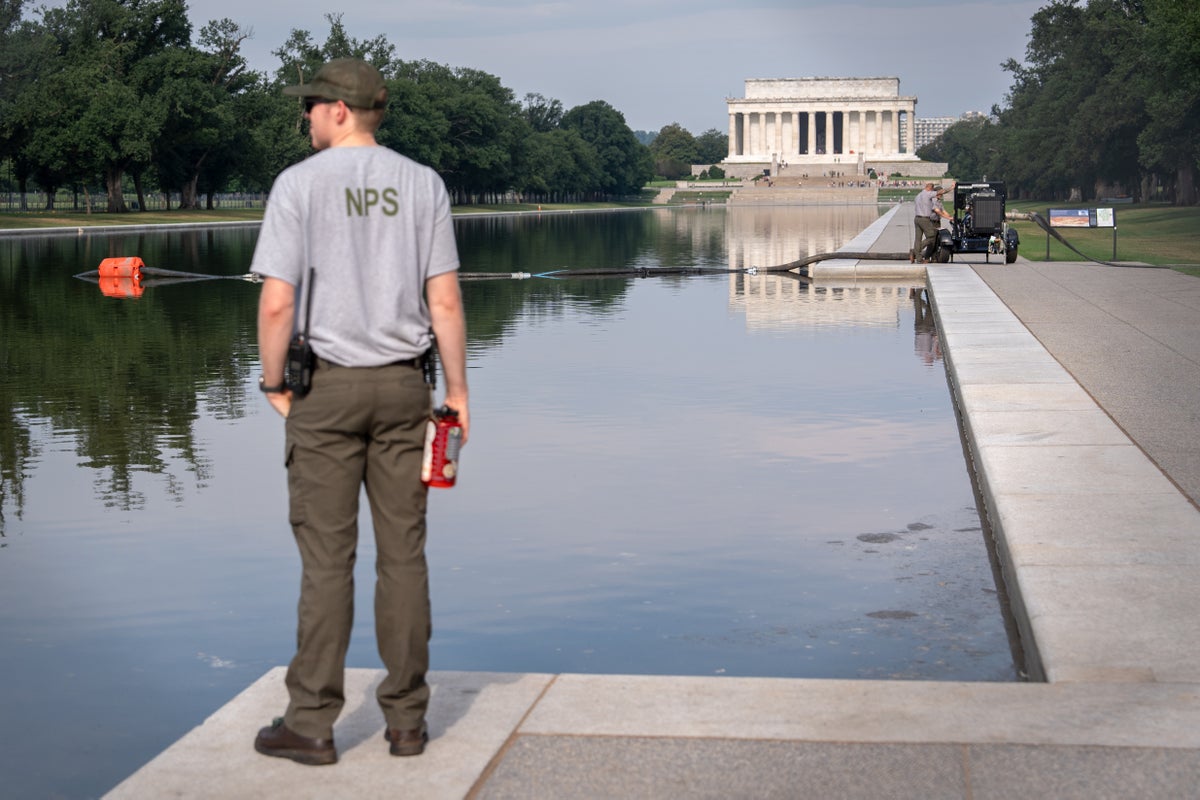
Capital infrastructure projects fail when arbitrary timelines supersede material science. The recent sixteen million dollar rehabilitation of the Lincoln Memorial Reflecting Pool provides a clinical case study in operational collapse, organizational friction, and institutional displacement. When the National Park Service executed a rapid overhaul to align with the America 250 celebrations, the initiative bypassed fundamental engineering constraints. The resulting structural delamination and immediate algal proliferation exposed systemic vulnerabilities in how federal agencies manage large-scale public works under direct political pressure.
The Tripartite Failure Matrix
Public asset restoration relies on three interdependent variables: material compatibility, quality assurance protocols, and schedule realism. When any single pillar is compromised, system failure becomes mathematically probable. The Reflecting Pool project suffered simultaneous degradation across all three fronts.
Material selection drove the initial vulnerability. The application of an epoxy primer alongside a polyurea coating onto a historic basin requires strict adherence to curing windows, substrate moisture thresholds, and thermal expansion coefficients. Historical data regarding large-scale concrete and stone basin waterproofing indicates that accelerated curing schedules under high UV exposure inhibit proper chemical cross-linking.
Quality control protocols deteriorated under political compression. Investigative findings by the Department of Justice later confirmed that the contractor, Atlantic Industrial Coatings, executed a flawed installation characterized by poor quality control. Compliance records revealed deviations from manufacturer instructions concerning minimum and maximum dwell times between coating applications. Rather than enforcing contractual milestones, oversight mechanisms were subordinated to a rigid calendar deadline.
Schedule compression served as the primary catalyst. Imposing a fixed deadline for a complex civil engineering intervention eliminates contingency buffers. When weather anomalies or material sensitivities occur, a compressed timeline forces labor teams to bypass intermediate inspection phases.
The Mechanics of Material Breakdown
The physical manifestations of the renovation failure—widespread peeling of the blue polyurea lining and acute cyanobacterial and algal blooms—are direct symptoms of underlying chemical and hydrological mismatches.
Polyurea coatings demand optimal surface preparation to achieve mechanical and chemical adhesion. When applied to aged concrete or stone infrastructure without adequate profile etching or prime coat penetration, interfacial shear stresses quickly exceed bond strength. Thermal cycling on the National Mall—characterized by high daytime radiant heat coupled with sub-surface moisture vapor transmission—creates hydrostatic pressure beneath the membrane. Without an unimpeded venting mechanism or complete substrate bonding, blisters form, rupture, and delaminate in large sheets.
Simultaneously, the introduction of a nanobubbler filtration system failed to suppress organic growth because the underlying biological nutrient load was unaddressed, and chemical disinfectant balancing was miscalculated. Pouring hydrogen peroxide and increasing ozone levels post-fill represent reactive band-aids rather than systemic water management solutions. True biological control requires hydraulic turnover rates matched to organic input and solar insolation, variables that cannot be corrected by chemical shock treatments alone when the basin surface itself is actively shedding synthetic polymers into the water column.
Institutional Friction and Accountability Displacement
The operational fallout extended far beyond physical decay into the realm of administrative governance. When structural defects became publicly visible, the institutional response followed a predictable trajectory of accountability displacement.
Initial administrative communications attributed the physical destruction of the pool lining to targeted vandalism. This framing triggered an enforcement cascade:
- United States Park Police filed multiple police reports.
- Federal citations and criminal charges were levied against civilian visitors, including a high-profile indictment of an Olympic athlete.
- Prosecution teams pursued felony property destruction charges based on initial incident logs provided by the Department of the Interior.
The institutional strain intensified as career personnel within the National Park Service were positioned between professional integrity and executive directives. The divergence between field-level engineering reality and top-down narrative generation created a systemic hazard for the agency. When federal prosecutors eventually moved to dismiss the criminal charges after discovering that internal documents had detailed contractor errors rather than malicious human intervention, the episode underscored the vulnerability of independent agency stewardship under intense executive oversight.
Structural Correction Protocols
Resolving chronic infrastructure decay at historic monuments requires an operational reset built on empirical risk management rather than fixed calendar mandates. Future public asset rehabilitations must institutionalize independent third-party quality assurance audits that hold absolute authority to halt work when environmental or curing parameters fall outside strict tolerances. Contractual frameworks should penalize schedule acceleration when it compromises material integrity, ensuring that public heritage sites are insulated from short-term political expediency. Comprehensive diagnostic monitoring, transparent data sharing regarding contractor performance, and the strict separation of forensic engineering from political messaging represent the baseline requirements for restoring institutional credibility and structural resilience.