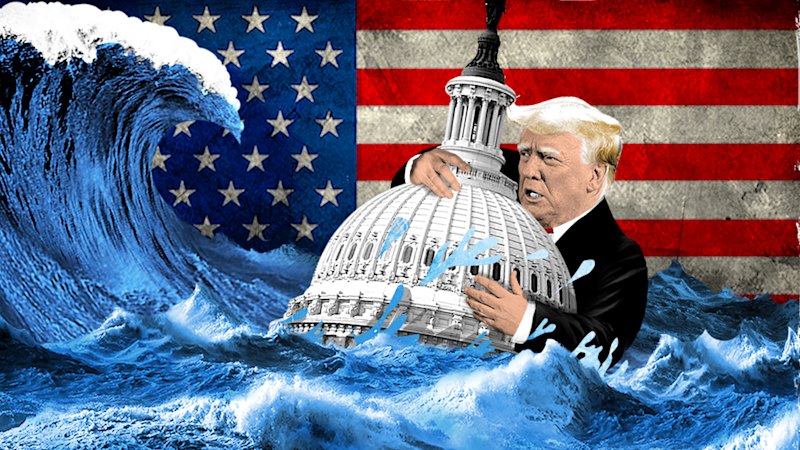
Post-election infighting within American political parties is not an emotional breakdown; it is a predictable resource allocation battle triggered by campaign losses. When a party underperforms in United States midterm elections, internal factions immediately initiate a blame cycle to protect their institutional power, secure future fundraising channels, and dictate the ideological direction for the upcoming presidential cycle. Understanding this phenomenon requires stripping away cable news narratives and examining the structural mechanics of political survival, donor leverage, and voter coalition math.
The Structural Mechanics of Post-Election Attribution
In corporate environments, a missed quarterly target triggers a root-cause analysis focused on product-market fit, distribution channels, and operational execution. In politics, root-cause analysis is subordinate to factional self-preservation. Because political parties are loose coalitions of competing ideological wings, institutional consultants, and major donors rather than unified hierarchies, no single entity owns the profit-and-loss statement.
When a midterm election fails to yield expected seat gains—or results in unexpected losses—three distinct attribution vectors emerge immediately:
- Candidate Quality vs. Institutional Support: Party leadership and national committees typically attribute losses to flawed individual candidates who alienated swing voters during general elections. Conversely, the candidates and their grassroots backers blame national committees for withholding financial resources during critical final weeks.
- Ideological Positioning vs. Turnout Operations: Centrist factions argue that extreme rhetoric from the party's base depressed independent support in suburban districts. Progressive or populist factions counter that uninspiring, moderate platforms failed to mobilize core voters, creating an enthusiasm gap.
- Message Framing vs. Macroeconomic Reality: Strategists debate whether the party failed to communicate its legislative achievements or whether structural headwinds—such as inflation, interest rates, or historical midterm penalties against the sitting president's party—made the outcome mathematically inevitable regardless of messaging.
This friction persists because electoral outcomes are multi-variable events. Without controlled A/B testing in a live congressional district, factions can selectively isolate data points to validate their pre-existing strategic preferences.
The Economic Incentives Driving the Blame Cycle
To understand why political operatives prolong public infighting rather than quietly correcting course, one must examine the financial architecture of modern campaigns. Political consulting firms, media buyers, and data vendors operate on thin windows of peak revenue that align with two-year election cycles. A major electoral loss threatens their future retainers.
Protecting the Consulting Class
National campaign committees—such as the Democratic Congressional Campaign Committee (DCCC) and the National Republican Congressional Committee (NRCC)—distribute hundreds of millions of dollars to preferred vendors. When a cycle ends poorly, major donors demand accountability before writing checks for the next cycle.
If the consulting class admits that their media-buying strategies, polling models, or ad creative failed to move persuadable voters, they risk losing lucrative contracts. By shifting the narrative toward "unprecedented external factors" or "rogue candidates who ignored professional advice," entrenched operatives insulate their business models from market correction. The blame game functions as a reputation-management shield designed to preserve vendor incumbency.
Donor Leverage and Capital Flight
High-net-worth individual donors and Political Action Committees (PACs) treat campaign contributions as capital investments aimed at securing policy outcomes or regulatory access. When a party fails to capture a congressional chamber, the return on investment drops to zero.
Factions weaponize post-election post-mortems to redirect donor capital away from rivals. If a centrist super PAC can convince major financiers that populist primary winners cost the party five winnable House seats, those financiers will redirect their capital toward primary defense funds in the next cycle. The public argument over "what went wrong" is actually a pitch deck to institutional capital.
Coalition Math and the Primary-General Paradox
The core structural flaw driving post-midterm recriminations is the irreconcilable tension between primary electorates and general electorates. This is not a messaging failure; it is a systemic design problem rooted in American election law and gerrymandering.
The Mechanics of the Primary Bottleneck
In the vast majority of congressional districts, partisan redistricting has eliminated general election competition. The true contest occurs in the party primary, where turnout routinely hovers between 15% and 25% of eligible voters. This small subset of the electorate is disproportionately ideological, highly engaged, and intolerant of compromise.
To survive this bottleneck, candidates must adopt policy positions and rhetorical styles tailored to the activist base. However, in the roughly 35 to 45 genuinely competitive House districts—and in statewide Senate races—those exact positions become liabilities among low-information, swing, and independent voters who decide general elections.
The Attribution Trap
When a candidate tailored for a primary loses a competitive general election, the party falls into an attribution trap:
- The Base Hypothesis: Argues the candidate lost because they pivoted toward the center after the primary, appearing inauthentic and depressing base turnout.
- The Moderate Hypothesis: Argues the candidate lost because their primary rhetoric provided opposition researchers with endless ammunition for attack ads, disqualifying them among suburban moderates.
Both hypotheses rely on correlation rather than causation. Academic political science generally demonstrates that ticket-splitting has declined sharply over the past two decades, meaning partisanship dictates the baseline vote. However, in races decided by fewer than 10,000 votes, candidate-specific drag—measured by comparing a congressional candidate's vote share to the top-of-the-ticket benchmark—proves that individual candidate quality remains a decisive variable at the margins. Factions ignore this margin analysis because acknowledging it requires conceding that primary voters frequently nominate unviable general election contenders.
Historical Baselines and the Presidential Penalty
A rigorous assessment of any US midterm election requires anchoring the results against historical baselines rather than partisan expectations. Since the Civil War, the party controlling the White House has lost House seats in nearly every midterm election, with rare exceptions such as 1934, 1998, and 2002.
Thermostatic Public Opinion
Political scientists refer to this phenomenon as thermostatic public opinion. When one party holds the presidency and enacts its agenda, the electorate perceives policy moving too far in one direction and uses the midterm election to apply a corrective brake.
Media narratives frequently amplify expectations of a "wave election" based on mid-cycle polling, presidential approval ratings, and economic indicators like the Consumer Price Index (CPI). When the out-party fails to achieve a sweeping landslide—winning a narrow majority instead of a massive one—internal factions treat a historical norm as a catastrophic failure.
Expectation Management Failure
The severity of the post-midterm blame game is directly proportional to the gap between pre-election projections and actual seat counts. When party leaders project confidence to boost fundraising and suppress opposition morale, they inadvertently set an artificial performance floor. Failing to clear that floor triggers an immediate crisis of confidence, even if the party technically gained power or defied historical midterm losses.
Operational Limitations of Post-Election Autopsies
Following high-profile losses, national party committees frequently commission formal "autopsies" to diagnose organizational failures. While these reports project institutional seriousness, their operational utility is severely constrained by three structural realities:
- Survivorship Bias in Leadership: The individuals overseeing the autopsy are usually the same party chairs, committee directors, and senior strategists who managed the losing cycle. They possess zero incentive to publish findings that implicate their own resource allocation decisions or strategic blunders.
- Static Modeling in a Dynamic Environment: Autopsies analyze the voter coalition of the previous election, treating demographic voting blocs as static assets. However, voter realignment is continuous. Strategies optimized to recapture lost suburban voters from two years prior often fail to account for shifting attitudes among working-class, Hispanic, or younger voters in the subsequent cycle.
- Lack of Enforcement Mechanisms: Even when an autopsy correctly identifies a systemic flaw—such as inferior voter-file infrastructure or late entry into digital advertising—national committees lack the legal authority to force state parties, independent super PACs, or individual candidates to adopt standardized best practices. Campaign finance laws prohibiting coordination between candidates and outside spending groups further fragment strategic execution.
Separating Signal from Noise in Voter Data
To replace factional guesswork with empirical clarity, analysts must isolate three specific metrics when evaluating midterm performance:
- Partisan Lean vs. Actual Margin (WAR - Wins Above Replacement): By comparing a candidate's final vote percentage against the district's Cook Partisan Voting Index (PVI) or recent presidential baseline, strategists can strip out national wave effects and measure pure candidate performance. A candidate who loses by 2 points in an R+8 district outperformed their baseline; a candidate who loses by 2 points in an R+1 district underperformed.
- Ticket-Splitting Rates: Examining the variance between votes cast for Senate, Governor, and House candidates within the exact same precincts reveals whether voters rejected a specific individual or the entire party brand. High variance indicates a candidate quality problem; uniform underperformance indicates a brand or macroeconomic problem.
- Turnout Composition vs. Persuasion: Comparing precinct-level turnout against validated voter files determines whether a loss resulted from core supporters staying home (mobilization failure) or 2020/2022 partisan voters switching sides (persuasion failure).
Without this granular decomposition, post-election debates remain exercises in confirmation bias.
Executing Strategic Course Correction
Party leadership and institutional donors cannot eliminate factional friction, as ideological competition is inherent to a two-party system. However, decision-makers can neutralize the destructive effects of the post-midterm blame cycle by altering how capital and institutional support are deployed before the next primary season begins.
National committees and major aligned super PACs must abandon reactive post-election messaging reviews and implement strict pre-primary capital gating. Funding, data access, and institutional endorsements in competitive battleground districts must be conditioned on objective viability metrics—specifically, early general-election polling head-to-heads and fundraising velocity among independent donors—rather than primary ideological purity. If party infrastructure refuses to subsidize unviable primary winners, the market incentives for extreme positioning will collapse, forcing candidates to build winning general-election coalitions before the primary ballots are cast.