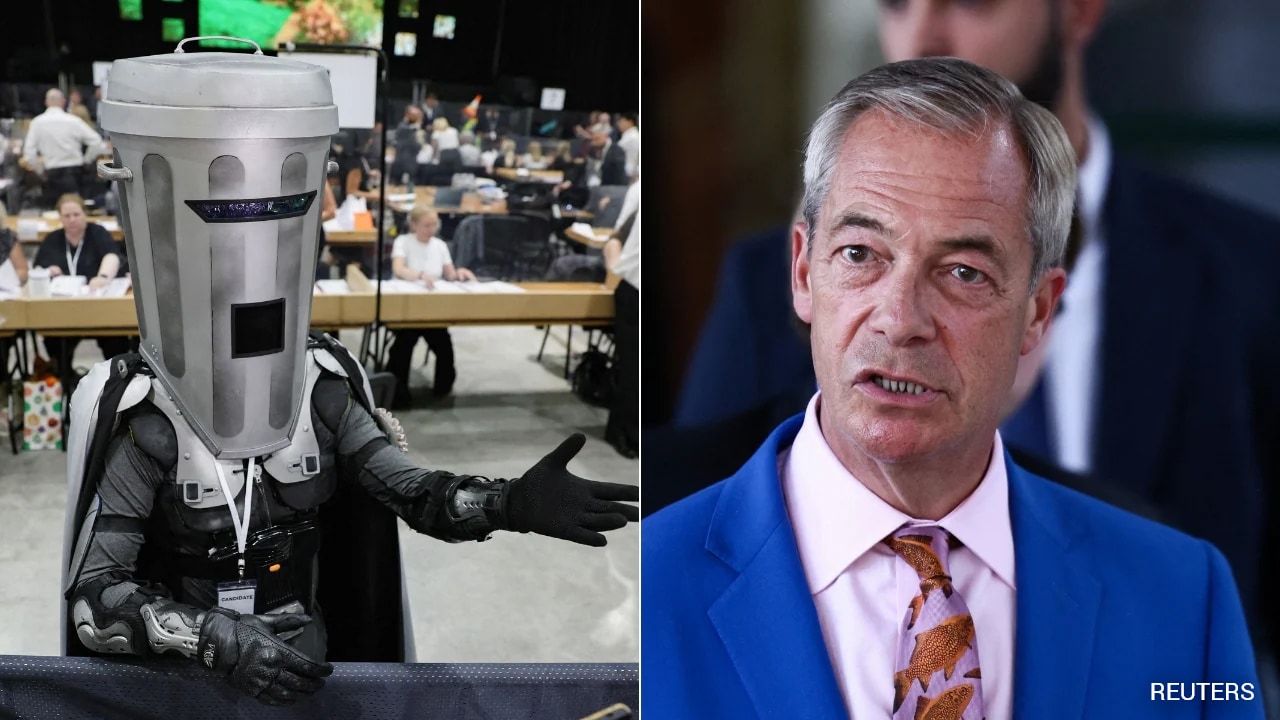
Political leverage depends on asymmetric conflict. When Nigel Farage resigned his parliamentary seat in Clacton to trigger a snap byelection, his strategic objective was to engineer a high-stakes, binary confrontation between himself and the British political establishment. This tactical move was designed to neutralize an intensifying parliamentary standards investigation into undisclosed financial benefits, including private security and housing assets linked to George Cottrell. By translating a regulatory liability into a populist referendum, Farage expected to secure a renewed democratic mandate that would render any subsequent parliamentary sanctions politically unviable.
The strategy collapsed because it miscalculated institutional game theory. Instead of accepting the challenge and validating the "people versus the establishment" narrative, the major political parties—Labour, the Conservatives, the Liberal Democrats, and the Greens—executed a coordinated boycott. By refusing to field candidates, the establishment starved the Reform UK leader of the friction required to generate political momentum. Farage is now trapped in an electoral vacuum where his primary competitor is Count Binface, a satirical novelty candidate wearing a garbage can. This structural failure isolates the populist leader, leaving him to fight an asymmetric war of absurdity where winning yields zero marginal utility, and any drop in his previous 46 percent voting share signals structural weakness.
The Cost Function of the Electoral Gambit
The decision to force a byelection carries compounding political costs without the possibility of an equivalent strategic return. Populist mechanics require a clear, institutional adversary to justify the mobilization of an insurgent base. The establishment's strategic withdrawal alters the operational environment across three distinct variables.
The Dilution of the Mandate
In a standard electoral contest, victory over mainstream parties validates a populist movement’s platform and operational viability. By removing themselves from the ballot, the established parties have commoditized the Clacton seat. A victory against an intergalactic parody candidate offers no empirical proof of shifting national sentiment. The absolute vote count will drop due to depressed overall turnout, weakening Farage's claim to a broader populist surge ahead of the 2029 general election.
The Asymmetry of Risk
The statistical distribution of outcomes is heavily skewed against the incumbent.
- The Ceiling: If Farage retains the seat with a substantial majority, the victory is dismissed as the predictable outcome of an uncontested race against a comedian. No new political capital is generated.
- The Floor: If a significant percentage of the electorate uses Count Binface as a proxy for an "anyone but Farage" protest vote, the Reform UK leader's perceived electoral invincibility is broken. If the satirical candidate manages to capture even a modest fraction of the anti-Reform electorate, the narrative shifts from a populist triumph to an embarrassing localized bottleneck.
The Regulatory Redundancy
The primary operational goal of the snap election was to bypass the House of Commons Committee on Standards. Under parliamentary rules, lawmakers must declare gifts exceeding £300 if they relate to political activities. The investigation centers on systemic financial support that Farage asserts was a personal gift for private security prior to his election. Triggering a byelection does not expunge the regulatory framework. Because the parliamentary standards inquiry automatically resumes upon a member's reelection, Farage has spent significant political capital to delay, rather than dissolve, his legal liability. If the inquiry subsequently recommends a suspension exceeding the statutory threshold, a second, legally mandated byelection will be triggered, rendering the current exercise entirely redundant.
Structural Incentives of the Cartel Boycott
The institutional response by the major political parties highlights a rare alignment of defensive interests. In standard political modeling, parties maximize utility by contesting every available seat to maintain brand visibility and organizational infrastructure. The decision to cede Clacton entirely reflects a calculated containment strategy.
The first strategic benefit for the establishment is narrative starvation. Populism thrives on friction, media polarization, and the optics of institutional suppression. By removing themselves from the ballot, the mainstream parties denied Farage the adversarial oxygen required to sustain a national media campaign.
The second structural benefit is the transfer of the accountability mechanism. Rather than spending resources on a localized campaign that Reform UK was statistically favored to win based on historical margins, the establishment opted to let the regulatory process do the work. If Farage wins the byelection, he returns to a Parliament where the cross-party standards committee still holds the authority to suspend him. By staying out of the race, the Prime Minister, Keir Starmer, and the opposition leader, Kemi Badenoch, have insulated their parties from an electoral defeat while preserving the institutional machinery that could ultimately unseat Farage through regulatory means.
The Absurdity Bottleneck: Facing the Novelty Candidate
The emergence of Count Binface as the primary challenger introduces an unpredictable variable into the populist playbook. Populist rhetoric is highly effective at deconstructing institutional failure, attacking bureaucratic elite groups, and exploiting economic grievances. It is structurally ill-equipped, however, to counter disciplined political satire.
When debating a traditional politician, a populist can weaponize voting records, policy failures, and establishment ties. When the opponent is a comedian campaigning on the nationalization of pop stars and capping the price of ice cream, traditional political attacks fail to land. If Farage engages with the caricature, he diminishes his authority as a serious political leader and potential future prime minister. If he ignores the challenger, he allows the satirical narrative to dominate the media cycle uncontested.
This creates a tactical bottleneck. The presence of a singular, absurd opponent transforms the entire election from a serious constitutional debate into a referendum on political farce. The international and domestic media focus inevitably shifts from Reform UK’s policy platforms to the spectacle of a prominent political figure defending his record against a man wearing a trash can.
The Next Strategic Play
The Clacton byelection has ceased to be an offensive weapon for Reform UK and has instead become an exercise in political containment. To minimize the long-term structural damage of this miscalculation, the optimal strategic play for Farage requires an immediate shift in operational focus.
First, the campaign must aggressively pivot away from the local contest and treat the August byelection as a purely administrative formality. Attempting to run a high-energy, localized campaign against a novelty candidate only amplifies the absurdity of the spectacle. Farage should minimize his physical footprint in Clacton, treat his reelection as an assumed conclusion, and redirect Reform UK's operational resources toward broader national issues and regional campaigns where the mainstream parties are actively competing.
Second, the leadership must prepare its defensive infrastructure for the resumption of the parliamentary standards investigation. Winning the seat will provide no protection against the legal reality of the financial disclosures regarding George Cottrell. The party must establish a rigorous, transparent internal auditing framework to address the funding allegations before the committee delivers its findings.
The establishment's boycott successfully transformed a planned populist coronation into an isolated, low-reward skirmish. The long-term viability of Reform UK depends on its ability to move past the Clacton bottleneck without letting a localized piece of political theater dictate the trajectory of its national strategy.