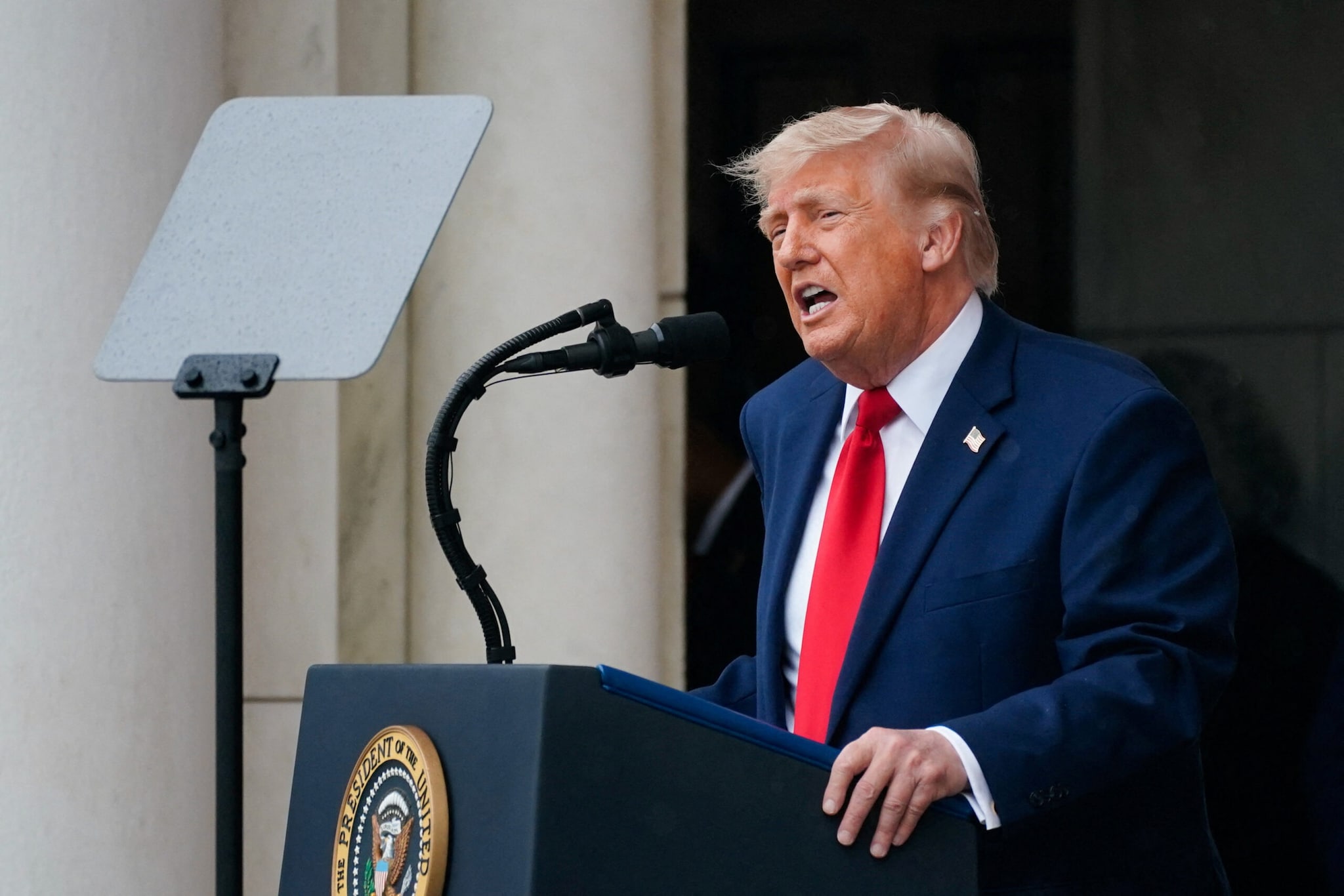
Political approval ratings operate as a lagging indicator of public tolerance for macroeconomic friction. When the executive branch initiated military strikes against Iran alongside regional allies on February 28, the immediate political fallout was masked by standard rally-around-the-flag dynamics. However, the subsequent structural closure of the Strait of Hormuz—a maritime chokepoint responsible for the transit of approximately 20 percent of the global petroleum supply—triggered a classic supply-side shock. This shock altered the domestic cost of living and triggered a rapid deterioration in executive approval ratings.
Data completed on June 8 reveals that President Donald Trump's approval rating has stagnated at 35%, hovering immediately above the absolute floor of his presidency (Lange, 2026b). The core mechanism driving this decline is not a sudden ideological shift among the electorate, but rather the rapid evaporation of the "economic premium" that historically anchored the administration's political coalition. By tracing the transmission vector from geopolitical friction to the retail gas pump, we can map how localized maritime disruptions erode political capital across both independent and partisan demographics.
The Transmission Vector: From Chokepoint to Pump
The relationship between geopolitical conflict and voter disapproval is mediated by a multi-stage economic transmission mechanism. Rather than responding to the abstract concept of foreign warfare, voters register discontent when military actions disrupt highly visible, inelastic consumer goods.
[Geopolitical Kinetic Action]
       │
       ▼
[Strait of Hormuz Shipping Closure]
       │
       ▼
[Global Crude Supply Contraction (Brent/WTI Surge)]
       │
       ▼
[Domestic Refining Cost Influx]
       │
       ▼
[Visible Retail Price Spikes ($4.30–$4.48 National Average)]
       │
       ▼
[Severe Erosion of Executive Economic Competency Rating]
1. The Crude Supply Contraction
The initial kinetic strikes triggered immediate retaliatory asymmetric counterattacks within the Persian Gulf, effectively halting commercial merchant transit through the Strait of Hormuz. Because global oil markets operate on highly optimized, just-in-time logistics, the sudden removal of a fifth of global supply caused benchmark crude indices like Brent and West Texas Intermediate (WTI) to surge. Even as fragile diplomatic maneuvers and a partial House resolution aimed at limiting executive military authority temporarily cooled markets down to approximately $97.14 per barrel for Brent crude, the baseline energy cost structure remains elevated relative to pre-war equilibriums (Livemint, 2026).
2. Retail Inelasticity and Fiscal Strain
Unlike discretionary purchases, retail gasoline features a high degree of price inelasticity; consumers cannot immediately alter their commuting patterns or supply chain dependencies. Consequently, national average retail gasoline prices escalated by over 44% from the onset of hostilities, climbing from a pre-war baseline of $3.17 to an average range between $4.30 and $4.48 per gallon (California Governor's Office, 2026; PBS News, 2026b).
This represents an aggregate domestic fuel expenditure surplus of over $29.2 billion—translating to an unhedged "war tax" of approximately $223 per American household (California Governor's Office, 2026). The localized economic pain is distributed unevenly, concentrated heavily within interior logistics hubs and agricultural states. For example, Ohio and Utah recorded retail price surges of 58.6%, directly squeezing consumer disposable income in regions critical to the incumbent coalition (California Governor's Office, 2026).
The Asymmetry of Cost-of-Living Polling
The political vulnerability of the administration is crystallized by the divergence between general partisan alignment and specific economic sentiment. An evaluation of contemporary polling data demonstrates that the traditional Republican advantage regarding macroeconomic stewardship has completely eroded.
- Cost-of-Living Disapproval: A striking 70% of Americans explicitly disapprove of the administration's management of domestic household costs, while only 22% express approval (Lange, 2026b).
- The Historical Comparison: This 22% approval rating undercuts the nadir of the previous administration. Former President Joe Biden concluded his term with a 29% approval rating on cost-of-living management, despite facing multi-year inflationary headwinds driven by post-pandemic supply chain bottlenecks (Lange, 2026b).
- The Benefit-to-Cost Deficit: While 36% of the electorate initially supported the kinetic strikes on Iran, only 25% state that the strategic benefits of the military campaign justify the downstream economic costs (Lange, 2026b).
This 11-point deficit between ideological approval of an action and the willingness to absorb its fiscal consequences represents the precise zone of political erosion.
The Electoral De-alignment Function
The political consequence of this energy-driven inflationary environment is a structural shift in congressional generic ballots. Independent voters, who lack rigid party loyalty, utilize retail energy costs as a proxy metric for executive competence.
Currently, 63% of independent voters directly attribute escalating retail fuel prices to executive policy decisions rather than external market dynamics, with nearly half assigning blame "a great deal" (PBS News, 2026b). This economic frustration has translated into a measurable shift on the generic legislative ballot, where Democrats currently lead Republicans by a margin of 41% to 37% (Lange, 2026b).
The primary structural bottleneck for the incumbent party is the erosion of its core base. Approximately 32% of self-identified Republicans and 26% of the president's 2024 voter base now attribute a substantial portion of the rising cost of living to the White House's foreign policy trajectory (PBS News, 2026b). When more than one in five Republicans disapprove of a signature executive foreign policy initiative, the cross-pressures prevent effective partisan mobilization (PBS News, 2026b).
Strategic Constraints on Market Normalization
Resolving this political vulnerability requires an immediate reduction in retail energy prices, a feat constrained by complex geopolitical realities. The administration faces a trilemma between maintaining regional deterrence, stabilizing global energy markets, and preserving domestic political viability.
The primary limitation of current administration strategies lies in the mechanical delay of maritime logistics. Naval escort operations—such as the recent U.S. mission to guide commercial vessels through the Strait of Hormuz—are highly sensitive to international coalition dynamics. The recent pause of these operations at the request of regional partners demonstrates that military force alone cannot reliably suppress the risk premium embedded in maritime insurance rates (PBS News, 2026b).
Furthermore, even if a formal memorandum of understanding or a credible written framework is achieved between Washington and Tehran—which energy analysts estimate could immediately remove a $5 to $6 geopolitical premium from crude benchmarks—the physical extraction of underwater naval mines and the restoration of normal shipping volumes introduces a multi-week lag before retail supply chains normalize (Livemint, 2026).
The administration's forward trajectory depends entirely on the execution speed of this diplomatic off-ramp. If talks stall and the Strait of Hormuz remains structurally impaired through the third quarter, depletion of domestic inventories will likely push benchmark crude prices back above the $100 threshold (Livemint, 2026). This scenario would solidify the current retail fuel pricing floor, permanently entrenching the cost-of-living grievance among independent swing voters and compounding down-ballot vulnerability ahead of the November legislative elections.
References
California Governor's Office. (2026, April 30). 61 days later, no plan: Trump's Iran war drives national gas prices to a four-year high, sending prices soaring across the economy. https://www.gov.ca.gov/2026/04/30/61-days-later-no-plan-trumps-iran-war-drives-national-gas-prices-to-a-four-year-high-sending-prices-soaring-across-the-economy/
Lange, J. (2026b, June 8). Trump approval stays near record low as most Americans expect higher gas prices. Reuters. https://wiky.com/2026/06/08/trump-approval-stays-near-record-low-as-most-americans-expect-higher-gas-prices/
Livemint. (2026, June 4). Oil prices fall amid US-Iran peace talks hopes; Brent at $97. Where are prices headed? https://www.livemint.com/market/commodities/oil-prices-fall-amid-us-iran-peace-talks-hopes-brent-at-97-where-are-prices-headed-11780544302904.html
PBS News. (2026b, May 11). About 2 in 3 Americans blame Trump for rising gas prices. https://www.pbs.org/newshour/politics/6-in-10-americans-disapprove-of-how-trump-is-handling-iran-new-poll-finds