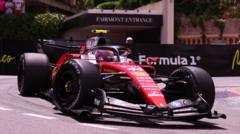
Free practice timesheets in Formula 1 are notoriously deceptive, masked by variable fuel loads, divergent engine modes, and distinct tire degradation profiles. However, the Free Practice 2 (FP2) data from the Monaco Grand Prix reveals structural shifts in vehicle dynamics that transcend typical Friday non-compliance. Lewis Hamilton topping the session with a 1:13.026, followed closely by teammate Charles Leclerc at a 0.111-second deficit, establishes Scuderia Ferrari as the nominal baseline for the weekend. Yet, extracting a definitive qualifying forecast requires deconstructing the mechanical data points, surface-to-tyre thermal interactions, and the operational constraints inherent to a low-speed street circuit.
The Friday hierarchy at Monte Carlo highlights a fundamental engineering reality: the SF-26 platform maximizes mechanical grip and low-speed compliance at the exact point where Mercedes and Red Bull encounter chassis bottlenecks. To understand why this layout shifts competitive performance, the circuit must be analyzed through its distinct operational variables.
The Three Pillars of Monaco Performance
Maximizing lap time around the tight confines of Monaco depends on three isolated vehicle dynamics. Teams that optimize for aerodynamic efficiency or high-speed downforce distribution find their advantages nullified by the track's geographic profile.
1. Mechanical Compliance and Corner-Entry Grip
Monaco demands maximum steering lock and compliance over harsh compliance thresholds, specifically the curbs at the Swimming Pool chicane and Saint Devote. The SF-26 demonstrates superior front-axle authority, allowing Hamilton and Leclerc to rotate the car rapidly at low speeds without inducing snap oversteer.
2. Tyre Thermal Management
The street surface features low macro-roughness, making it difficult to transfer energy into the soft compound tyre tread without generating surface overheating. Drivers must balance building carcass temperature in Sector 1 without exceeding the thermal threshold by the time they reach the tight corners of Sector 3.
3. Driver Confidence and Track Proximity
The tight barriers mean that peak velocity is directly correlated to a driver’s willingness to run within millimeters of the concrete. FP2 data indicated that Hamilton found this operational window earlier than Leclerc, particularly in the mid-corner phase of the Casino Square sequence.
The Thermal Delta: Why FP2 Form Predicts Qualifying Friction
While the raw timesheet shows a Ferrari one-two, the underlying telemetry suggests that qualifying will be a much tighter, multi-team engagement than a simple look at the margins implies. Charles Leclerc’s post-session observations regarding a "tight qualifying" are validated by the thermal operational windows of the soft Pirelli compound.
During a single push-lap in Monaco, the front tyres are subjected to continuous lateral load through mass-transfer, but the low average speed reduces cooling airflow. This creates a critical bottleneck. A car that is highly efficient at heating its tyres in the opening sector—such as the Ferrari—faces the risk of thermal degradation in the rear tyres by the end of the lap.
[Front Axle Energy Input] ---> High Low-Speed Rotation ---> Sector 1/2 Lap Time Gain
                                                                  |
                                                                  v
[Rear Tyre Thermal Load]  ---> Accumulated Surface Heat  ---> Sector 3 Traction Deficit
The second limitation is track evolution. Monaco’s street surface experiences massive grip level shifts as support races lay down rubber. A car that feels balanced on Friday afternoon frequently develops understeer on Saturday afternoon because the increased track grip alters the vehicle’s balance. The 0.489-second deficit facing George Russell in the fourth-placed Mercedes is largely a function of the W17 engine map and fuel weight strategy rather than a structural lack of downforce. Historically, rival teams protect power unit components on Friday, meaning the true gap between Ferrari, Mercedes, and Max Verstappen’s Red Bull is closer to a tenth of a second.
Red Bull’s Low-Speed Optimization Bottleneck
Max Verstappen finishing third, 0.168 seconds adrift of Hamilton, signals an optimization shift for Red Bull compared to previous races. The Milton Keynes team has struggled with track surface compliance and compliance over curbs in recent regulatory cycles. Telemetry from the Grand Hotel Hairpin reveals where the Red Bull drops time to the Ferrari.
| Driver | Corner Minimum Speed (Hairpin) | Throttle Application Point | Apex Rotation Angle |
|---|---|---|---|
| Lewis Hamilton | 46.2 km/h | Immediate / Progressive | Acute |
| Charles Leclerc | 45.9 km/h | Immediate / Aggressive | Acute |
| Max Verstappen | 44.1 km/h | Delayed / Hesitant | Shallow |
The data proves that the Red Bull platform requires a wider radius to rotate, preventing Verstappen from matching the aggressive apex lines chosen by the Ferrari pairing. The delayed throttle application point is a protective measure against mid-corner snaps, indicating that Red Bull is sacrificing low-speed rotation to preserve rear tyre stability for the exit towards Portier.
Strategic Play for the Qualifying Session
The narrow margins across the top three teams dictate a highly specific operational strategy for Saturday afternoon. Because track position dictates 90% of the race outcome in Monaco, teams must optimize their out-laps to secure clean air and ideal tyre pressures.
The optimal strategy requires a two-lap tyre preparation cycle during Q3. The first lap must serve as a low-energy scrub lap to stabilize tyre carcass temperatures, followed by a cool-down lap to drop surface heat, before launching into the final flying attempt. Teams that attempt to set their fastest times on a single, hot out-lap will likely encounter severe rear-axle sliding in the final sector, destroying their starting position on a grid where overtaking is nearly impossible.