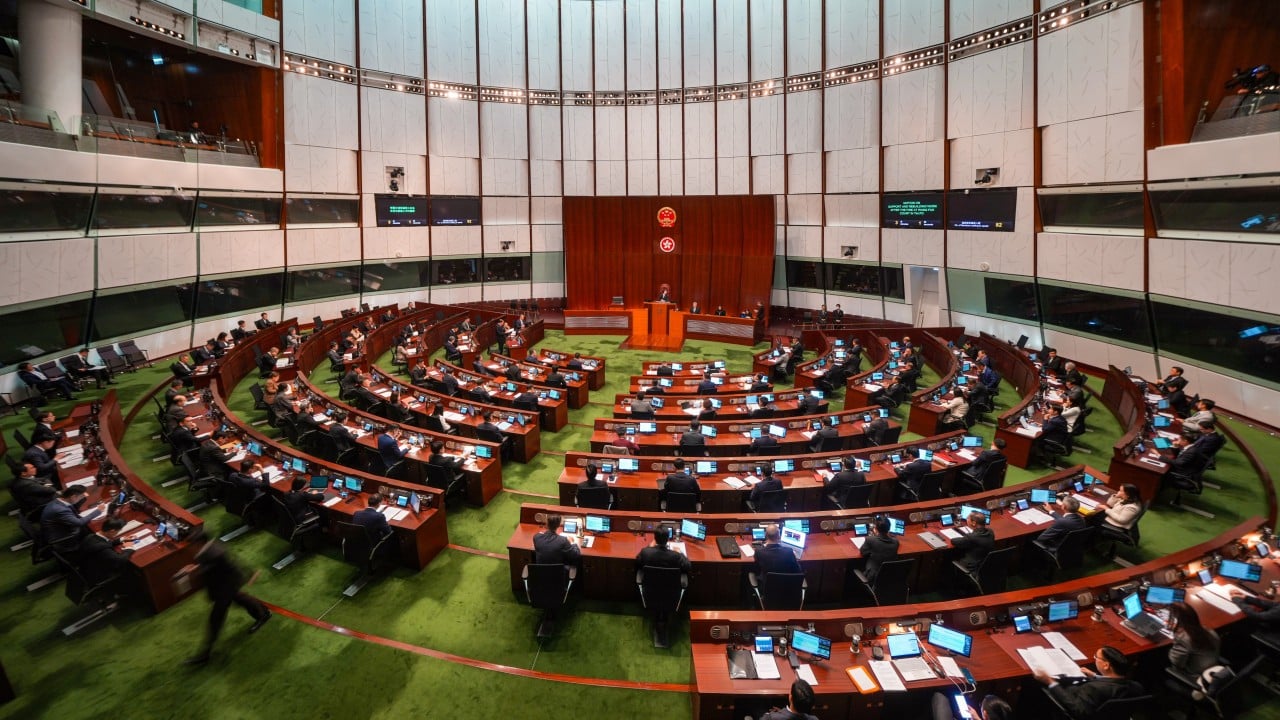
Hong Kong is fundamentally redefining its legislative role from a passive regulatory body into an active instrument of state-directed economic planning. The upcoming July 19 to 25 national affairs study visit to Beijing—the first collective delegation of all 90 Legislative Council (Legco) members since 1997—is not merely a symbolic diplomatic exercise. It represents a structural mechanism designed to align Hong Kong’s municipal governance directly with mainland China’s macroeconomic frameworks. By embedding legislative leaders within the central government’s state planning apparatus, the administration is establishing a top-down operational pipeline to draft, ratify, and implement Hong Kong’s inaugural local five-year development blueprint, ensuring absolute integration with the national 15th Five-Year Plan.
Understanding this institutional shift requires moving past political headlines to dissect the underlying economic mechanisms. The trip, budgeted at a lean HK$1.4 million (approximately HK$15,600 per lawmaker), functions as a specialized executive briefing. The objective is to translate Beijing's high-level mandates into granular regulatory, fiscal, and infrastructure policies back in Hong Kong.
The Structural Framework of Legislative Integration
The mechanics of this coordination operate across three distinct operational layers. Each layer corresponds to a specific deficit in Hong Kong's legacy governance model, which historically favored a laissez-faire approach over highly structured industrial planning.
+-----------------------------------------------------------------+
|                    REGULATORY ALIGNMENT LAYER                   |
|  Liaison with HK & Macau Work Office / State Council HKMAO      |
+-----------------------------------------------------------------+
                                |
                                v
+-----------------------------------------------------------------+
|                    MACROECONOMIC POLICY LAYER                   |
|  Seminars on National Security, Geopolitics, and Digital China  |
+-----------------------------------------------------------------+
                                |
                                v
+-----------------------------------------------------------------+
|                    INDUSTRIAL EMULATION LAYER                   |
|  Site Inspections: Aerospace, EV Transport, Embodied AI, YMTC   |
+-----------------------------------------------------------------+
The Regulatory Layer
Lawmakers will interface directly with the Hong Kong and Macau Work Office of the Communist Party of China Central Committee and the State Council’s Hong Kong and Macau Affairs Office (HKMAO). This formal linkage removes previous bureaucratic intermediaries. It establishes a direct feedback loop where draft local legislation can be pre-vetted or conceptually aligned with mainland legal frameworks, notably regarding cross-border data flows and national security protocols.
The Macroeconomic Layer
Structured seminars will focus on the operationalization of "Digital China" frameworks and the formulation mechanics of national five-year plans. This serves as an immediate instructional template. The Hong Kong government plans to launch a public consultation on its own local five-year blueprint by early June, making this mid-July trip the critical execution phase where lawmakers gather the inputs required to process the upcoming public consultation data.
The Industrial Emulation Layer
The delegation will inspect specific high-technology verticals that Beijing categorizes as "new quality productive forces." The choice of these sectors signals the exact industrial capabilities the central government expects Hong Kong to finance, incubate, or legally facilitate.
Deconstructing the Industrial Targets
The focus on technological sectors reveals where Hong Kong’s capital markets and legal infrastructure will be directed over the next decade. The choice of verticals represents a deliberate strategy to position Hong Kong as the global capital capitalization node for state-supported industries.
- Aerospace Manufacturing and Supply Chains: Following recent massive public listings of mainland aerospace component manufacturers, Hong Kong is being positioned as the primary offshore financing venue for China’s commercial aviation push. Legco will need to evaluate how local aviation regulations and maritime logistics can integrate with mainland aerospace supply chains.
- Information Technology Application Innovation (ITAI): As mainland China aggressively pursues hardware and software self-reliance, Hong Kong must shift its internal municipal IT infrastructure away from Western enterprise software toward domestic alternatives. Lawmakers will examine the deployment velocity of mainland enterprise databases and operating systems to standardize local public sector procurement.
- Advanced Semiconductor and Memory Architecture: With mainland entities like Yangtze Memory Technologies Corp (YMTC) and ChangXin Memory Technologies (CXMT) preparing for substantial market maneuvers amid global supply constraints, Hong Kong’s role is shifting. Legco must build regulatory frameworks that protect intellectual property while facilitating capital raises for these critical semiconductor anchors.
- Embodied Artificial Intelligence and Green Transport: The inspection of humanoid robotics engineered for commercial applications and new-energy logistics vehicles points to a broader transition. Hong Kong’s role is to act as the initial testing ground for international product compliance, using its unique common law jurisdiction to certify mainland AI and electric vehicle assets for global export.
The Policy Bottlenecks and Structural Friction
A rigorous analysis must account for the substantial execution risks inherent in this alignment strategy. Merging a common-law, free-port economy with a state-directed, highly centralized macroeconomic plan creates immediate operational friction.
The primary structural bottleneck is the mismatch in capital allocation velocity. Mainland industrial planning relies heavily on state-directed credit, state-owned enterprise (SOE) capital expenditure, and local government financing vehicles. Hong Kong, conversely, operates on a market-driven allocation model governed by international institutional equity and private asset management.
When Legco attempts to mandate or heavily incentivize investments into specific "new quality productive forces," it risks capital flight if market-clearing returns do not align with political priorities. This tension is already visible in Hong Kong's equity markets, where tech optimism frequently outpaces actual corporate earnings growth.
The second limitation involves regulatory divergence in data governance and artificial intelligence oversight. Mainland China’s "Digital China" strategy demands centralized data aggregation and strict sovereignty controls. For Hong Kong to maintain its status as an international data hub and financing center, it must preserve a distinct legal regime that permits relatively unhindered international data transit.
Legco faces the complex task of drafting a local five-year blueprint that satisfies national security mandates without compromising the legal separation that makes the city attractive to foreign capital.
The Strategic Path Forward
The Legislative Council must avoid treating this study visit as a passive educational seminar. To maximize the institutional return on this historical deployment of political capital, lawmakers must execute a precise three-part strategy upon their return.
First, Legco must establish a dedicated Joint Committee on National Plan Integration immediately following the July recess. This body should be tasked with translating the insights gained from the HKMAO and the National People's Congress into a legal checklist for the upcoming local five-year development blueprint consultation. This ensures that the public feedback collected in June is evaluated against the hard realities of Beijing's macroeconomic targets.
Second, the legislature must fast-track regulatory sandboxes specifically designed for the cross-border deployment of mainland autonomous systems and embodied AI. If Hong Kong is to serve as a global launchpad for these technologies, it must provide a regulatory environment where mainland firms can test compliance under international legal standards before seeking global export.
Finally, fiscal policy must be adjusted to match the targeted industrial pillars. Lawmakers should structure tax incentives and co-investment frameworks through the Hong Kong Investment Corporation to de-risk private sector capital entering deep-tech sectors like semiconductor logistics and aerospace manufacturing. By actively matching public capital with targeted mainland initiatives, Hong Kong can bridge the gap between state-directed planning and market-driven execution.