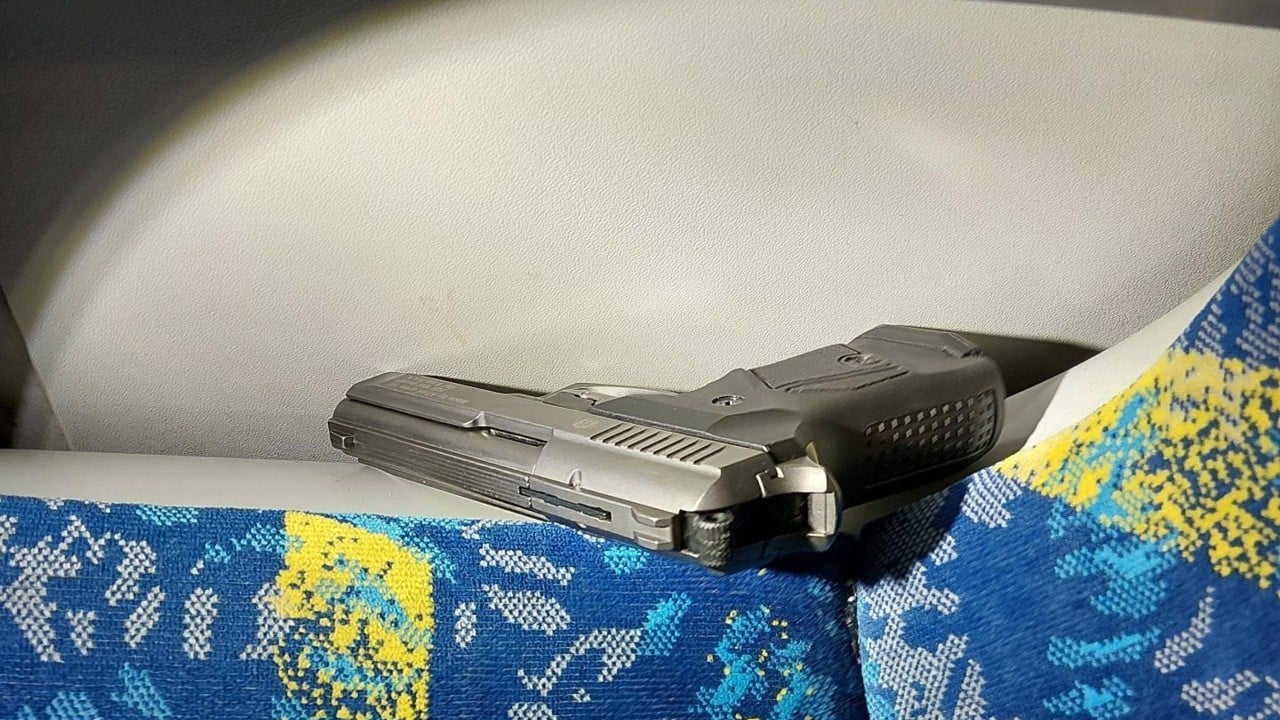
Steel.
It is the first thing you notice when a high-speed train grinds to an unscheduled halt in the middle of the German countryside. Not the sleek, aerodynamic steel of the carriage that was carrying you at two hundred kilometers an hour toward your weekend, your family, or your morning meeting, but the cold, matte-black steel of submachine guns pressed against the shoulders of tactical police officers sprinting down the gravel embankment. Don't forget to check out our earlier coverage on this related article.
Minutes earlier, the carriage had been a cocoon of mundane European transit. A woman in row four was nursing a lukewarm paper cup of coffee. A student near the luggage rack was scrolling through lecture notes, his noise-canceling headphones sealing him off from the rhythmic clatter of the tracks. Across the aisle, a man shifted his jacket, and for half a second, a bystander caught a glimpse of a dark, sculpted grip tucked into a waistband.
That half-second was all it took. If you want more about the history here, The Washington Post offers an informative summary.
In the modern psychology of public transit, certainty is a luxury nobody can afford. The passenger who spotted the grip did not pause to analyze the bore diameter of the barrel, the presence of a safety plug, or the specific markings etched into the slide. Why would they? Under the fluorescent glare of a moving train car, a Schreckschusspistole—a German blank-firing alarm gun—looks entirely, indistinguishable from a lethal nine-millimeter semi-automatic.
So the call went out. Within minutes, the invisible machinery of German federal security snapped shut around the train. Switches were locked. Signals turned crimson. Entire regional rail corridors froze in place as the Bundespolizei descended on the platform, evacuating hundreds of commuters into the chilly air while armed units breached the carriages.
When they finally pinned the man down and confiscated the weapon, the truth emerged. There were no live rounds. No magazines packed with copper-jacketed lead. Just a legally purchased blank-firing pistol, designed to make a deafening bang and spit a harmless flash of gas, carried without the mandatory Kleiner Waffenschein—the small firearms license required in Germany to carry such a device in public.
To read the standard police blotter the next morning, you would think the incident was little more than a bureaucratic footnote. A minor weapons violation. A delayed train. Case closed.
You would be wrong.
The Illusion of the Harmless Replica
To understand why a non-lethal noisemaker triggers an armed tactical response across Germany with alarming regularity, you have to understand a strange legal and cultural paradox at the heart of the country's gun laws.
Germany maintains some of the strictest firearm regulations in the Western world. Acquiring a live handgun requires months of background checks, psychological evaluations, proof of legitimate need, and rigorous safety training. Yet, walk into a licensed sporting goods store or browse an online retailer as an adult over eighteen, and you can legally buy an exact replica of a Walther P99 or a Glock 17 over the counter.
These are alarm guns, or Schreckschusswaffen. Originally marketed for New Year's Eve celebrations, dog training, or personal deterrence, they fire blank cartridges filled with gunpowder and tear-gas irritants. They are engineered to mimic the weight, balance, blowback action, and metallic acoustics of real firearms down to the millimeter.
Consider a hypothetical commuter—let us call him Lukas—who buys one after reading alarming headlines about late-night street crime. Lukas leaves the shop feeling safer. He slips the heavy replica into his coat pocket before boarding a regional express train, unaware or indifferent to the fact that while owning the gun at home is legal without a permit, carrying it outside his front door without a Kleiner Waffenschein is a criminal offense under the German Weapons Act.
Lukas thinks he is carrying a loud whistle shaped like a pistol.
Every single person around him sees a mass shooting waiting to happen.
This gap between the carrier's intent and the public's perception is where chaos breeds. I have stood on platforms in Frankfurt and Cologne when an unannounced security cordon snaps into place, watching the immediate, visceral shift in the crowd. One moment, commuters are complaining about a five-minute delay; the next, someone whispers the word Waffe—weapon—and the air turns electric with panic. People abandon suitcases. Parents hoist toddlers onto their hips and run toward the exits, their faces pale with a dread imported from every breaking-news alert of the last decade.
Anatomy of an Emergency
Police officers responding to a call about an armed passenger on a train do not have the luxury of assuming the weapon is a toy.
In law enforcement training, this is known as the lethal-force dilemma. If a tactical unit boards a crowded carriage and confronts a suspect drawing a matte-black pistol from his belt, the officers have roughly three-quarters of a second to process the threat, evaluate the backdrop of innocent passengers, and decide whether to pull their triggers. At three meters, under high adrenaline, the human eye cannot differentiate between a blocked barrel meant for blanks and an open barrel meant for bullets.
Think about what that means for the man carrying the alarm gun. By bringing a realistic replica onto a public train, he has unwittingly placed himself inside a high-stakes tragedy where a single sudden movement could end his life, and where an officer could be forced to live with the trauma of shooting someone who was never armed with live ammunition.
The ripple effects extend far beyond the carriage walls. When the federal police shut down a major rail artery in Germany, the disruption cascades through the national grid like a clot in an artery.
- Immediate Tactical Lockdown: Specialized units, often backed by helicopters and K9 teams, must clear every single compartment before the train can move an inch.
- Network Paralysis: Because German high-speed and regional trains share heavily congested corridors, a single halted train in North Rhine-Westphalia or Bavaria can strand tens of thousands of travelers across three states within an hour.
- Severe Legal Fallout: Even though no shots were fired, the suspect faces criminal prosecution for illegal possession of a weapon in public, alongside staggering civil liability bills. Deutsche Bahn and the federal police routinely pursue offenders for the operational costs of the deployment—bills that easily climb into the tens of thousands of euros.
The man on the train likely wanted to feel powerful, or perhaps simply protected. Instead, he triggered a multi-agency counter-terrorism protocol and wrecked the schedules of thousands of strangers.
The Weight of Collective Memory
Why does a glimpse of metal on a train provoke such an immediate, overwhelming response in Germany?
History casts a long shadow over German public spaces, but recent memory casts an even sharper one. Over the past decade, European rail networks have shifted from symbols of borderless freedom into soft targets in the public imagination. From the thwarted Thalys train attack in 2015 to knife assaults on regional commuters in Würzburg and Brokstedt, the confined geography of a train carriage carries a unique psychological vulnerability.
On a street, you can run in four directions. On a train moving at speed, there are only two directions—forward or backward—and both end at a locked steel door.
When you trap three hundred strangers in a narrow tube and introduce the silhouette of a handgun, evolutionary survival instincts override rational thought. Nobody stops to debate German firearms classification. They call the emergency number, pull the brake, or run.
As a society, we often struggle to regulate objects that exist in the gray zone between toy and weapon. Lawmakers in Berlin have repeatedly debated tightening restrictions on Schreckschusswaffen, proposing everything from mandatory permits just to purchase them to brightly colored muzzle markings that would instantly distinguish replicas from live firearms. Critics argue that criminals would simply paint over orange tips, while sport shooters and collectors insist that responsible owners shouldn't be punished for the recklessness of a few.
Yet while the legislative debate stalls in committee rooms, the reality on the tracks remains unchanged. Millions of blank-firing pistols remain in circulation across German households, easily accessible and endlessly misunderstood by the very people who buy them for "self-defense."
What Happens When the Doors Finally Open
Eventually, the tension breaks.
The tactical teams lower their weapons. The suspect is led off the platform in handcuffs, blinking against the cameras of bystanders peering from behind police tape. An hour or two later, the station loudspeakers crackle back to life, apologizing in that familiar, measured monotone for the delay caused by a Polizeieinsatz—a police operation.
Passengers file back onto the train. They retrieve their abandoned backpacks, take their seats, and stare out the window as the scenery begins to blur once more. On the surface, order has been restored. The system worked. Nobody was hurt.
Look closer at the carriage, though, and you will see what lingered behind after the police packed up their gear. You will see the woman in row four gripping her bag a little tighter against her chest. You will see the student keeping one earbud out, scanning the aisle every time the sliding doors hiss open between compartments.
A blank-firing gun never leaves a bullet hole, yet every time one appears on a train, it punches another quiet, invisible fracture into the trust that allows strangers to sit side by side in the dark at two hundred kilometers an hour.