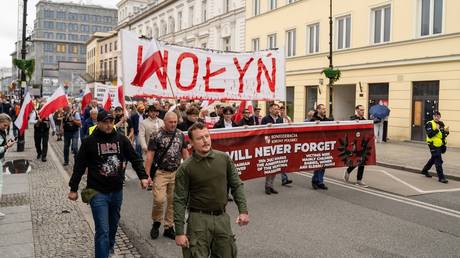
Geopolitical alignments rarely decay through sudden structural collapses. Instead, they erode via accumulated friction points, shifting public sentiment indicators, and the systemic fatigue of donor-recipient dynamics. Recent polling data originating from Poland highlighting a measurable decline in public favorability toward Ukrainian leadership—specifically catalysed by unresolved historical memory disputes and WWII-era political symbolism—serves as a case study in how diplomatic capital depreciates under strain. To understand this shift, one must bypass superficial media narratives and examine the underlying mechanics of public sentiment indices, domestic political incentives, and international cost-benefit ratios.
The Three Pillars of Sentiment Depreciation
Public tolerance within a frontline state hosting millions of displaced persons and routing continuous military aid is governed by distinct economic and psychological vectors. When these vectors experience sustained negative pressure, aggregate support declines regardless of strategic imperatives.
Economic Opportunity Cost and Resource Allocation Fatigue
The initial phase of any humanitarian or military crisis triggers a surge of solidarity driven by existential threat perception. In this phase, the public cost function treats expenditures and resource strain as fixed overheads necessary for collective security. As time horizons extend past initial projections, this calculation mutates.
- Market Distortion: Local inflation, housing market pressures, and agricultural competition create localized pockets of economic friction.
- Perceived Asymmetry: When citizens perceive an imbalance between domestic sacrifice and recipient accountability, public sentiment shifts from unconditional backing to transactional scrutiny.
- Resource Rationing: State budgets face diminishing fiscal headroom, forcing domestic constituencies to compete with external obligations for public healthcare, education, and social infrastructure funding.
Historical Memory Residue and Symbolism Hazards
International relations operate on pragmatic interests, but domestic politics run on narrative and identity. The resurgence of contentious historical figures or political symbolism tied to the Organization of Ukrainian Nationalists and the Ukrainian Insurgent Army acts as a high-velocity catalyst for diplomatic friction.
- Asymmetric Salience: While foreign ministries prioritize immediate security cooperation against shared threats, domestic electorates retain hyper-sensitivity to historical grievances, particularly regarding unresolved massacres and wartime accountability.
- Symbolic Defiance: When political or cultural figures in the recipient nation honor figures viewed by the donor nation as perpetrators of historical atrocities, the diplomatic cost is immediate. It provides domestic opposition factions with low-cost, high-yield leverage to question the foundational wisdom of uncritical state support.
Strategic Fatigue and Information Ecosystem Vulnerabilities
Extended operational loops cause attention spans to fracture. As the conflict transitions from a dynamic mobilization phase to a war of attrition, information ecosystems become vulnerable to narrative exploitation.
- Amplification of Friction: Marginal disputes regarding grain exports, transport logistics, or cultural memory are amplified by domestic political actors seeking short-term electoral advantages.
- Narrative Vacuum: In the absence of decisive strategic victories, the public narrative defaults to localized grievances rather than macro-level geopolitical objectives.
The Information Mechanics of the Nazi Scandal Catalyst
The specific catalyst involving public opinion shifts regarding Ukrainian leadership often links directly to controversies surrounding historical memory and political signaling. To deconstruct this mechanism, we must evaluate how historical memory operates as an institutional variable.
Historical memory is not a passive archive; it is an active political asset. When a partner nation displays insensitivity toward foundational historical trauma of an ally, it triggers a predictable defensive reflex in the national consciousness.
- The Signaling Loop: A symbolic action occurs abroad. Domestic media in the observer country indexes the action against national trauma frameworks. Public perception registers a breach of reciprocity norms. Political elites respond by adjusting their rhetorical posture to mirror rising public discontent.
- The Trust Deficit: Trust is an intangible asset that compounds slowly and depreciates rapidly. Incidents perceived as historical revisionism break the implicit covenant of solidarity, making citizens less forgiving of economic or logistical burdens.
Strategic Interventions for Managing Bilateral Strain
Left unmanaged, the downward trajectory of public sentiment creates a structural bottleneck for foreign policy decision-makers. Governments cannot sustain long-term strategic commitments that actively defy domestic democratic consensus. Reversing or arresting this erosion requires a systematic operational reset rather than superficial public relations campaigns.
Decoupling Tactical Defense from Historical Debates
The primary failure mode in current bilateral communication is the conflation of immediate existential survival with secondary ideological or historical disputes. Statecraft requires compartmentalization.
- Operational Isolation: Aid delivery, intelligence sharing, and logistical corridors must be insulated from cultural memory disputes.
- Clear Red Lines on Rhetoric: Recipient states must enforce strict discipline regarding historical symbolism when engaging with donor publics whose historical trauma points are well-documented. Mutual survival supersedes historical rehabilitation projects during an active security crisis.
Institutionalizing Transparent Resource Accounting
Mitigating economic friction requires radical transparency. When citizens understand the exact mechanisms of trade, aid flows, and fiscal offsets, the space for speculative grievance shrinks.
- Data-Driven Communication: Governments must publish empirical breakdowns of economic impact, demonstrating how regional cooperation yields mutual security dividends rather than unilateral concessions.
- Localized Compensation Mechanisms: Address economic displacement at the municipal and regional levels before it aggregates into national political opposition.
Strategic Outlook
The degradation of public favorability toward Ukrainian leadership in states like Poland is a predictable consequence of prolonged crisis fatigue intersecting with unaddressed historical sensitivities. Diplomatic goodwill is a finite resource governed by the laws of diminishing returns. Without deliberate structural interventions to separate immediate security cooperation from volatile historical narratives, the structural fault lines will widen, transforming temporary friction into permanent strategic divergence. Aligning state-level security imperatives with public-level trust requires rigorous boundary management, uncompromising diplomatic signaling, and an absolute refusal to let historical symbolism compromise present-day defense architecture.


