Biosecurity interventions fail not at the level of molecular biology, but at the point of community friction. The arson attack on the Rwampara General Hospital treatment center on the outskirts of Bunia, Ituri Province, underscores a predictable breakdown in epidemic management. When external institutional mandates collide with deeply entrenched local customs, the resulting friction destroys physical assets, drives medical personnel from the field, and accelerates the geometric spread of contagion.
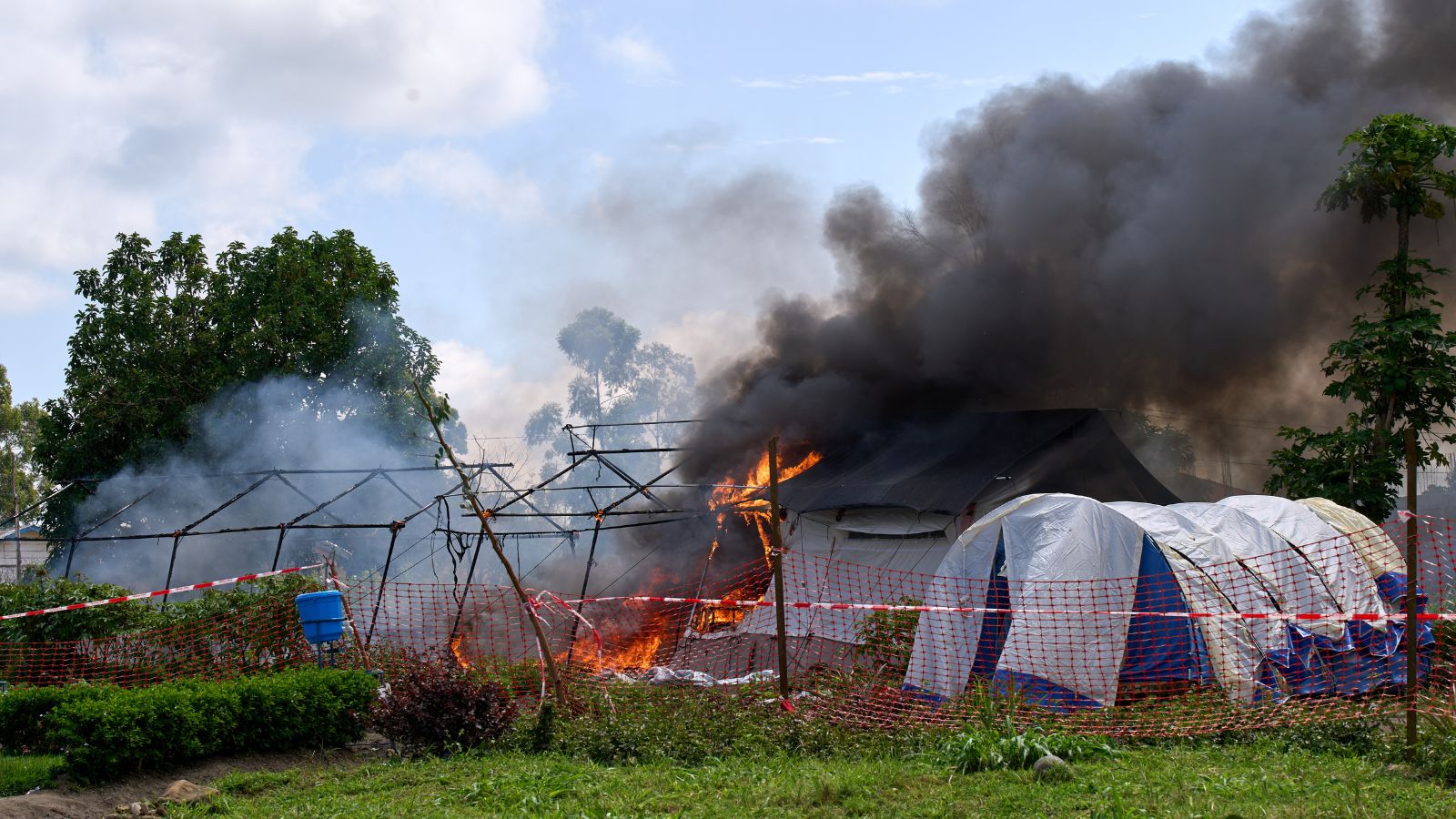
The incident in the Democratic Republic of the Congo (DRC) is an unvarnished case study in containment failure. Driven by the refusal of medical authorities to surrender the corpse of a local man to his family, a crowd of youths overran the facility, torched isolation tents, and incinerated medical infrastructure. Understanding this event requires discarding superficial narratives of "unruly crowds" and examining the structural mechanics of public health resistance.
The Epidemiology of Post-Mortem Transmission
To understand why health authorities refuse to release corpses, one must examine the specific transmission physics of the Ebola virus. The current outbreak, linked to the Bundibugyo strain, carries a high case-fatality rate for which there is currently no approved vaccine.
The biological reality of the virus dictates that viral load does not drop at the moment of death; it peaks. The corpse of an Ebola victim is a highly concentrated vector of infection.
The transmission mechanics of post-mortem exposure follow a distinct sequence:
- Systemic Cellular Lysis: As the patient succumbs, massive viral replication causes widespread cellular breakdown. The skin, blood, and bodily fluids are heavily saturated with active viral particles.
- Traditional Preparation Friction: Local burial customs dictate that family members wash, shroud, and closely interact with the body. This process involves direct mucosal contact with highly infectious secretions.
- Super-Spreader Funerals: Large communal gatherings where mourners touch the deceased convert a single casualty into an exponential cluster of new infections.
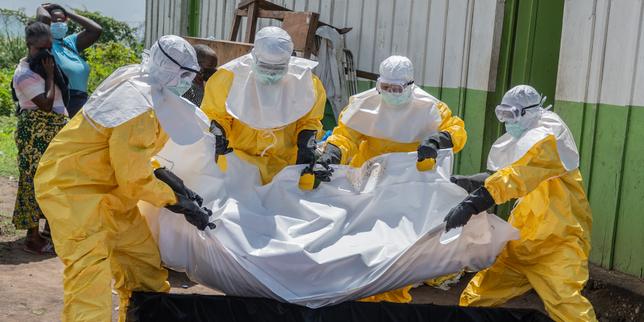
Because traditional funerary practices act as a transmission multiplier, international protocols require Safe and Dignified Burials (SDB) executed by specialized, personal protective equipment (PPE)-clad teams. However, removing a corpse from the family structure severs a vital social contract. For the community, an institutional burial is not health preservation; it is a forced disappearance that desecrates ancestral obligations.
The Structural Anatomy of Local Resistance
The destruction of the Rwampara treatment facility is a manifestation of institutional distrust and operational bottlenecks. This resistance is driven by two distinct structural pillars.
The Misinformation Feedback Loop
In areas isolated by conflict and historical underinvestment, external medical interventions are rarely viewed as altruistic. Local political figures note that a segment of the remote population views Ebola as an exogenous invention—a fabricated crisis designed to generate funding for foreign non-governmental organizations (NGOs) and corrupt local actors.
When people enter an isolation facility and emerge in body bags, the hospital is perceived not as a center for healing, but as a execution chamber. When authorities withhold the body, it confirms the community's worst suspicion: organs are being harvested, or a hoax is being covered up.
The Institutional Capacity Deficit
The outbreak occurs within a broader humanitarian crisis characterized by armed conflict and mass population displacement. This creates severe logistical vulnerabilities:
[Systemic Funding Cuts] ➔ [Surveillance Stalled] ➔ [Undetected Community Spread]
                                                             │
[Overwhelmed Isolation Wards] 🔀 [Delayed Diagnostics] 🌁 🔀 ──┘
The International Rescue Committee reported that funding cuts forced the suspension of surveillance activities in three out of five critical zones in Ituri over the past year. Consequently, health networks cannot detect cases early.
Patients arrive at hospitals in late-stage hemorrhaging and vomiting, frequently misdiagnosing their symptoms as malaria. By the time they enter a facility like Rwampara, death is imminent. The extreme speed of mortality fuels the community perception that the hospital itself kills the patient.
The Strategic Failure of Enforcement-Led Biosecurity
When the crowd assembled at Rwampara to demand the body, the state’s default response was kinetic deterrence. National police deployed tear gas and fired warning shots to disperse the crowd. This escalation completely failed to protect the facility.
State Kinetic Deterrence (Tear Gas/Warning Shots)
        │
        ▼
Escalation of Local Hostility
        │
        ▼
Physical Breach of Facility
        │
        ▼
Destruction of Infrastructure & Disruption of Care
The deployment of state force against a grieving population validates local narratives of oppression. When the police failed to hold the perimeter, the crowd did not merely retrieve the body; they burned the facility's isolation tents and destroyed specialized medical equipment.
A critical operational consequence of this chaos is asset liquidation. Six active Ebola patients were inside the isolation tents when the fire was set. While the medical charity ALIMA confirmed these patients were accounted for and relocated, the physical destruction of isolation capacity severely degrades the region's total containment bandwidth. Nearby hospitals are already operating at maximum capacity, reporting zero available beds for incoming suspected cases.
The retreat of medical teams in vehicles introduces a catastrophic gap in contact tracing. When health workers flee an area due to immediate physical threats, active transmission chains go unmonitored. The virus spreads completely unchecked in the shadow of security vacuums.
Strategic Reconfiguration for High-Risk Interventions
Containing an infectious disease outbreak in a conflict zone requires transitioning away from enforcement-heavy biosecurity toward an integrated, community-embedded operational model. Relying entirely on state force to implement sanitary mandates creates unsustainable security risks.
Future field operations must deploy a revised intervention strategy built on three distinct execution lines:
- Decentralized De-Escalation Protocols: Medical facilities must integrate community elders, religious leaders, and trusted local actors directly into the facility's governance structure. No safety mandate should be communicated exclusively via state security forces.
- Visual Transparency in Post-Mortem Processing: To neutralize organ-harvesting rumors and denialist narratives, containment teams must design transparent, barrier-protected viewing areas. Families must visually verify the body of the deceased and witness the secure preparation process from a safe distance before final interment.
- Co-Opted Safe Burial Practices: Rather than replacing traditional rites entirely with sterile bureaucratic protocols, intervention teams must train and equip local community members to execute safe burial practices themselves. Transferring ownership of the safety process reduces the perception of foreign imposition.
The destruction of the Rwampara facility demonstrates that public health cannot exist in an operational vacuum. If a medical strategy depends on kinetic police power to manage grieving families, it is fundamentally flawed. Until containment protocols treat community trust as an asset as critical as PPE or experimental therapeutics, local populations will continue to view isolation centers as hostile installations—and treat them accordingly.