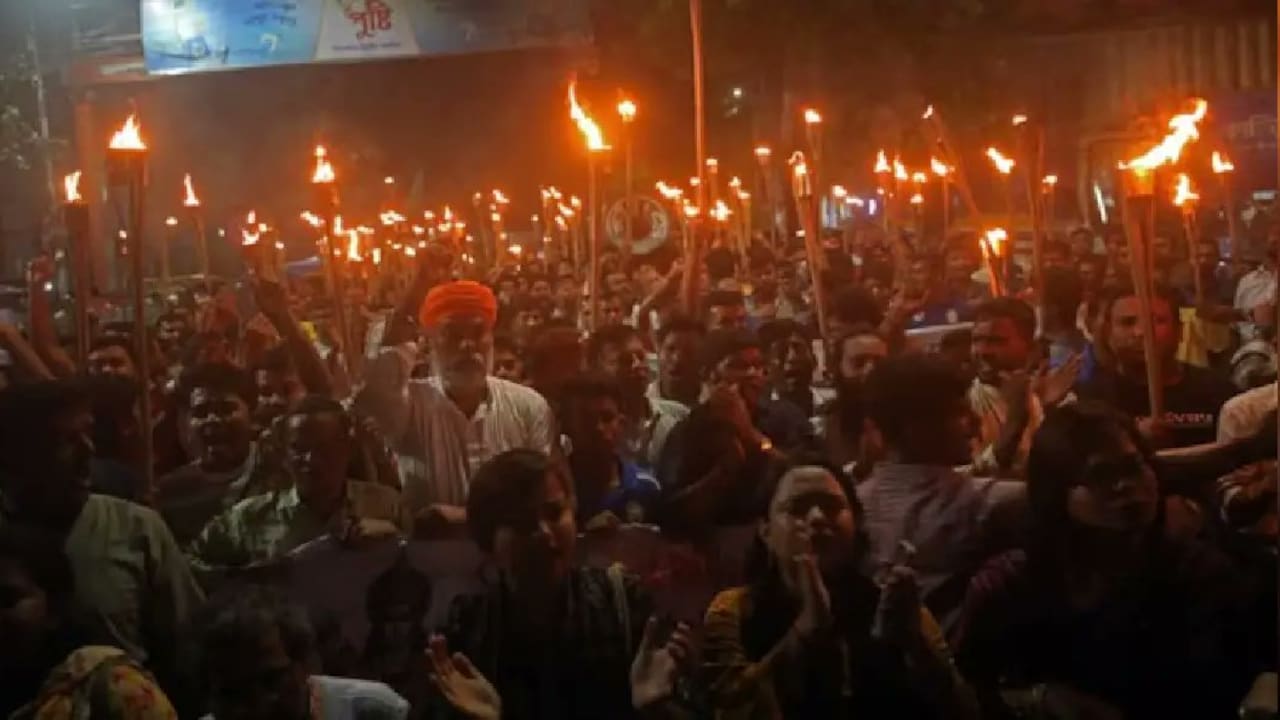
The escalation of street protests in Dhaka, characterized by torchlight marches and the mass chanting of religious slogans, exposes a structural vulnerability common to transitional states: the breakdown of state capacity to regulate competitive mobilization between majoritarian and minority groups. When the Sri Sri Radha Govinda Temple committee in Gaibandha suspended construction of an 81-foot statue of Lord Ram due to threats from radical groups, it triggered a predictable chain reaction of minority counter-mobilization. This phenomenon is not merely an emotional or religious reaction; it operates as a rational security-seeking strategy within a fluid political environment where institutional safeguards are weak.
Analyzing these events requires looking past superficial descriptions of religious friction to examine the underlying structural components. The current civil unrest in Bangladesh is driven by three main operational factors: state-level enforcement deficits, asymmetrical veto power wielded by non-state actors, and the strategic calculus of minority group mobilization under newly formed governments.
The Tri-Partite Framework of Communitarian Escalation
To model how local disputes turn into national security challenges, the situation must be broken down into three distinct operational layers.
1. The Asymmetrical Veto Problem
In weak or transitional regimes, small radical factions can effectively veto public or private infrastructure projects through threats of violence. The halt of the Gaibandha statue project, which was 80% complete and represented an investment of approximately 22 crore Bangladeshi taka, demonstrates this dynamic. When the state fails to provide credible security guarantees to project stakeholders, the cost of continuing construction rises sharply. For temple management, the decision to pause was a calculated move to minimize asset destruction and protect physical safety. When the state allows non-state actors to halt a legal infrastructure project through intimidation, it effectively hands veto power over civil liberties to the most radical elements of society.
2. Strategic Counter-Mobilization as a Security Signal
Minority populations facing an enforcement deficit cannot rely on institutional channels alone to protect their rights. The mass rallies at the Shahbagh intersection and the National Press Club function as signaling mechanisms. By issuing a 72-hour ultimatum to the Tarique Rahman administration, the Hindu Mahajot and student organizations are testing the enforcement priorities of the state. The choice of high-visibility tactics—such as torchlight processions and politically charged slogans like "Jai Shri Ram"—is designed to increase the political cost of government inaction. It signals that continuing to accommodate majoritarian demands will lead to widespread civil unrest and disrupt urban economic centers.
[Local Dispute: Statue Project Threat]
               │
               ▼
[State Security Failure / Project Suspension]
               │
               ▼
[Minority Security Threat Perception]
               │
               ▼
[Strategic Counter-Mobilization (Dhaka Rallies)]
               │
               ▼
[State Policy Dilemma: Law Enforcement vs. Majoritarian Backlash]
3. The Institutional Credibility Dilemma
The current administration, which assumed power in February 2026, faces a classic credibility problem. While the Prime Minister's first national address emphasized civic nationalism, stating that "the country belongs to all," empirical data reveals a gap between official rhetoric and local enforcement. The recording of 133 incidents of communal violence between January 1 and March 31, 2026, shows that local law enforcement agencies are either unable or unwilling to suppress majoritarian violence. This gap between central government policy and local enforcement encourages radical groups to push for further concessions, while forcing minority groups to rely on disruptive street protests for self-defense.
The Economics and Material Underpinnings of the Conflict
Civilian unrest is rarely driven by ideology alone; it is heavily shaped by economic assets and material investments. The dispute in the Palashbari upazila of Gaibandha involves significant capital expenditure and long-term development plans.
The planned religious complex was designed to feature three large monuments: an 81-foot statue of Lord Ram, a 50-foot statue of Lord Krishna, and a 30-foot statue of Lord Shiva. The total budget of 22 crore taka represents a major concentration of minority capital in a rural district. In developing economies, large-scale infrastructure projects by minority communities serve two functions:
- Cultural Assertion: They establish a permanent, visible presence in the public sphere, claiming a right to the physical environment.
- Economic Anchoring: These complexes attract religious tourism, pilgrimage traffic, and local commerce, building an economic base that helps protect the community against displacement.
When radical groups target these sites, their goal is to disrupt the economic anchoring of the minority population as much as to target their religious symbols. Threatening to destroy the infrastructure with heavy machinery is a deliberate tactic to inflict maximum financial loss and discourage future capital investments by the minority community. The temple committee's decision to halt construction to "preserve social harmony" shows how threat modeling forces minority managers to accept stranded assets and sunk costs rather than risk total capital destruction.
Tactical Mechanics of the Protests
The protests across Dhaka follow a structured escalation strategy designed to maximize political leverage while minimizing the risk of a direct government crackdown.
Spatial Aggregation at Critical Chokepoints
The gathering of student groups and civic organizations at the Shahbagh intersection is a deliberate tactical choice. Shahbagh is a key transit and symbolic hub in Dhaka, sitting near Dhaka University, major hospitals, and government offices. Blocking this area immediately impacts city logistics and forces a response from senior government officials. Moving the march toward the National Press Club expands the media footprint of the protest, ensuring visibility in both domestic and international news cycles.
The 72-Hour Ultimatum and Policy Leverage
By setting a explicit 72-hour deadline for the arrest of those who desecrated the religious image, protest leaders are attempting to force a policy response from a hesitant state apparatus. This time-bound demand prevents the government from using long, drawn-out bureaucratic processes to defuse the situation. It forces the Ministry of Religious Affairs to make a binary choice: either enforce the law against majoritarian agitators or risk a broader, nationwide protest campaign organized by the National Committee for Puja Celebrations.
Decentralized Deterrence
The threat by the Hindu Mahajot to construct smaller shrines across all 64 districts if the Gaibandha project is blocked represents a shift toward decentralized deterrence. If the state permits a centralized monument to be stopped by radical groups, the minority community plans to scatter its cultural footprint across the entire country. This tactic complicates the security situation for both radical groups and local police, as protecting or attacking dozens of scattered sites requires far more resources than managing a single, central location.
The Structural Mechanics of Communal Instability
┌──────────────────────────────────────────────────────────┐
│             Transitional State Environment               │
│  (Weak Institutional Governance & Enforcement Deficits)   │
└────────────────────────────┬─────────────────────────────┘
                             │
                             ▼
┌──────────────────────────────────────────────────────────┐
│           Majoritarian Mobilization & Threats            │
│       (Radical groups demand halt of infrastructure)     │
└────────────────────────────┬─────────────────────────────┘
                             │
                             ▼
┌──────────────────────────────────────────────────────────┐
│              Appeasement or State Inaction                │
│       (Project suspended to preserve social harmony)     │
└────────────────────────────┬─────────────────────────────┘
                             │
                             ▼
┌──────────────────────────────────────────────────────────┐
│             Minority Security Panic & Rallies            │
│         (Torchlight marches, 72-hour ultimatums)         │
└────────────────────────────┬─────────────────────────────┘
                             │
                             ▼
┌──────────────────────────────────────────────────────────┐
│               Sustained Communal Friction               │
│    (Decentralized infrastructure & permanent unrest)    │
└──────────────────────────────────────────────────────────┘
Strategic Forecast and Policy Recommendations
The current dynamic in Bangladesh points toward an unstable equilibrium marked by recurring, localized civil unrest. The government cannot resolve this friction through rhetorical appeals for peace or temporary concessions to radical groups. Appeasing radical factions to maintain short-term order creates a moral hazard: it signals that intimidation is an effective way to dictate state policy, which guarantees future threats against other minority projects.
The state has two viable paths forward, each with distinct operational requirements and risks.
Option A: The Enforcement-Led Stabilisation Model
The state can choose to assert its monopoly on violence by enforcing existing laws regarding property rights, religious freedom, and public order. This path requires:
- Arresting the individuals responsible for the desecration of the image in Gaibandha to satisfy the minority community's immediate demands for justice.
- Providing state security forces to protect the Gaibandha temple site, allowing the remaining 20% of the construction project to be completed under state protection.
- Deploying rapid-response security details to vulnerable minority neighborhoods in rural districts to prevent retributive violence.
The primary risk of this approach is short-term majoritarian backlash, which radical groups could use to organize counter-protests against the government. However, it establishes long-term stability by making it clear that intimidation cannot alter state policy.
Option B: Managed Attrition and Bureaucratic Delay
Alternatively, the government may choose to delay, attempting to defuse the protests through protracted negotiations, committees of inquiry, and vague promises of future security. While this strategy avoids an immediate confrontation with radical groups, it carries severe long-term costs. It ensures that minority organizations will remain mobilized, turning local friction into a permanent drag on urban productivity and social cohesion. It also damages the country's international standing regarding minority rights, which can affect foreign direct investment and trade relationships.
The optimal strategy requires the administration to shift from reactive crisis management to proactive enforcement. The government must treat threats against legal infrastructure projects as direct challenges to state sovereignty. If the state fails to protect the Gaibandha project, the resulting shift toward decentralized minority mobilization will lock the polity into a cycle of structural friction, legal uncertainty, and recurring civil unrest.