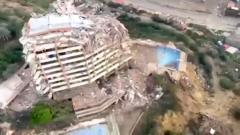
Aerial surveys of the central Venezuelan coastline reveal a catastrophic structural failure pattern that cannot be explained by standard seismic models. The destruction concentrated in La Guaira state—specifically across the high-density coastal corridors of Caraballeda, Catia La Mar, and Los Corales—represents a complex interplay of tectonic mechanics, soil liquefaction, and structural non-compliance. When dual earthquakes measuring 7.2 and 7.5 magnitude struck a mere 39 seconds apart, they exposed critical vulnerabilities in the region's built environment.
Understanding this disaster requires looking past the surface imagery of ruined tower blocks to isolate the mechanical and geological variables that drove this specific failure rate. The widespread destruction is not a randomized consequence of magnitude; it is the direct output of an accelerated structural cost function where geological amplification intersected with widespread engineering deficiencies.
The Tectonic Mechanism: Explaining the Seismic Doublet
The primary driver of the coastal destruction was the structural stress profile of a seismic doublet—a rare phenomenon where two major tectonic ruptures occur almost simultaneously within the same region. This sequence fundamentally disrupted standard emergency response assumptions and exceeded the tolerance limits of structures designed for single-event attenuation.
[Initial Rupture: M7.2] ──(39s Intervallic Fatigue)──> [Secondary Rupture: M7.5]
         │                                                      │
         ▼                                                      ▼
Primary Wave Stress                                    Accelerated Elastic Failure
(Micro-fracturing & Joint Separation)                 (Total Structural Collapse)
The 39-second interval between the two shocks created a compounding destruction loop. The initial 7.2 magnitude shock acted as a structural pre-weakening mechanism, forcing concrete structures into their plastic deformation phase. During this phase, internal micro-fracturing occurs, concrete cores begin to spall (shed layers), and the bonding between reinforcing steel and concrete degrades.
Before any kinetic energy could dissipate or emergency stabilizers could be deployed, the secondary 7.5 magnitude shock struck. Because the structural integrity of these coastal towers had already been compromised, their capacity to absorb the second wave's peak ground acceleration was drastically lower. The second shock triggered rapid, brittle failure in columns that had lost their lateral confinement during the first 39 seconds.
The Soil Bottleneck: Geotechnical Amplification on the Ávila Slopes
The distribution of building collapses along the coast and the lower slopes of the El Ávila mountain range demonstrates severe geotechnical amplification. The geological composition of this strip introduces a high-risk variable: deep, unconsolidated sedimentary deposits overlying hard metamorphic bedrock.
The seismic energy traveling through the dense bedrock accelerated sharply upon entering the loose coastal sands and alluvial soils. This variation in density slows the seismic waves down, forcing an increase in wave amplitude to conserve energy. This process causes much more violent surface shaking than what occurs on solid rock.
A secondary, highly destructive consequence of this geological makeup was localized soil liquefaction. Under the cyclical stress of the double shock, pore water pressure within the saturated coastal soils rose rapidly until it equaled the external pressure of the soil particles. At this critical threshold, the ground lost its shear strength and began behaving like a dense fluid. This shift instantly removed the necessary bearing capacity beneath heavy multi-story foundations, leading to rapid foundation tilting, structural shifting, and eventual building collapse.
Engineering Vulnerabilities: The Physics of Concrete Failure
The visual evidence from the La Guaira disaster zone shows distinct structural failure patterns. Multi-story residential and tourist towers built during the coastal expansion periods collapsed in a highly specific manner, revealing systemic engineering vulnerabilities.
Soft-Story Collapse Mechanics
A major point of failure across the collapsed beachfront towers was the "soft-story" vulnerability. Many of these buildings featured open-plan ground floors designed for parking lots, lobbies, or retail spaces, which lacked sufficient internal structural walls.
When the horizontal forces of the earthquakes hit, the lateral stiffness of these open ground floors was significantly lower than the rigid residential floors above them. This stark difference focused the building's lateral displacement entirely onto the ground-floor columns. Unable to withstand the extreme bending forces, these columns suffered rapid shear failures, causing upper floors to drop straight down in a classic pancake collapse.
Deficiencies in Structural Detailing
Close inspection of the concrete rubble highlights several recurring engineering violations that compromised structural integrity:
- Inadequate Stirrup Spacing: Transverse reinforcement ties (stirrups) inside the columns were spaced too far apart. Stirrups are vital because they provide lateral restraint to the vertical rebar and keep the concrete core contained. Excessively wide spacing allowed the internal concrete to crumble and burst outward under high pressure.
- Smooth Rebar Usage: Several older structures contained smooth reinforcing steel bars rather than modern deformed rebar, which features ridges to grip the concrete. Smooth bars easily lose their bond with the surrounding concrete under cyclical stress, causing the internal reinforcement to slip and leading to sudden, brittle failures.
- Substandard Aggregate and Concrete Compaction: Large pockets of uncompacted concrete and poor aggregate distribution were visible in fractured columns. This issue reduces the overall compressive strength of the concrete well below its specified design limits.
Logistical Bottlenecks in the Acute Response Phase
The destruction of infrastructure along the central coast created immediate operational bottlenecks that severely hindered the primary phase of search-and-rescue efforts.
The closed-off coastal geography of La Guaira, which sits squeezed between the steep slopes of the El Ávila range and the Caribbean Sea, leaves it dependent on a few critical transit routes. Massive landslides triggered by the earthquakes blocked the primary highways connecting Caracas to the coast, leaving the region isolated during the vital early hours of the emergency.
Furthermore, structural damage to Simon Bolívar International Airport in Maiquetía shut down air operations, preventing the rapid deployment of heavy machinery and specialized international rescue teams. For the first 14 hours of the crisis, local response teams had to rely almost entirely on manual labor and hand tools to clear debris. This delay significantly reduced the survival window for individuals trapped beneath collapsed concrete slabs, where the lack of hydration and crush-related injuries require medical intervention within a strict time limit.
Systemic Risks in Industrial Infrastructures
Beyond residential structural failures, the seismic doublet created major operational risks within regional industrial facilities. The state-owned Pequiven petrochemical complex in Morón reported noticeable damage to storage tanks and processing lines, highlighting a critical point of vulnerability.
Industrial containment structures face distinct risks during prolonged seismic events due to hydrodynamic sloshing. When an earthquake strikes a large fluid storage tank, the liquid inside forms a powerful wave that sloshes back and forth. If the frequency of this fluid movement matches the natural vibration frequency of the tank structure, it creates a resonance effect.
This resonance places immense stress on the upper shell of the tank and its anchor bolts, which can cause the tank walls to buckle or split open at the seams. In a petrochemical environment, such structural failures present immediate secondary hazards, including hazardous material spills, toxic gas plumes, and high-intensity industrial fires that can quickly overwhelm local emergency containment systems.
Strategic Directives for Coastal Reconstruction
Rebuilding the northern seismic corridor requires moving away from historical construction practices and adopting a strict, risk-adjusted engineering framework. The high probability of future seismic activity along the San Sebastián fault system means reconstruction strategies must incorporate strict regulatory changes.
Structural engineering mandates must ban the construction of unbraced soft-story layouts in high-density developments. Any future open-ground designs must utilize heavy structural steel bracing frames or reinforced concrete shear walls to distribute lateral forces evenly. Furthermore, building codes must require the installation of ductile detailing—including closely spaced, continuous spiral stirrups—to ensure structures can bend and absorb energy without completely collapsing during a major earthquake.
Geotechnical zoning must also be updated to reflect clear soil-bearing capacities. Construction on highly liquefiable coastal soils must either be heavily restricted or require advanced foundation engineering, such as driving deep friction piles down into solid bedrock rather than relying on shallow mat foundations. If these rigorous engineering protocols are not systematically enforced, the structural cost function of future seismic events along the Venezuelan coast will remain unacceptably high.