If you walked through Boston or Miami recently, you probably noticed something weird happening to the local monuments. Historical figures, sports legends, and even random public art pieces are suddenly sporting bright orange traffic cones as hats. Don't panic. It isn't a new wave of localized American vandalism. It's just the Tartan Army marking its territory during the World Cup, and honestly, the locals are absolutely loving it.
Scottish football fans have descended on the United States in their tens of thousands. They brought bagpipes, an unquenchable thirst that emptied several Boston pubs of their entire beer supply, and a singular cultural obsession. They can't look at a bronze statue without wanting to climb it and crown it with a piece of roadside plastic.
What started as a hyper-local piece of late-night Glasgow tomfoolery has officially become an international diplomatic phenomenon. Even American politicians are joining in.
The Story Behind the Orange Hats
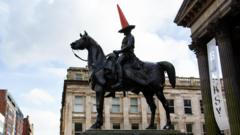
To understand why grown men in kilts are scaling pedestals in New England and Florida, you have to look at Glasgow. Since the late 1980s, the statue of the Duke of Wellington sitting on his horse outside the Gallery of Modern Art has worn a traffic cone.
Nobody knows exactly who put the first one up, but it quickly became a symbol of the city's stubborn, working-class sense of humor. Whenever Glasgow City Council used taxpayer money to take the cone down, someone else would scale the statue that same night to put a fresh one back up.
The council once claimed it cost around £10,000 a year to keep removing them. They even tried a bizarre plan in 2013 to double the height of the plinth to stop people climbing it. The public backlash was so fierce, with tens of thousands signing petitions, that the city backed down. The cone won.
Now, that exact brand of Glasgow defiance has crossed the Atlantic. Scottish fans openly admitted they discussed targeting American statues before they even boarded their flights. The moment the Tartan Army landed for Scotland's opening matches against Haiti and Morocco, the hunt for target statues began.
Boston Gets a Glasgow Makeover
Boston was the first major stop for the Scottish fans, and the city didn't know what hit it. Within days, statues across the city started changing look.
Founding Father Samuel Adams got an orange hat right outside Faneuil Hall. Fans tried throwing the cone up several times before one dedicated supporter scaled the giant pedestal to place it perfectly. Soon after, two statues of former Massachusetts Governor James Michael Curley were given the same treatment. The Tartan Army didn't stop at historical politicians. They hit sports icons too, putting a cone on hockey legend Bobby Orr and basketball giant Bill Russell.
Even the local wildlife statues weren't safe. The famous "Mother Duck" and her eight bronze ducklings in the Boston Public Garden ended up wearing tiny improvised cone hats.
Instead of getting angry, Boston embraced the chaos. Mayor Michelle Wu openly praised the Scottish fans for making the city come alive. She didn't just tolerate the high jinks; she participated. Wu admitted to reporters that she personally helped place a traffic cone on the Bill Russell statue outside City Hall.
The bond between the two cities grew so fast that Glasgow and Boston officially declared themselves sister cities. To celebrate, back home in Scotland, pranksters scaled the original Duke of Wellington statue and crowned him with a custom cone emblazoned with the word "BOSTON".
Miami Gives the Green Light to Go Cone Crazy
As the tournament progressed and the Tartan Army moved south to Miami for the final group match against Brazil, the tradition ran into a brief bit of trouble with local law enforcement.
A fan named Chris Nicoll from St Andrews made headlines after scaling a monument dedicated to Spanish explorer Juan Ponce de León in Miami's Little Havana neighborhood. The moment the orange cone touched the explorer's head, a nearby police cruiser blared its horn. Officers ordered Nicoll down, warning him about the stunt.
Nicoll later explained to the press that he meant no disrespect to his American hosts. He just wanted to share a bit of Scottish culture.
The mild police friction didn't last long. The very next day, Rolando Escalon, the commissioner for Miami's District 3, showed up in Little Havana to meet with the traveling Scots. Instead of handing out fines, Escalon brought his own blessing. He explicitly told the fans that all bets were off and told them to go cone crazy. To prove his point, the commissioner helped place a traffic cone on top of a local public chicken statue and posed for photos with the fans.
Why Vandalism This Polite Works
Normally, local authorities don't look kindly on people climbing historic monuments. If local teenagers did this, they would likely end up in the back of a police car. So why does the Tartan Army get away with it?
It comes down to the sheer joy and lack of malice behind it. The fans aren't defacing property, spray-painting walls, or breaking things. They are treating these cities like an extended living room, inviting the locals into a forty-year-old inside joke.
The economic boost doesn't hurt either. Tens of thousands of traveling fans spending money on hotels, food, and massive amounts of lager can make any city council look the other way. Tourism experts in Scotland are already predicting that this specific World Cup tour will drive massive American tourism back to the country. The image of the friendly, singing, cone-wielding Scot is the best free advertising the country could ask for.
If you happen to spot a cone out of place this week, leave it alone. It's just a wee present from Glasgow.
If you want to experience the atmosphere yourself, find the nearest bar flying a Saltire before the Brazil game. Grab a pint, learn the words to "Yes Sir, I Can Boogie," and don't look too surprised if you see someone carrying a three-foot orange piece of plastic down the street.