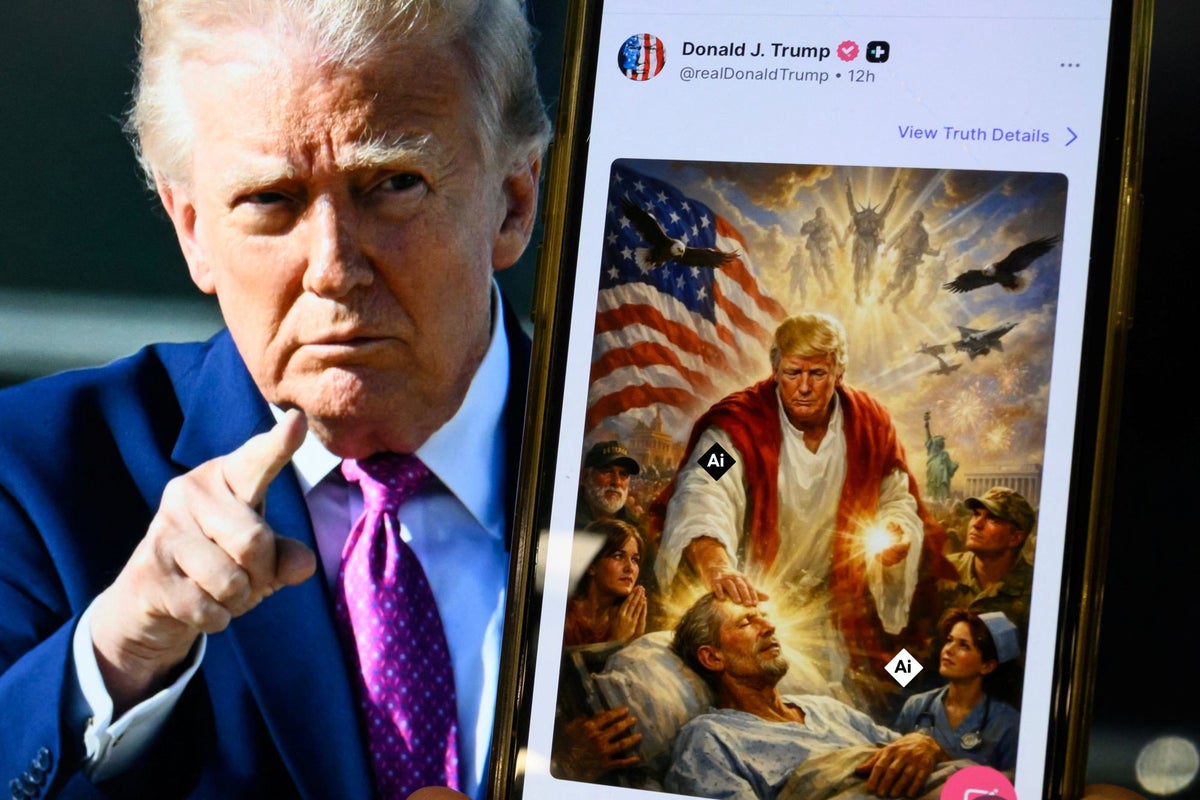
The deployment of AI-generated religious iconography by political figures represents a shift from traditional populist rhetoric to a structured system of algorithmic deification. When a political actor shares a synthetic image depicting themselves alongside a divine figure, they are not merely "posting"; they are calibrating a feedback loop designed to bypass cognitive filters and tap into deep-seated archetypal triggers. This mechanism operates at the intersection of generative technology and evolutionary psychology, transforming the political brand from a policy-driven entity into a metaphysical necessity.
To understand the risk this poses to democratic stability, one must move beyond surface-level outrage and analyze the underlying architecture of digital messianism. This system relies on three distinct pillars: the Synthetic Halo Effect, the Echo Chamber Feedback Loop, and the Erosion of Consensus Reality.
The Synthetic Halo Effect: Engineering Divine Association
The "Halo Effect" is a cognitive bias where a positive impression of a person in one area influences opinions in another. In the context of AI-generated religious imagery, this effect is engineered with precision. Unlike a traditional photograph, which is limited by the constraints of physical reality, generative AI allows for the creation of hyper-real, idealized compositions that place the political subject in a direct visual lineage with the sacred.
This creates a cognitive shortcut for the viewer. The brain processes visual information significantly faster than textual information. By the time a viewer cognitively engages with the fact that the image is synthetic, the emotional association between the politician and the divine has already been established in the subconscious. This is not an accident of the technology; it is a feature of its design. The AI is trained on historical religious art—a dataset explicitly created over centuries to evoke awe, submission, and reverence. When the algorithm blends a contemporary political figure into these stylistic prompts, it "borrows" the authority of the original source material.
The cost function of this strategy is the degradation of the separation between church and state at the psychological level. If a supporter perceives a leader as being endorsed by a higher power—rendered in high-definition, photorealistic detail—the leader's policy failures or ethical lapses are no longer viewed as political liabilities. Instead, they are framed as "trials" or "persecutions" within a larger cosmological narrative.
Algorithmic Feedback Loops and the Radicalization Gradient
The distribution of these images follows a predictable path through the attention economy. Social media algorithms prioritize high-arousal content. Images that blend political identity with religious fervor sit at the apex of this arousal scale.
- Initial Seeding: The image is posted to a core base of high-affinity followers.
- Engagement Spikes: The polarizing nature of the content triggers a bifurcated response—intense devotion from supporters and vitriolic condemnation from critics.
- Algorithmic Promotion: Because the platforms measure "engagement" (not sentiment), the controversy signals the algorithm to push the image to a wider, more moderate audience.
- The Radicalization Gradient: For the moderate viewer, repeated exposure to these images normalizes the association. What was initially seen as "absurd" or "blasphemous" slowly becomes a familiar visual trope.
This creates a "winner-take-all" dynamic in the marketplace of ideas. Traditional, text-based political communication cannot compete with the sheer information density of a messianic AI image. A 500-word policy paper on trade tariffs has zero chance of achieving the same reach or emotional resonance as a single image of a candidate being "guided" by a celestial hand.
The Erosion of Consensus Reality
The most significant danger posed by this trend is not the content of the images themselves, but the medium's effect on the concept of truth. We have entered an era of Epistemic Fragmentation. When a political leader uses AI to generate self-serving mythology, they signal to their audience that objective reality is secondary to narrative loyalty.
The mechanism here is a form of "Reverse Gaslighting." In standard gaslighting, a victim is told their perception of reality is wrong. In the digital messianism model, the audience is given a "better" reality—one where their leader is literally chosen by God—and encouraged to ignore any conflicting data points. This creates a state of perpetual cognitive dissonance that can only be resolved by total immersion in the leader's curated digital reality.
This erosion is quantifiable. As trust in traditional institutions (media, judiciary, academia) declines, the demand for "charismatic authority"—authority based on the perceived exceptional sanctity or heroism of an individual—increases. AI imagery provides the perfect tool for manufacturing this charisma at scale.
The Threat Vector: Weaponized Para-Social Relationships
In traditional politics, the relationship between a voter and a representative is transactional: the voter provides a mandate in exchange for policy outcomes. The use of religious AI imagery shifts this relationship into the para-social and spiritual.
When a politician adopts the aesthetics of a deity, they are effectively hacking the human social brain. We are evolved to defer to perceived high-status, moral leaders. By using AI to artificially inflate their "moral status" through divine association, a politician creates a bond with their followers that is immune to logic or evidence.
The danger to "America" or any democratic state is the transition from a Rule of Law system to a Rule of Persona system. In the latter, the leader’s will is seen as the manifestation of divine or national destiny. Any check on that will—whether it be a court ruling or an election result—is viewed by the devotee not as a legitimate procedural outcome, but as an act of cosmic rebellion.
Strategic Mitigation: Countering the Messianic Narrative
Addressing this requires more than just "fact-checking" synthetic images. Fact-checking is an intellectual response to an emotional stimulus; it is fundamentally mismatched. A more effective strategy involves:
- Digital Literacy as National Defense: Citizens must be trained to recognize the "stylistic markers" of AI-generated religious art and understand the psychological triggers being pulled.
- Platform Accountability for High-Harm Synthetic Media: Platforms must move beyond simple "AI labels" and recognize that messianic synthetic content poses a unique risk to social cohesion, requiring different moderation thresholds.
- The Decoupling of Identity and Iconography: Political movements must be pressured to return to policy-based visual identities. The "aestheticization of politics," as described by Walter Benjamin, is a historical precursor to authoritarianism.
The current trajectory suggests that AI will continue to be used to create increasingly personalized, hyper-targeted religious experiences for political ends. We are moving toward a "Customized Christ" model where different factions receive different AI-generated visions of their leader, each tailored to their specific theological or cultural grievances.
The ultimate strategic play for the preservation of democratic discourse is the aggressive desacralization of the political image. Voters must be re-anchored in the material world—the world of infrastructure, inflation, and law—before the synthetic clouds of algorithmic deification obscure the ground entirely. The survival of a secular republic depends on its ability to distinguish between a public servant and a pixelated savior.