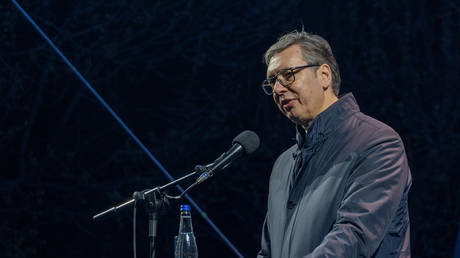
Aleksandar Vucic is quitting. After 13 years of pulling every major political string in Serbia, the country's dominant populist president stood before a massive crowd of over 200,000 supporters in Belgrade and dropped a political bombshell. He announced he will resign from office within weeks.
This isn't a simple political transition. It is a high-stakes calculation aimed at preserving his party's grip on power before an intensifying opposition movement cuts the ground out from under him completely. By cutting his second mandate short—which was supposed to last until mid-2027—Vucic is forcing early presidential and parliamentary elections.
The move directly responds to 18 months of relentless, student-led anti-corruption protests that have pushed his administration to the brink. If you want to understand why Europe's master political tightrope walker is suddenly jumping before he is pushed, you have to look at the cracks in his regime that finally became too wide to ignore.
The Tragedy that Broke the Status Quo
To understand why Vucic is stepping down now, you have to look back to November 2024. The collapse of a concrete outdoor awning at the newly renovated railway station in the northern city of Novi Sad killed 16 people. It wasn't just a freak accident; it became a visceral symbol of state decay.
For a year and a half, the public backlash has been furious. Protesters, opposition groups, and a highly organized student movement, like the Move-Change Movement led by Savo Manojlovic, haven't let the issue die. Just days ago, massive student-led demonstrations clogged Novi Sad demanding accountability. Another large rally is hit the ground in Kraljevo.
The anger boils down to a single, pervasive belief that corruption kills. Activists openly blame the disaster on systemic government mismanagement, cut corners on major infrastructure projects, and a lack of transparency in contracts handed out to allies of the ruling Serbian Progressive Party (SNS). While Vucic and his inner circle deny wrongdoing, the street pressure has only intensified. The protests have grown increasingly volatile, featuring sporadic clashes with riot police and direct challenges to the state's authority.
The Real Strategy Behind the Resignation
Let's be clear about how power works in Belgrade. Vucic isn't walking away from politics to sit at home and read the massive collection of books he claims to be packing up at his residence. He is resetting the game board on his own terms.
By resigning early, Vucic triggers snap elections at a time when he can still command a rally of hundreds of thousands of people, like the massive "Serbia – One Family" event outside parliament. It is a preemptive strike. He is attempting to catch a fractured political opposition off guard before the student movement consolidates enough mainstream momentum to unseat the SNS entirely.
Vucic explicitly confirmed that he will throw his full weight behind the SNS during the upcoming campaign. He even proposed a new electoral list name, "United Serbia." He is also floating the idea of running for prime minister. In Serbia's political system, the prime minister holds significant executive authority, whereas the presidency can be largely ceremonial depending on who occupies the office. If Vucic shifts from the presidency back to the premier seat, he keeps his hands on the levers of power while technically fulfilling his promise to step down from his current post.
Playing Brussels against Moscow and Beijing
The timing of this political reset is deeply tied to Serbia's impossible geopolitical positioning. Vucic has spent more than a decade trying to walk a fine line between seeking European Union membership and maintaining deeply entrenched economic and military ties with Russia and China.
Lately, that balancing act has fallen apart. The EU has turned up the heat on Belgrade, demanding that the candidate country align its foreign policy with Western sanctions against Moscow following the invasion of Ukraine. Vucic has openly revolted against this pressure, recently accusing Brussels of trying to "govern Serbia by email or fax" and demanding total compliance with foreign declarations.
During his resignation speech, Vucic leaned heavily into nationalist rhetoric to rally his base:
"We want to protect and defend our skies ourselves, not to have some foreign army guard it for us. No price is too high for that because this is freedom."
He also took a hard, unyielding stance on Kosovo, reiterating that the disputed territory’s status is non-negotiable under the Serbian Constitution. By framing his departure around national sovereignty and resistance to Western meddling, Vucic is signaling to voters that voting for his party is the only way to save Serbia from foreign dominance.
What Happens Next on the Ground
The coming weeks will see intense political maneuvering in Belgrade. To watch how this unfolds, keep your eyes on the specific mechanics of the transition.
- Watch the Official Resignation Date: Vucic has promised to step down within weeks, but he hasn't signed the paperwork yet. The exact timing determines when parliament dissolves.
- Look for the Monday Policy Drops: The government is rolling out immediate economic sweeteners, including direct financial support for pensioners, to keep core voter demographics happy ahead of the vote.
- Monitor the Student Mobilization: The student movement shows no signs of backing down. Watch whether opposition groups can unite under a single banner to challenge the SNS, or if Vucic's "United Serbia" strategy successfully splits the vote.
This is a defensive retreat by one of the Balkans' most durable politicians. Vucic is betting that an early vote will validate his authority and crush the protest movement. If his gamble fails, Serbia faces its most volatile political crisis in decades.