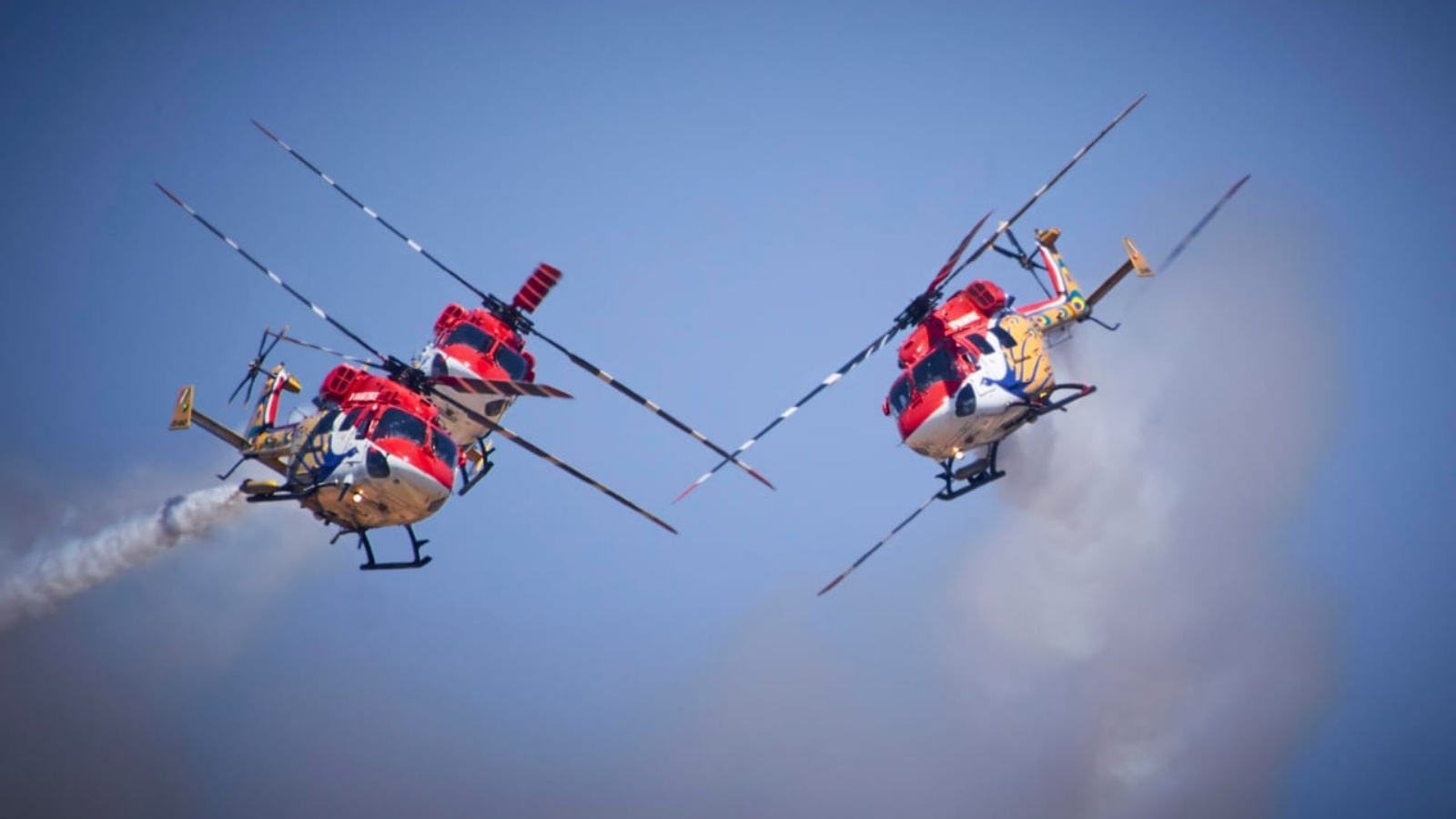
The media treats military aerobatic teams like traveling circus troupes. When the Indian Air Force’s Sarang helicopter display unit touches down for events like the El Alamein International Airshow, the coverage reads like a breathless fan-club newsletter. Five airframes paint the sky, a signature move called the Dolphin Leap gets executed, and commentators swoon over tight formations.
Stop buying the hype.
Airshows are not raw operational benchmarks. They are high-risk marketing platforms disguised as combat readiness. If you judge a military transport or utility platform by how gracefully it executes a spot stall turn over a civilian airport, you understand nothing about modern aerospace economics or attrition warfare.
The False Equivalency of Aerobatic Prowess
The lazy consensus in defense journalism is that precision formation flying equates directly to battlefield dominance. If a unit can hover five feet from a rotor blade at two hundred knots, the helicopter must be an unbeatable war machine.
That logic collapses under scrutiny.
Imagine a scenario where a military procurement agency evaluates a multi-role utility helicopter based entirely on its capability to perform airshow routines. You end up optimizing for low-speed cyclic authority, specialized tuning, and high-maintenance rigging that would never survive a muddy forward operating base in a contested theater.
The Advanced Light Helicopter Dhruv, flown by the Sarang team, is a capable machine. Its domestic manufacturing pedigree matters. But the platform’s true value lies in payload capacity, hot-and-high altitude performance, and electronic warfare survivability—none of which can be fully assessed while watching four ships loop through a smoke trail.
The Export Illusion
Governments love sending display teams abroad because they function as flying billboards. The pitch is simple: look at this acrobatic discipline; buy our hardware.
Except defense procurement does not work like retail shopping. Nations do not acquire billion-dollar aviation fleets because a pilot can execute a clean loop over an Egyptian resort town. They buy based on lifecycle cost, spare parts availability, maintenance man-hours per flight hour, and geopolitical alignment.
When defense analysts focus on the aesthetic grace of a five-ship helicopter routine, they ignore the grueling logistics tail required just to keep those aircraft airworthy thousands of miles away from home. The real story isn't the maneuver. The real story is the brutal logistics chain that transports maintenance crews, diagnostic gear, and backup engines across international borders without missing a beat.
Decoding the Operational Reality
Let’s look at what actually matters when evaluating military aerospace capabilities:
- Mean Time Between Failures: The statistical reliability of core avionics and engines under stress.
- Turnaround Speed: How fast a ground crew can refuel, rearm, and inspect a platform between sorties in hostile environments.
- Industrial Autonomy: Whether a nation can scale manufacturing lines during a protracted conflict without relying on imported sub-components.
Aerobatic displays showcase none of these metrics. They test the absolute limits of specialized pilot skill and pre-flight maintenance tweaking. A display helicopter is often stripped down, meticulously balanced, and flown by elite instructors who spend months practicing a single choreographed routine. That bears zero resemblance to an operational squadron executing MEDEVAC missions under hostile fire.
The Danger of Aesthetic Diplomacy
Defense diplomacy relies on pageantry. Flying flags in foreign skies builds soft power, opens doors for bilateral talks, and reassures allies. That has value. But confusing soft power projection with hard combat validation is a dangerous analytical error.
When you read headlines praising the tight formations over El Alamein, remember what is being masked. The applauding crowds see precision. Fleet commanders see maintenance schedules, structural fatigue limits, and replacement costs.
Stop evaluating military capability through a telephoto lens. Strip away the smoke, ignore the synchronized routines, and look at the logistics ledger. That is where wars are won or lost.