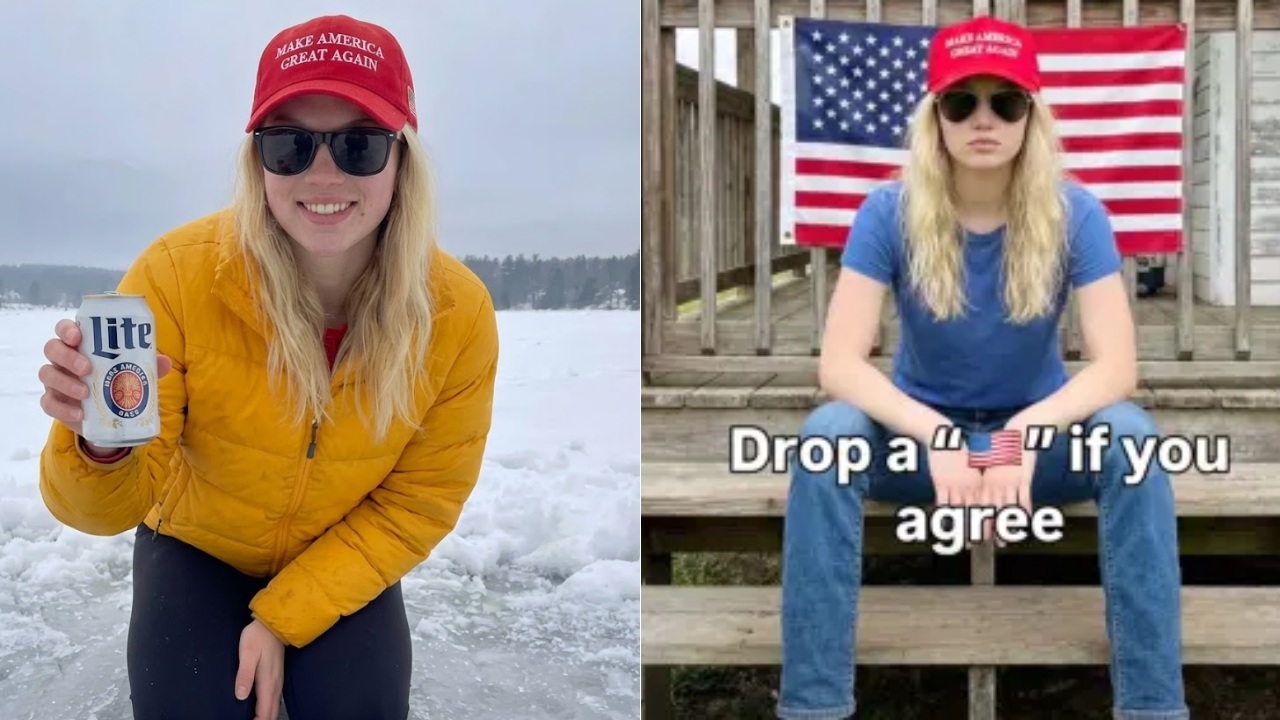
The media is having a collective meltdown over an Indian student running a "hot girl" MAGA influencer account. They want you to be outraged. They want you to see it as a "threat to democracy."
They are wrong.
The story isn't that a computer generated a face. The story is that a single student in a bedroom in India understands the American psychological profile better than the billion-dollar consulting firms running digital campaigns for the DNC and the RNC.
The "lazy consensus" says this is about misinformation. It isn't. It’s about attention arbitrage.
The Myth of the "Tricked" Voter
Stop pretending the followers are victims. The people engaging with "Luna" or whatever blonde AI avatar is currently trending aren't being "fooled" into a political ideology. They are being serviced.
The average political consumer doesn't want "truth." They want validation.
Traditional news outlets treat politics like a high school civics debate. They think if they just provide enough facts, the public will reach the "correct" conclusion. They’ve ignored the reality of the dopamine economy.
This Indian student didn't invent a new form of propaganda. He just automated the oldest trick in the book: mirroring the audience's desires back to them. If a user wants to hear that the border is a mess and taxes are too high, they don't care if the person saying it is a real human or a collection of pixels generated by a Stable Diffusion prompt.
The media focuses on the "fake" face because they are terrified of the "real" message's resonance.
Why "Authenticity" is a Dead Metric
I’ve spent years watching brands pour millions into "authentic" influencer marketing. They hire expensive photographers. They write "relatable" captions. They try to "foster" (a word for people who have never actually sold anything) a "human connection."
Then a kid with a $20/month Midjourney subscription and an LLM comes along and blows their engagement metrics out of the water.
Why? Because human influencers are high-maintenance and inconsistent. They have opinions. They get "canceled." They age. They get tired.
An AI influencer is a perfected vessel.
In the attention economy, "authenticity" is just another aesthetic. If the aesthetic of a MAGA-hat-wearing girl in a pickup truck generates 10,000 retweets, the fact that she doesn't exist is a technicality. The engagement is real. The data is real. The sentiment is real.
When critics cry about "synthetic media," they are actually mourning their lost monopoly on narrative control. They hate that the barrier to entry has dropped to zero. They hate that they can no longer gatekeep who gets to be a "voice" in the political sphere.
The Economic Reality of Digital Borders
The outrage over an "Indian student" interfering in American politics is a hilarious display of selective xenophobia.
In a globalized digital economy, there are no borders for content. We outsource our customer service to Manila. We outsource our software engineering to Bangalore. We outsource our manufacturing to Shenzhen. Why on earth wouldn't we outsource our political shitposting?
This is Business 101.
- Cost of Production: Near zero.
- Market Demand: Infinite.
- Scalability: Linear with GPU hours.
The student isn't a "threat." He’s an entrepreneur. He found a market gap—hyper-partisan, visually stimulating content—and filled it with the most efficient tool available.
If American political campaigns were actually competent, they would be doing this themselves. Instead, they spend $500,000 on a single TV ad that 80% of the population skips or ignores. This kid is getting millions of impressions for the price of a Netflix subscription.
Who is the real idiot here?
Dismantling the "Deepfake" Moral Panic
Let’s get precise with our terms. A "deepfake" is typically used to describe a malicious impersonation of a real person (e.g., making a video of a politician saying something they didn't).
Creating a fictional persona from scratch—which is what this student did—is just fictional branding.
Is Betty Crocker a threat to the culinary arts? Is the GEICO gecko a threat to the insurance industry? No. They are mascots.
The MAGA AI influencer is a political mascot. The fact that she looks like a "hot girl" instead of a cartoon lizard is just a reflection of the target demographic's preferences. To call this a "danger to the fabric of reality" is a massive overreach. It assumes the public is too stupid to distinguish between a person and a persona, while simultaneously ignoring that every politician is a curated, artificial persona.
The Brutal Truth About "Media Literacy"
People ask: "How do we teach media literacy to prevent this?"
The answer is: You don't.
You cannot "educate" your way out of a biological impulse. Humans are hardwired to respond to beauty and tribal signaling. No amount of "fact-checking" labels or school curriculum will stop a 60-year-old man from clicking on a photo of a beautiful woman holding a flag that represents his values.
The "Media Literacy" movement is a grift. It’s a way for academics to secure grants by promising to fix a "problem" that is actually just human nature.
The only "fix" is to compete.
The Counter-Intuitive Path Forward
If you are a political strategist or a brand manager and you are pearl-clutching about AI influencers, you have already lost.
The winners won't be the ones who successfully "ban" AI. The winners will be the ones who lean into the Synthetic Age.
Imagine a scenario where a campaign doesn't have one spokesperson, but 10,000. Each one is hyper-targeted to a specific micro-demographic.
- An AI influencer for suburban moms in Ohio.
- An AI influencer for industrial workers in Pennsylvania.
- An AI influencer for tech bros in Austin.
Each one speaks the local slang. Each one shares the specific grievances of that zip code. This isn't "faking" a conversation; it’s scaling a conversation.
The downside? Yes, the "truth" gets muddied. But the truth has been a casualty of mass media since the invention of the printing press. The only difference now is the velocity.
Stop Asking the Wrong Questions
The question isn't "How do we stop AI influencers?"
The question is "Why is our existing political discourse so hollow that a fake girl from India can dominate it?"
We have created a political environment so reliant on slogans, aesthetics, and tribalism that a machine can replicate it perfectly. The AI isn't the problem. The AI is a mirror. If you don't like what you see, don't blame the glass.
The media’s obsession with the "Indian student" is a deflection. It allows them to avoid the uncomfortable truth: that the American voter is more moved by a hallucinated blonde in a MAGA hat than by any 50-page policy white paper.
If you want to beat the AI, you have to offer something the AI can't: Actual Risk.
AI cannot go to jail. AI cannot lose its soul. AI cannot bleed.
Until "real" political figures start acting with the kind of skin in the game that a machine can't simulate, they will continue to lose the attention war to a kid in India with a clever prompt and a dream.
The era of the human influencer as a "trusted source" is over. We are all just nodes in the network now. Get used to it.
Build your own bot or get out of the way.