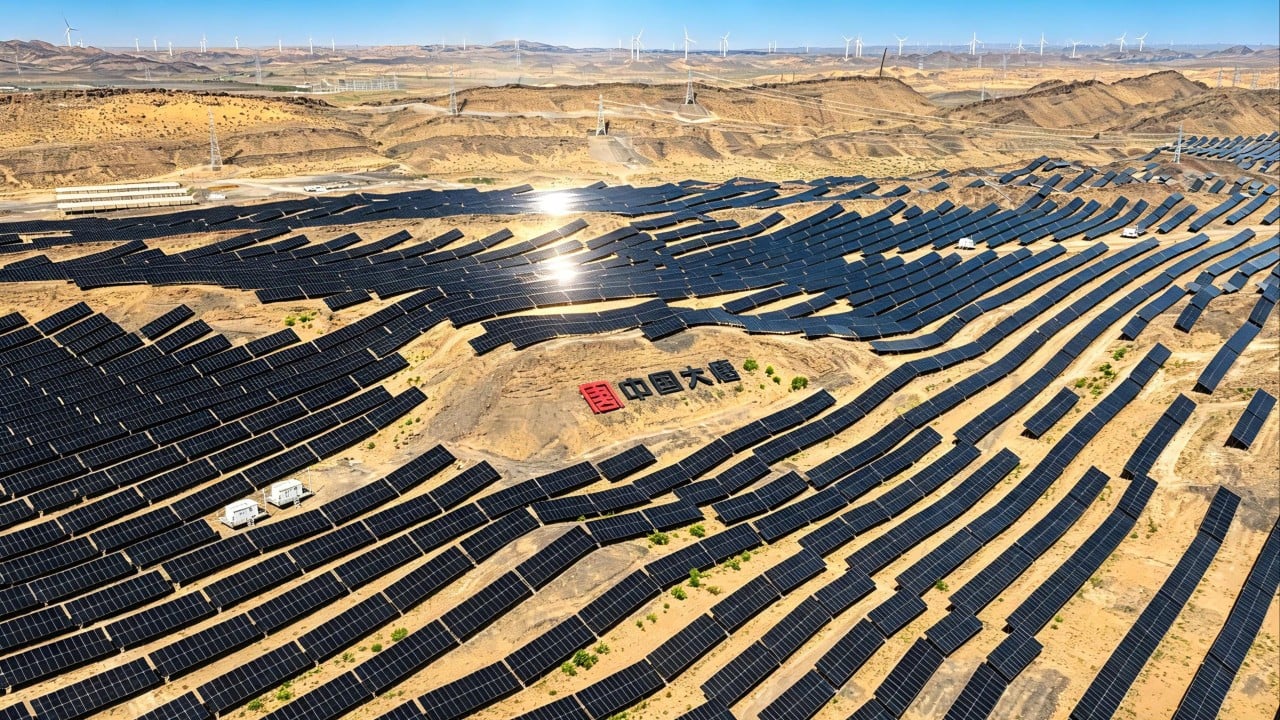
Tech pundits love a good resource scarcity narrative. The latest consensus chewing gum is that the geopolitical race for artificial intelligence isn't about algorithmic breakthroughs or silicon dominance anymore. They claim it is a crude, low-tech cage match over gigawatts. They look at the rising power consumption of data centers, draw a straight line into infinity, and declare that whoever hoards the most electricity wins the century.
This is lazy analysis. It treats AI like an aluminum smelter.
The narrative that the US-China AI rivalry boils down to a contest over electricity isn't just wrong; it actively misdirects capital and policy. Having advised infrastructure funds on multi-billion-dollar data center deployments, I can tell you that the bottleneck isn’t the aggregate supply of electrons. The true battleground is an architectural war over algorithmic efficiency, grid topology, and the harsh reality of capital depreciation.
The side that builds the biggest, hungriest grid won’t win. The side that learns how to do the most computation with the absolute fewest electrons will.
The Efficiency Myth of the Linear Grid Scale
Let’s dismantle the foundational premise of the grid panic. The mainstream argument relies on linear extrapolation: if training Model A took 10 megawatts, then Model B will take 100 megawatts, and eventually, we will need a dedicated nuclear reactor for every cluster.
This ignores a fundamental law of computing history: software optimization always outpaces hardware provisioning.
Look at the hardware level itself. Nvidia’s architectural transitions have consistently delivered massive performance-per-watt gains. The leap from Hopper to Blackwell architectures wasn't just about packing more transistors; it was about specialized engines designed to slash energy consumption during LLM inference by orders of magnitude.
When you look at the software layer, the linear consumption model completely falls apart. Quantization techniques take 16-bit weights down to 8-bit, 4-bit, or even lower with negligible loss in accuracy. Mixture-of-Experts (MoE) architectures ensure that only a fraction of a model’s parameters activate for any given prompt.
Imagine a scenario where a company spends $5 billion building a gigawatt-scale data center campus, only for a rival to release an algorithmic optimization six months later that makes their massive cluster entirely redundant. The rival achieves the same compute output using 15% of the power on a standard regional grid.
The winner didn't secure more power. They made power a secondary variable.
The Topography Trap: Generation vs. Transmission
Everyone is obsessed with generation. Tech giants sign high-profile power purchase agreements (PPAs) with nuclear plants and build massive solar arrays. They act as if generating electricity is the hard part.
It isn't. The real nightmare is transmission and interconnection queues.
You can have all the clean, cheap electrons in the world sitting in a rural field, but if you cannot get them to a high-density substation near a fiber optic backbone, they are useless. The US electrical grid is a fragmented, bureaucratic maze split across separate interconnections, managed by a patchwork of regional transmission organizations (RTOs) like PJM or ERCOT.
The wait times to connect new high-capacity loads to the grid stretch out for years. China face similar structural issues. While state-directed capitalism allows China to build ultra-high-voltage (UHV) DC transmission lines across the country at a speed the US can only dream of, they are trying to bridge a massive geographic divide between where energy is generated (the barren west) and where the data centers and economic hubs sit (the east).
The constraint is not a lack of coal, gas, or nuclear energy. The constraint is the physics and politics of moving power through a copper wire.
[Power Generation Site] ---> (Transmission Queue Bottleneck) ---> [The Data Center Cluster]
       ^                                                                   ^
  Plenty of Supply                                                   Desperate for Juice
Focusing on aggregate national power capacity is a vanity metric. The actual competition is a hyper-local scramble for specific nodes on the grid that possess both high-capacity transmission lines and low-latency fiber access.
Why China’s Energy Edge is an Illusion
The pro-grid-war argument often points to China's massive state-backed energy infrastructure as an insurmountable advantage. They note that China brings more renewable and nuclear capacity online every year than anyone else, unencumbered by local zoning laws or environmental litigation.
But this structural advantage turns into a disadvantage when you look at capital deployment.
Because the Chinese state subsidizes and directs energy infrastructure, it often optimizes for employment and raw physical output rather than economic efficiency. This leads to massive malinvestments—data centers built in remote provinces like Guizhou where the power is cheap, but the latency to major industrial hubs is horrific. This infrastructure works fine for cold storage or asynchronous batch processing, but it is deeply flawed for real-time AI inference at scale.
Furthermore, the US has a secret weapon that state-planned economies struggle to replicate: hyperscale market discipline.
American tech firms are ruthless about unit economics. If a US hyperscaler cannot make a data center profitable because of local power costs, they don't just absorb the loss with state funds. They redesign the software stack. They move workloads dynamically across the globe to follow the lowest spot price of energy. They pioneer edge computing architectures that push the inference load onto the consumer's device, shifting the energy burden from the corporate data center to the end-user's wall socket.
The True Bottleneck: Capital Depreciation, Not Energy
Let's look at the actual balance sheet of an AI data center. Pundits talk as if electricity is the dominant cost. It isn’t.
The primary cost driver in a cutting-edge AI facility is the amortization of the silicon itself. High-end AI accelerators have a useful economic lifespan of about three to five years before they are rendered obsolete by the next generation of computing architecture.
If you spend $250,000 on a modern server node, that asset loses value every single day it sits there, whether it is running at 100% capacity or sitting idle. The cost of the electricity to run that node over its lifetime is a fraction of its upfront capital cost.
- The Wrong Strategy: Focus obsessively on sourcing the cheapest possible power, even if it delays your data center deployment by two years due to regulatory hurdles.
- The Winning Strategy: Pay a premium for power right now at an existing site to get your chips spinning immediately, because speed to market and algorithmic iteration beat cheap electricity every single time.
When you understand this economic reality, the "energy war" narrative falls apart. Companies aren't looking for countries with the most surplus power; they are looking for jurisdictions that let them build facilities fast enough to exploit the narrow window of their silicon’s peak utility.
The Dark Side of the Low-Power Approach
To be intellectually honest, moving away from the brute-force energy model carries distinct risks.
If you bet entirely on algorithmic efficiency and quantization to save you from needing a massive energy footprint, you risk hitting a wall where certain emergent properties of AI only manifest at extreme scale. If it turns out that true artificial general intelligence genuinely requires a trillion-parameter model running on a raw, un-quantized dense network, then the brute-force, high-energy approach will win out.
In that scenario, the player with the biggest, ugliest, most heavily subsidized coal-and-nuclear grid will have a temporary advantage. But that is a massive, unproven assumption. Betting your national strategy on the idea that software engineers won't find a way to optimize code is historically a losing wager.
Stop tracking gigawatt announcements. Stop assuming the country with the most nuclear reactors wins the AI race.
The US-China AI competition will not be decided by who can build the largest coal plant or who can capture the most solar radiation. It will be decided by the engineers who figure out how to squeeze human-level intelligence into a power budget that doesn't melt the local substation. The winner won't be the empire with the biggest power grid. It will be the one that renders the massive power grid obsolete.