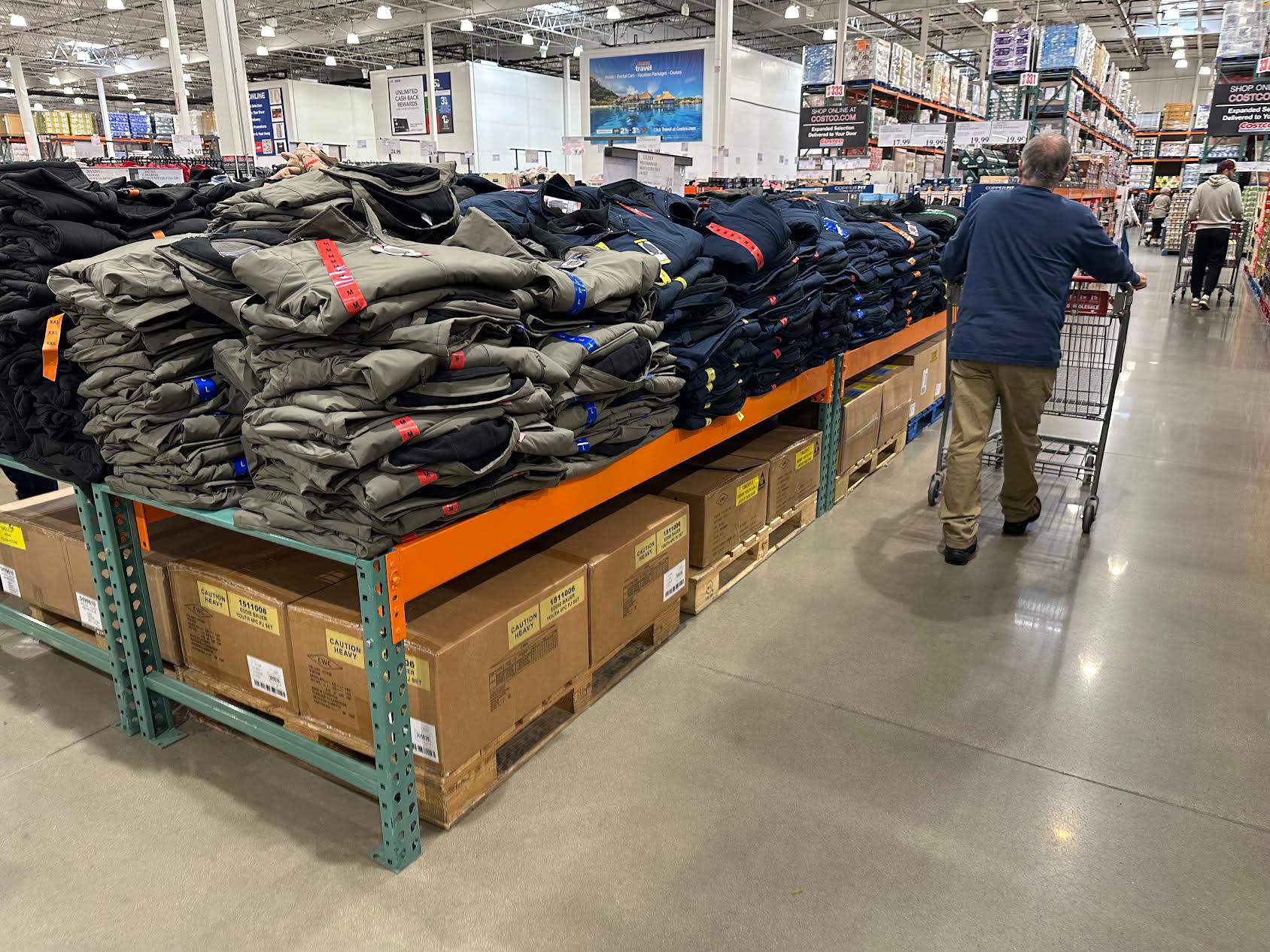
Costco Wholesale generates hundreds of billions of dollars in annual revenue inside concrete-floored warehouses devoid of a single note of ambient music. Conventional retail doctrine treats background audio as a mandatory tool for mood manipulation, dwell-time extension, and brand signaling. Costco rejects this orthodoxy entirely because its business model relies on membership fee economics, extreme SKU rationalization, and operational velocity rather than atmospheric persuasion. Eliminating audio reduces capital expenditure, removes recurring licensing liabilities, improves floor-level safety in a live logistics environment, and aligns the sensory environment with a treasure-hunt merchandising strategy.
The Unit Economics of Sensory Subtraction
Traditional supermarkets and department stores operate on a margin-extraction model. They pay for commercial audio infrastructure and licensing fees because their gross margins—often ranging between 25% and 40%—justify incremental spending on psychological nudges that encourage impulse browsing. Costco operates under a fundamentally different economic constraint. The company caps its product markups, deriving the vast majority of its net operating income from annual membership fees rather than retail margin on goods sold.
When a retailer operates on razor-thin merchandise margins, every non-revenue-generating expense must be scrutinized against its direct contribution to operational throughput. Background music fails this test across three distinct cost centers:
- Capital Expenditure and Maintenance: Outfitting an average 146,000-square-foot warehouse with commercial-grade speakers, amplifiers, and zoning controls requires substantial upfront hardware investment. Concrete ceilings, exposed steel trusses, and towering pallet racks create severe acoustic reflection and dead zones. Achieving uniform sound dispersion across a warehouse floor demands significantly more hardware than a standard drop-ceiling grocery store, inflating installation and ongoing maintenance costs across hundreds of global locations.
- Intellectual Property and Performance Royalties: Playing copyrighted music in a commercial space is legally classified as a public performance. Retailers must pay recurring licensing fees to Performance Rights Organizations (PROs) such as ASCAP, BMI, SESAC, and GMR, or contract with commercial B2B audio providers like Mood Media. While a few thousand dollars per warehouse annually appears negligible in isolation, scaling that recurring liability across nearly 900 warehouses creates a permanent multi-million-dollar drag on Selling, General, and Administrative (SG&A) expenses.
- Zero Proven Elasticity on Bulk Basket Size: In traditional retail, slow-tempo music has been shown in foundational consumer behavior studies—such as Ronald Milliman’s 1982 supermarket research—to reduce walking speed and increase gross sales volume. However, those findings apply to environments where shoppers browse thousands of high-margin, discretionary items. Costco members enter with high purchase intent, oversized flatbed carts, and a focus on bulk replenishment. Slowing down foot traffic in a high-volume warehouse does not increase basket size; it creates aisle congestion and lowers register throughput.
Acoustic Physics and Warehouse Safety Mechanics
A Costco warehouse is not a traditional retail store; it is an active distribution center that permits public entry. Forklifts, electric pallet jacks, and scissor lifts operate continuously during business hours to replenish high-velocity inventory from steel racking that reaches up to 20 feet high. In this hybrid industrial-retail environment, sound is a critical safety instrument rather than an aesthetic layer.
Concrete floors and metal shelving generate a high ambient noise floor. Cart wheels clattering over expansion joints, refrigeration compressors humming, and HVAC systems cycling already create baseline acoustic clutter. Introducing background music into a high-reverberation space compounds the signal-to-noise problem.
When ambient audio is added to a reflective environment, two dangerous operational bottlenecks emerge:
- Auditory Masking of Equipment Alerts: Forklifts rely on backup alarms, horns, and the physical sound of electric motors to alert pedestrians of their movement. Music occupies the exact mid-range frequencies (500 Hz to 4,000 Hz) where human speech and industrial warning horns sit. Masking these frequencies forces forklift spotters to shout louder and increases the reaction time of distracted shoppers stepping out from behind towering pallet displays.
- Communication Degradation Among Floor Staff: Warehouse associates rely on walkie-talkies, headsets, and direct vocal communication to coordinate restocking, manage front-end register lines, and respond to spills or safety hazards. Removing background music preserves vocal intelligibility across the floor, reducing operational errors and accelerating cross-warehouse coordination.
Behavioral Psychology of the Treasure Hunt Model
Conventional retail uses music to mask silence and soothe consumer anxiety about spending money. Costco uses sensory austerity to reinforce its core value proposition: institutional efficiency and wholesale pricing.
Shoppers evaluate price fairness through environmental cues. Polished terrazzo floors, warm spotlighting, and curated indie playlists signal high overhead, subconsciously priming consumers to accept higher retail markups. Bare concrete, fluorescent high-bay lighting, and acoustic silence signal that the retailer is stripping out every unnecessary cost to pass savings directly to the member. The absence of music functions as a continuous, non-verbal confirmation of Costco's low-margin promise.
This auditory vacuum also alters how shoppers interact with Costco’s merchandising architecture:
- Heightened Cognitive Alertness: Slow ambient music induces a passive, relaxed state suited for leisurely browsing. Costco’s "treasure hunt" model—where high-end luxury goods, seasonal electronics, and limited-time apparel appear unexpectedly alongside bulk paper towels—requires active visual scanning. Without music lulling the shopper into a trance, cognitive alertness remains elevated, increasing the likelihood that members notice end-cap markdowns and unadvertised pallet drops.
- Acoustic Focus at Point-of-Sale Demos: Costco relies heavily on live product demonstrations conducted by third-party vendors (such as Club Demonstration Services). These sampling stations are miniature sales pitches embedded directly in the aisles. Without overhead music competing for auditory attention, demonstrators can engage shoppers at normal conversational volume, directly boosting conversion rates on featured food and beverage SKUs.
Workforce Ergonomics and Cognitive Load
Retail turnover represents a massive hidden cost in brick-and-mortar operations. Costco famously maintains one of the lowest employee turnover rates in the retail sector through high wages and benefits, but environmental ergonomics also play a measurable role in associate retention and productivity.
In standard retail environments, background music loops endlessly over 8-hour shifts. During peak retail periods—such as the six-week holiday stretch between November and December—repetitive playlists become a documented source of psychological fatigue and auditory irritation for cashiers and floor staff. When workers experience chronic auditory annoyance, error rates at the register rise and customer service patience declines.
By eliminating overhead audio, Costco removes a persistent low-grade stressor from the workday. Cashiers scanning hundreds of items per hour can hear the scanner beeps clearly without straining, reducing double-scans and missed bottom-of-basket (BOB) items. Front-end supervisors can manage lane traffic verbally without competing against an overhead PA system.
The Structural Trade-Offs of Acoustic Austerity
Eliminating music is not without operational compromises. Every retail design choice creates friction elsewhere in the system, and Costco’s silent warehouse model introduces three distinct vulnerabilities that must be managed through other operational mechanisms:
- Exposure of Mechanical Noise: Without music to act as acoustic camouflage, every harsh industrial sound is amplified. Squeaky cart wheels, dropping pallets, and loud conversations carry across multiple aisles. Costco mitigates this through rigorous preventive maintenance on rolling stock and strict protocols restricting heavy forklift movement during peak weekend hours.
- Reduced Emotional Warmth for Discretionary Categories: Music excels at creating emotional resonance for lifestyle categories like apparel, home decor, and wine. In a silent, brightly lit warehouse, a rack of cashmere sweaters or a pallet of high-end Bordeaux lacks the atmospheric framing found in specialty boutiques. Costco compensates by anchoring these discretionary items with aggressive unit-price comparisons and prominent brand recognition rather than mood-based merchandising.
- Heightened Perception of Crowd Density: During peak Saturday afternoon rushes, the sound of hundreds of shoppers talking and rolling heavy carts creates a chaotic wall of white noise. Without a rhythmic musical beat to organize the auditory space, high-volume periods can feel overwhelmingly loud, driving rush-averse members to shift their shopping to off-peak weekday hours or e-commerce channels.
Strategic Application for Multi-Location Operators
Operators managing high-volume retail, grocery, or hybrid warehouse formats should evaluate their audio strategy not as a branding exercise, but as an operational variable tied directly to gross margin and floor safety.
If your business model depends on gross margins exceeding 30%, slow-moving discretionary inventory, and high impulse conversion, invested audio infrastructure remains a valid lever to extend dwell time and mask store quietness. However, if your operation relies on high inventory velocity, narrow margins, heavy floor equipment, or price-driven value perception, background music actively degrades unit economics. Strip the audio infrastructure out, reallocate the licensing budget toward front-end throughput or preventive equipment maintenance, and allow the physical austerity of the space to validate your pricing model.


