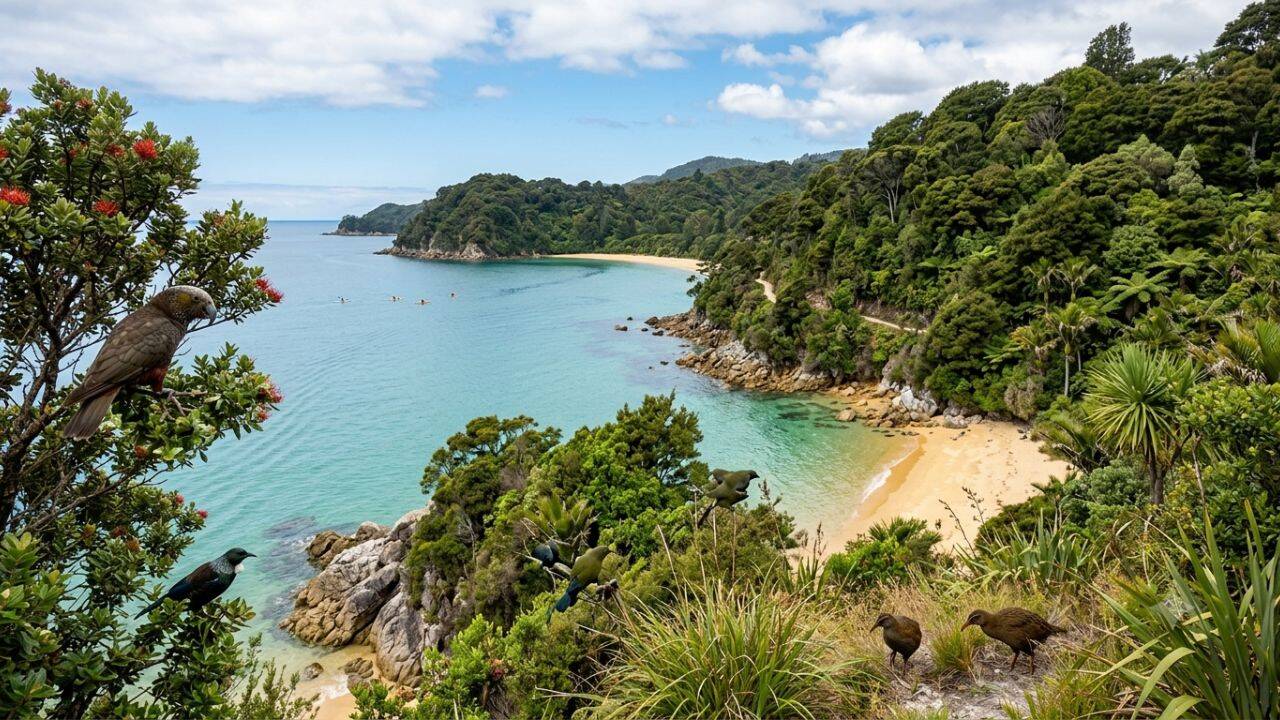
For fourteen years, New Zealand’s Abel Tasman National Park served as an intensive care unit for a dying ecosystem.
Quietness used to define the coastal park. Visitors walked beneath golden-sand beaches and thick canopies while noticing an eerie absence of sound. The air lacked the chaotic, deafening chorus of native birds. Stoats hunted unchecked. Invasive weeds choked out native flora. Wilding conifers marched across the ridgelines like an invading army.
Then came Project Janszoon. Backed by millions in private philanthropic funding from conservationists Annette and Russell Plowman alongside the Department of Conservation, this initiative refused to treat minor symptoms. It attacked the entire park as an interconnected organism.
Now, the results are undeniable. Kākā glide along the coastlines. Rare carnivorous land snails thrive inside heavily monitored sanctuaries. Blue ducks, known locally as whio, navigate the waterways once more.
Yet beneath the triumphant headlines of a restored paradise, a harder question remains. Can private philanthropy save nature permanently, or does it merely buy time before the machinery of extinction resumes its work?
The Anatomy of a Private Rescue
Traditional state-funded conservation operates on political cycles and short-term budgets. Bureaucracies fight brushfires. They react to crisis points rather than designing macro-level overhauls.
Project Janszoon changed the template. Launched in 2012, it introduced corporate-style rigor and long-term capital into the wild. Pouring over twenty-one million dollars into the region, the initiative bypassed standard government delays. It treated pest eradication like an engineering problem.
The strategy required absolute ruthlessness against introduced predators. Thousands of stoats, rats, and possums were hunted using sophisticated trapping grids. Volunteers and paid contractors cleared out the "Filthy 14," a collection of aggressive weed species that had escaped from private coastal bach gardens.
Without this sustained violence against invasive species, native recovery remains impossible. A forest cannot regrow if every seed is eaten and every nest is raided.
The Quiet Cost of Human Habitation
Conservation inside a popular national park creates friction. Tourists love the beaches. Property owners love their coastal retreats.
Yet private landholdings and high visitor volumes introduce constant ecological pressure. Garden plants jump boundaries. Uncontrolled domestic pets threaten ground-dwelling birds like the endangered pāteke.
Reconciling human recreation with strict ecological restoration requires uncomfortable compromises. Local iwi trusts, including Ngāti Rārua, Ngāti Tama, and Te Ātiawa, stepped forward to assert stewardship, grounding the physical work in indigenous history and long-term accountability.
The transition proved that clearing pests is only half the battle. Cultural ownership matters just as much as traps and poison lines. When local communities take pride in the noise of returning birdsong, protection shifts from an external mandate to an internal value.
The Danger of the Exit Strategy
After fourteen years of heavy lifting, Project Janszoon has formally wound down its direct operational control, handing the keys back to the state and local partners under an agreement known as the Tomorrow Accord.
This transition exposes the underlying vulnerability of modern conservation models. Philanthropy can spark a renaissance, but it cannot run forever.
If state funding stagnates, or if volunteer fatigue sets in, the gains made over a decade and a half can evaporate in a fraction of that time. Invasive species possess no sense of exhaustion. Stoats do not take breaks. Gorse and wilding pines wait patiently for human oversight to slip.
The success in Abel Tasman proves that ecological restoration is possible on a landscape scale. At the same time, it serves as a warning. Saving a park requires a permanent state of vigilance. The moment society decides the job is finished, nature begins to slip backward into silence.