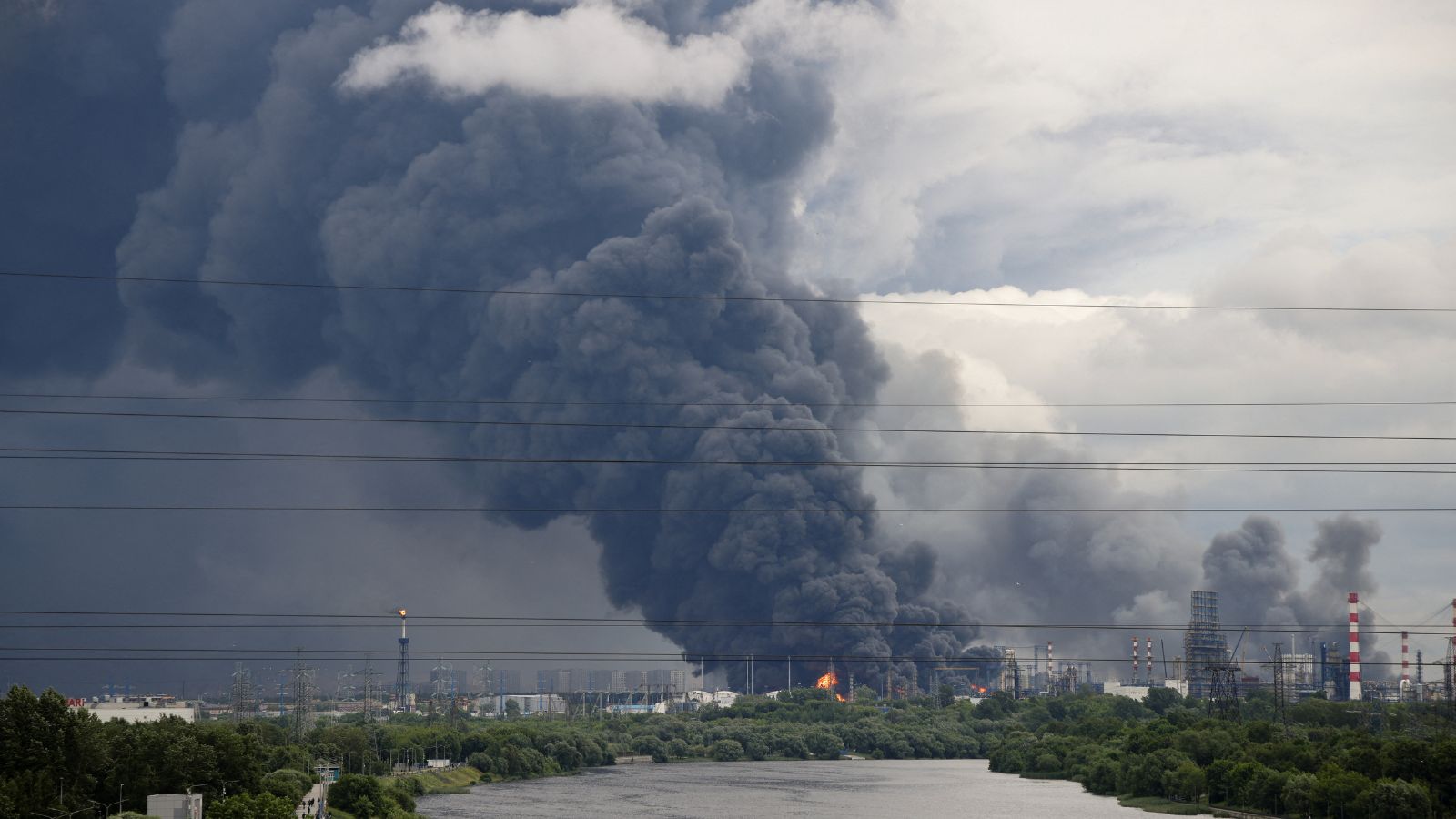
The mainstream media loves a big number. When Moscow claims it downed 660 Ukrainian drones in a single night, the headlines practically write themselves. The narrative is always the same: a terrifying escalation, a historic aerial assault, a massive blow to critical infrastructure like chemical plants.
It is a neat, dramatic story. It is also entirely wrong.
Looking at raw numbers to measure military efficacy is like counting clicks to measure profitability. It misses the mechanics of modern attrition. The lazy consensus screams about unprecedented scale. The operational reality tells a completely different story. This is not a demonstration of overwhelming strategic power. It is a masterclass in the diminishing returns of cheap hardware.
The Flawed Math of the Cheap Drone Myth
For the past two years, defense analysts have pushed the idea that ultra-cheap, asymmetrical drone warfare has permanently broken traditional defense economics. The argument goes like this: if a $5,000 drone forces an adversary to fire a $1 million air defense missile, the drone wins the economic war.
This logic is comforting. It is simple. And it completely falls apart under scrutiny when applied to mass raids.
When you launch hundreds of long-range, low-slow loitering munitions in a single wave, you are not exploiting a flaw in air defense. You are solving their biggest problem: targeting efficiency.
Large-scale salvos create high-density tracking environments. Modern integrated air defense systems (IADS) rely on automated command and control networks. They do not get tired. They do not panic when the screen lights up. Systems like the Pantsir-S1, Tor-M2, or localized electronic warfare (EW) networks operate with peak efficiency when targets are saturated in predictable flight corridors.
Mass Salvo -> High Target Density -> Optimized EW/Kinetic Response -> Low Attrition Efficiency
I have analyzed defense logistics budgets where planners assumed linear scaling for drone swarms. It never works that way in the field. When you fly 660 drones into a heavily defended airspace, you are not executing 660 individual precision strikes. You are creating a giant, slow-moving cloud of metal and radio signals that practically begs to be jammed, spoofed, or shot down by cheap anti-aircraft guns.
The Myth of the Successful Hit
But what about the chemical plant? The reports highlight a strike on an industrial facility as proof of the raid's success.
This is standard battle damage assessment error. In a mass raid, hitting a sprawling industrial site does not mean the mission succeeded. If you launch hundreds of assets and a single-digit percentage penetrates the perimeter to cause superficial damage to a non-critical storage tank, that is an operational failure disguised as a headline.
Industrial facilities are massive, static targets. If you throw enough unguided or pre-programmed objects into the sky, some of them will inevitably crash into something large and flammable. Concluding that a raid was effective because a factory caught fire is like saying a blindfolded dart thrower is an expert marksman because they eventually hit the wall.
Why Air Defense Numbers Are Padded on Both Sides
We need to talk about the 660 figure itself.
In electronic warfare, things are rarely what they seem on a radar screen. Military planners have used decoys since the dawn of radar, but the scale of modern digital deception has reached absurd levels.
Imagine a scenario where a drone swarm approaches a defensive line. Fifty of those drones are actual strike platforms carrying payload. Another fifty are cheap, unarmed decoys designed to look identical on radar. The remaining 560 "drones" do not even exist physically. They are digital ghosts generated by airborne electronic warfare transmitters or ground-based spoofing stations.
To a radar operator, and to the automated logging software of a defense network, the screen shows 660 incoming hostile tracks. When the electronic warfare units activate their directional jammers, those digital tracks vanish.
The defense ministry then proudly announces: 660 drones neutralized.
The attacker wins a public relations victory by claiming an assault of historic proportions. The defender wins a public relations victory by claiming near-perfect interception rates. The public receives a piece of fiction masquerading as military reporting.
The Actual Cost of Attrition
To understand why this matters, we have to look at the real bottleneck in modern warfare: industrial production capacity, not unit cost.
- The Component Bottleneck: Even cheap drones require specialized guidance chips, electric motors, and satellite navigation modules (often modified commercial gear). These supply chains are fragile and highly susceptible to sanctions and export controls.
- The Logistical Strain: Transporting, fueling, programming, and launching hundreds of physical platforms simultaneously requires a massive footprint. That footprint is vulnerable to counter-battery fire and pre-emptive strikes.
- The Operator Burnout: Coordinating mass launches requires extensive human labor and specialized technical teams. You cannot scale these teams indefinitely.
When you burn through hundreds of platforms in a single night for negligible strategic gain, you are depleting your own operational reserve faster than your adversary is depleting their interceptors. Russia and Ukraine are both trapped in this cycle, but the assumption that the attacker always holds the economic advantage is dead wrong.
The Reality of Electronic Warfare Defenses
Most intercepted drones are not brought down by expensive missiles. They are brought down by localized electronic jamming that breaks the command link or corrupts the GPS coordinate feed.
Incoming Drone GPS/GLONASS Signal -> Localized Spoofing Transmitter -> False Coordinates Injected -> Drone Crashes Safely in Open Field
Once a defensive grid establishes effective spoofing protocols for a specific frequency band, every drone utilizing that band becomes useless. It doesn't matter if you send ten or ten thousand. They will all fly into the ground or spin out of control. The cost to the defender is effectively the electricity required to run the transmitter.
The Wrong Questions Everyone Is Asking
People looking at this conflict keep asking the same flawed questions.
"How can any country defend against hundreds of drones at once?"
The premise assumes that defense requires matching every drone with a missile. It doesn't. It requires blinding the drone's guidance system. Defense scales far better than attack when the attack relies on predictable, low-tier technology.
"Does this mean traditional air forces are obsolete?"
Absolutely not. High-altitude, stealth platforms carrying heavy standoff munitions remain the only way to reliably degrade hard targets. A flock of lawnmower engines carrying small explosive charges can harass an adversary, but it cannot achieve strategic denial.
Stop looking at the big numbers posted by defense ministries. Stop assuming that a massive fireball on social media equals a shift in the balance of power. Mass drone raids are the military equivalent of spam emails: thousands are sent, almost all are filtered out by the system, and the few that get through rarely do enough damage to justify the effort.