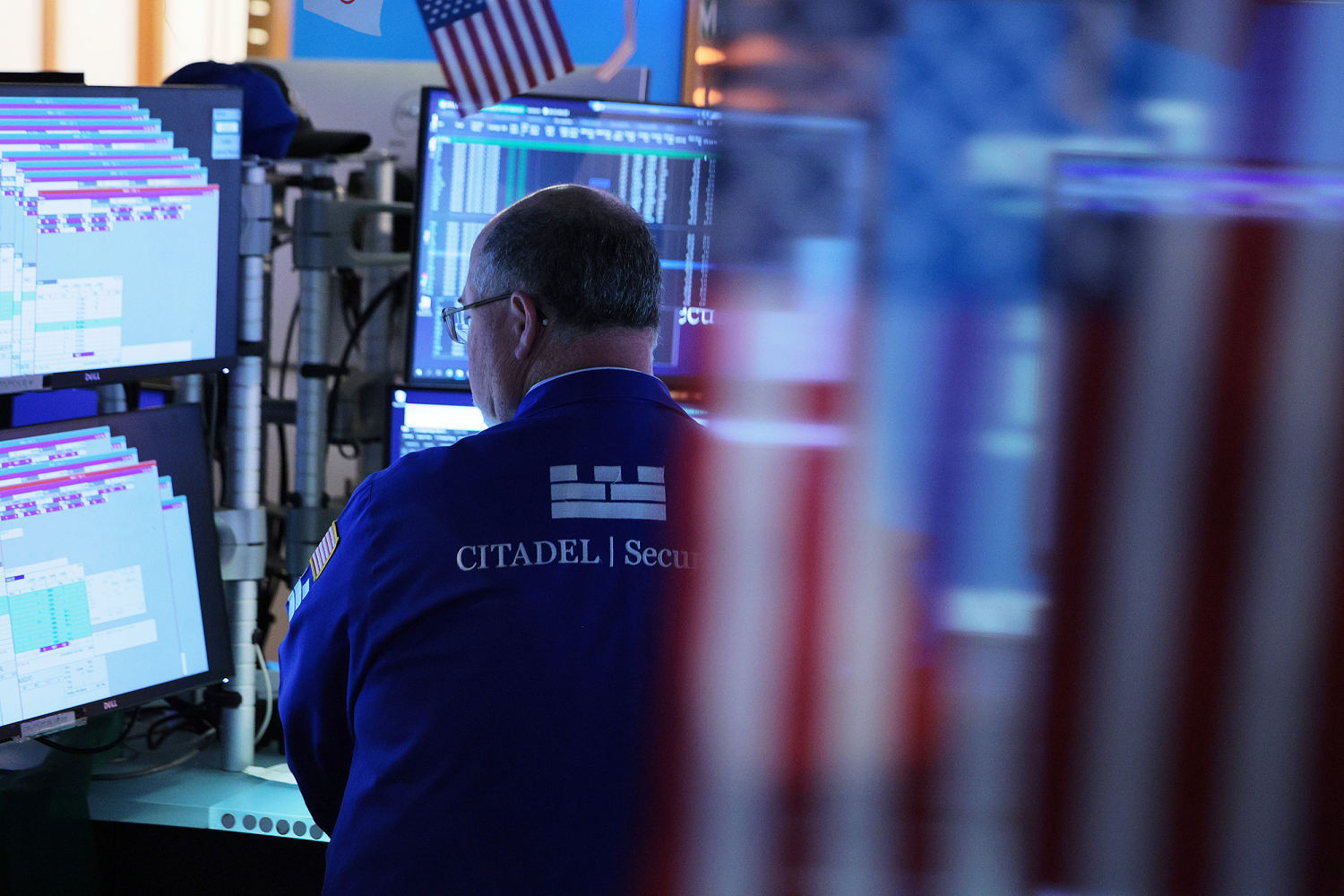
The floor of the New York Stock Exchange is no longer the cacophonous mosh pit of shouting men in colorful jackets that Hollywood once sold us. Today, it is a cathedral of glass and humming servers, a place where trillions of dollars move at the speed of light, governed by algorithms that don't sleep, don't sweat, and—most importantly—don't fear.
But on a Tuesday morning in the spring of 2026, the human element still flickered.
Consider a hypothetical trader named Elias. He sits in a midtown office, his face illuminated by the cool blue glow of six monitors. He has a wife, two daughters, and a mortgage. He also has a position in the S&P 500 that would make most people’s stomachs turn. When the news alerts began flashing crimson with reports of a massive oil infrastructure strike in the Middle East, Elias felt the familiar, cold prickle of adrenaline. Crude prices didn't just climb; they leaped. In the old world, the world of 1973 or even 2003, this was the script for a market funeral.
The logic used to be simple: high oil prices act as a tax on the world. They choke the consumer, starve the airline, and drive inflation into the stratosphere.
Elias waited for the drop. He hovered his finger over the sell button, watching the S&P 500 ticker—that pulse of the American economy—expecting a cardiac arrest. Instead, something strange happened. The line moved up. Then it moved up again. By noon, the index hadn't just recovered; it had punched through its previous ceiling to hit an all-time high.
The market looked at the threat of a global energy crisis and shrugged.
The Ghost in the Spreadsheet
To understand why the world didn't end, we have to look at the invisible architecture of the modern economy. We are no longer the same creature that panicked during the oil embargoes of the 20th century. The S&P 500 is a different beast now.
In 1980, the index was heavily weighted toward manufacturing and industrial giants—companies that breathed oil and exhaled smoke. Today, the titans of the index are companies like Apple, Microsoft, and Nvidia. These are businesses built on bits, not barrels. When the price of Brent Crude spikes, it doesn't fundamentally change how many people subscribe to a cloud service or how many developers buy AI chips to train the next generation of neural networks.
We have decoupled the "idea economy" from the "heavy economy." This creates a strange, almost eerie resilience. It is as if the stock market has moved into a high-rise penthouse, far above the flooded streets where the cost of a gallon of gas determines whether a family eats out or stays home.
But there is a deeper, more cynical reason for the record high. Investors have developed a psychological scar tissue. After a decade of pandemics, political upheavals, and regional wars, the "shock" value of a headline has diminished. We are living in the era of the Permanent Crisis. When everything is an emergency, nothing is.
The Calculus of Indifference
Let’s go back to Elias. He didn't click sell. He watched the data stream in and realized that the "War Premium" on oil was being offset by a massive, tidal wave of corporate earnings.
The machines that run the market—the high-frequency trading algorithms—don't read the news with emotion. They parse keywords. They saw "Oil Spike," but they also saw "Record Tech Guidance" and "Labor Market Resilience." To an algorithm, a war is just a variable in a complex equation. If the other variables are strong enough, the war is ignored.
This leads to a profound disconnect between the "Market" and the "World."
For the person driving a delivery truck in Ohio, the oil spike is a disaster. It is a direct hit to their take-home pay. But for the S&P 500, that driver’s pain is a rounding error. The index is a reflection of the top 500 companies, most of which have the pricing power to pass costs onto the consumer or the cash reserves to weather a storm.
We are witnessing the birth of a bulletproof market, but one that is increasingly detached from the human experience of the economy. The numbers on the screen are hitting records because they represent a global elite of corporations that have learned how to thrive in chaos. They are the houses that don't burn when the forest is on fire.
The Myth of the Rational Investor
There is a persistent lie that the market is a rational machine. We want to believe that if the S&P 500 is at an all-time high, it means things are "good."
It doesn't.
It means that capital has nowhere else to go. In a world of high inflation and geopolitical instability, cash is trash. Gold is heavy. Real estate is illiquid. So, the money flows into the only place it can: the 500 largest engines of American capitalism. This creates a feedback loop. The more the market ignores bad news, the more investors feel safe putting their money in, which drives the price higher, which makes the market look even more invincible.
It is a skyscraper built on a fault line. The higher it goes, the more impressive the view, but the more terrifying the potential for a tremor.
Elias eventually leaned back in his chair. He didn't feel like a master of the universe. He felt like a passenger on a plane that was flying through a hurricane without a pilot, yet somehow staying perfectly level. He looked at the charts. The green lines were defiant. They were a middle finger to the chaos of the Middle East and the anxieties of the average worker.
This resilience is a marvel of modern finance, but it comes with a cost. When the market stops reacting to the world, it stops being a signal. It becomes a closed loop. We are watching a record-breaking performance in an empty theater, where the actors are shouting lines to an audience of ghosts.
The oil will continue to flow, or it won't. The prices will climb, or they will stabilize. But the machines have made their decision. They have decided that the world can burn, as long as the servers keep humming and the margins stay fat.
Elias closed his laptop and walked to the window. Below him, the streets were jammed with cars, thousands of people burning expensive fuel to get to jobs that paid for the fuel. They were the ones living in the reality of the oil spike. Up here, in the digital ether of the S&P 500, the sun was shining, the sky was clear, and the numbers were higher than they had ever been in the history of man.
The silence of the machines is the loudest sound in the world.