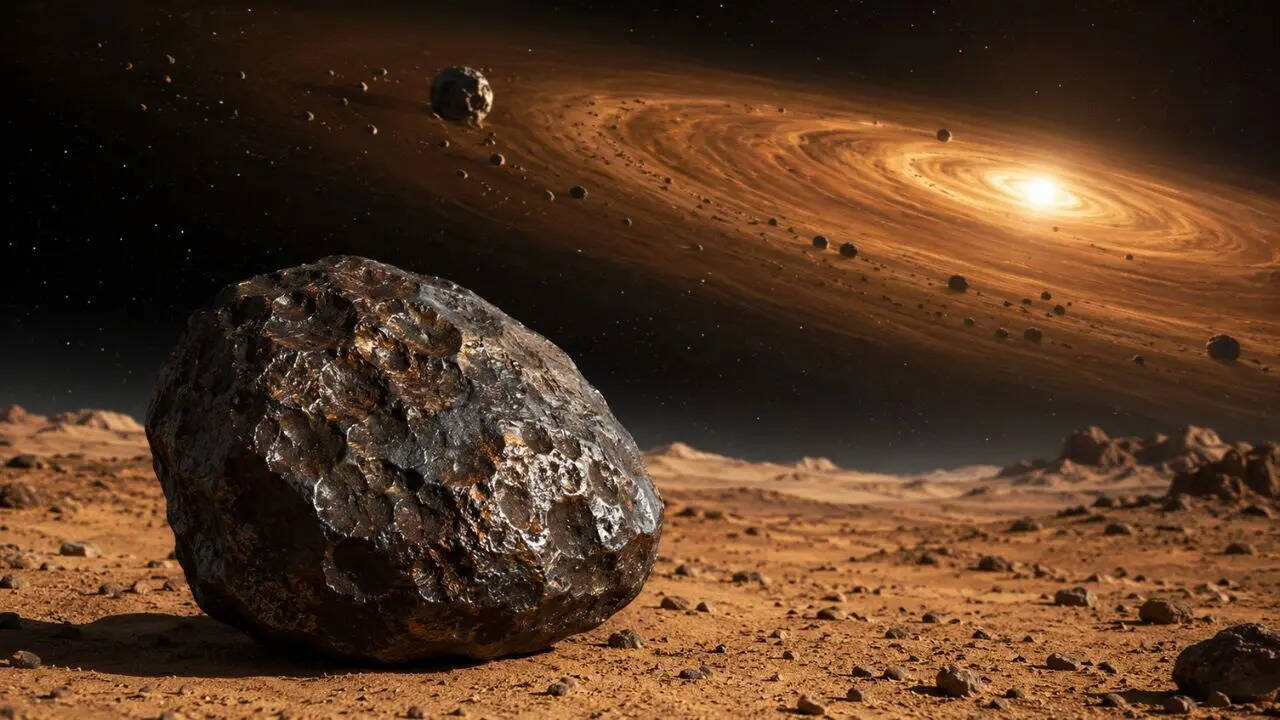
In 2020, meteorite hunters found a strange, greenish rock in the Erg Chech region of the Sahara Desert. It didn't look like the usual space rocks scattered across the sand. It looked volcanic.
Scientists quickly realized they were holding a piece of Erg Chech 002, a 4.5-billion-year-old Sahara meteorite that predates Earth itself. This chunk of rock is not just old. It is an artifact from a lost world, offering the first tangible clue to a vanished planet that existed when our solar system was just a chaotic swirl of dust and gas.
Most meteorites found on Earth come from chondrites, which are basically chunks of compacted space dust. Erg Chech 002 is different. It is an achondrite, a rock formed from molten lava that cooled and solidified on the crust of a distinct, massive space body.
By analyzing its chemical signature, geochemists confirmed that this meteorite did not break off from an asteroid. It came from a protoplanet. That planet is gone, swallowed up or destroyed during the violent game of cosmic billiards that shaped our modern solar system.
The Lost Protoplanet We Never Knew Existed
Early solar system models assume that dozens of baby planets, or protoplanets, started forming within the first few million years of our sun's life. Most of these bodies collided, broke apart, or were pulled into the sun. Erg Chech 002 is a literal piece of one of those casualties.
Researchers led by Jean-Alix Barrat at the University of Western Brittany analyzed the rock and published their findings in the Proceedings of the National Academy of Sciences. They discovered that the rock is an andesite, a type of volcanic rock rich in silica, sodium, and potassium. On Earth, andesite forms in subduction zones where tectonic plates collide. Finding it in a pristine, ancient meteorite is incredibly rare.
Most rocky meteorites from that era are basaltic, meaning they came from thin crusts that cooled quickly. The high silica content in Erg Chech 002 proves that its parent body had a complex, differentiated crust. It had a mantle and a core. It was a real planet in the making.
The data shows this rock crystallized roughly 4.565 billion years ago. Think about that timeframe. Earth did not even exist as a solid planet yet. This meteorite was already cooling into rock while our own world was still a molten mass of magma.
Why the Aligned Data Dismantles Old Space Models
For decades, planetary scientists assumed that the crusts of early protoplanets were universally basaltic, much like the ocean floors of Earth or the surface of Mars. Erg Chech 002 completely flips that assumption.
The presence of andesite proves that crustal melting in the early solar system was far more diverse than previously thought. If one protoplanet could develop a silica-rich crust, others certainly did.
So, where did they all go?
They were obliterated. The early solar system was crowded and unstable. Gravity from giant gas planets like Jupiter acted like a cosmic blender, pulling smaller worlds out of stable orbits and forcing them into catastrophic collisions. The parent body of Erg Chech 002 was likely smashed to bits during this violent epoch, its crust ground into dust and scattered across space.
A few fragments found their way into the asteroid belt, surviving for billions of years before a random gravitational nudge sent one particular piece hurtling toward Africa.
Decoding the Radioactive Footprint of Erg Chech 002
We know the exact age of this meteorite because of aluminum-26, a radioactive isotope that was abundant when the solar system formed. This isotope decays quickly, acting as a highly precise clock for early space history.
A 2023 study published in Nature Communications by researchers at the Australian National University looked closely at the lead and uranium isotopes in the meteorite. They found that aluminum-26 was distributed unevenly in the early solar nebula. This contradicts the old theory that the cloud of dust surrounding the young sun was perfectly mixed.
- Aluminum-26 distribution: The uneven spread means different pockets of the early solar system heated up at different rates.
- Melting timelines: Some protoplanets melted and formed crusts much earlier than previously simulated, depending on how much radioactive material they scooped up.
- The disappearing act: The high concentration of aluminum-26 in certain areas caused small worlds to melt entirely from the inside out, making them structurally weak and prone to shattering upon impact.
This isotopic fingerprint shows that the environment creating our solar system was highly volatile and localized. One corner could be a calm nursery, while another was a radioactive furnace destroying proto-worlds before they could fully mature.
The Discomforting Truth About Earth's Origins
Looking at Erg Chech 002 forces us to face a weird reality. Our planet built itself out of the wreckage of these lost worlds.
Every time a protoplanet smashed into pieces, those pieces didn't just vanish. They became the building blocks for the next generation of planets. Earth, Mars, and Venus grew by sweeping up the debris of the destroyed worlds that came before them.
You can think of Erg Chech 002 as a stray brick from a building that was torn down to build a skyscraper. By examining the brick, we can finally understand the architecture of the original structure.
The composition of this 4.5-billion-year-old Sahara meteorite reveals that the raw materials that formed Earth were already processed through the volcanic systems of older, forgotten planets. We are living on a recycled world.
How to Track and Verify Meteorite Discoveries Yourself
Most people think planetary science happens exclusively behind the closed doors of elite universities, but space rock research relies heavily on public databases and independent collectors. If you want to dive deeper into the data behind Erg Chech 002 or track similar discoveries, you don't need a PhD.
Start by bookmarking the Meteoritical Bulletin Database, maintained by the Meteoritical Society. This is the official global registry where every verified meteorite is logged. You can search for "Erg Chech 002" to view its official classification, exact coordinates of discovery, and total known mass.
If you want to view scientific breakdowns of isotopic data, the NASA Astrophysics Data System (ADS) provides free access to peer-reviewed abstracts and papers regarding planetary crust formation. Tracking the ongoing analysis of these rocks gives you a direct look at how planetary science evolves in real-time, long before it hits mainstream textbook chapters.