The air inside the terminal at Heathrow always smells faintly of jet fuel, damp wool, and expensive coffee. For David, a logistics manager who has spent two decades watching cargo containers swing beneath the gray skies of British ports, that smell is the scent of survival. He knows the precise weight of friction. He knows how a single delayed rubber stamp in a foreign port can rot a shipment of Scottish salmon or stall a assembly line in the Midlands.
For years, David and thousands like him have watched the traditional routes of British commerce stutter. Brexit reconfigured the map. Global supply chains fractured.
But thousands of miles away, across a stretch of water where the desert meets a turquoise sea, a different kind of energy has been building.
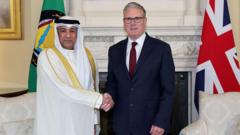
Politicians call it a macroeconomic milestone. The newspapers headline it as a £3.7 billion triumph. The UK has signed a sweeping free trade agreement with the Gulf Cooperation Council—encompassing Bahrain, Kuwait, Oman, Qatar, Saudi Arabia, and the United Arab Emirates.
To the bureaucrats in Whitehall, it is a spreadsheet victory. To the people whose sweat moves the global economy, it is something entirely different. It is a lifeline, a gamble, and a massive shifting of the geopolitical tectonic plates.
The Friction of Distance
To understand why this matters, you have to look past the glitz of Dubai’s skyline and the sterile press rooms of London. You have to look at the barriers that quietly suffocate businesses every single day.
Imagine a small engineering firm in Yorkshire. Let's call the founder Sarah. She manufactures specialized water-purification valves. Her product is world-class, but until recently, selling to a major infrastructure project in Riyadh meant navigating a labyrinth of duplicate certifications, unpredictable tariffs, and local sponsorship laws that felt like tax code written in sand. A tariff is not just a percentage; it is a wall. It is the reason Sarah had to tell her ten employees that they couldn't expand their workshop last year.
The new deal systematically begins to dismantle those walls. By slashing tariffs on British exports, the agreement removes the artificial weight that made UK goods heavier than their continental rivals.
Food and drink exporters, advanced manufacturing firms, and renewable energy consultants suddenly find themselves standing on a level playing field. The immediate benefit isn't just a number with nine zeros at the end. It is the sudden, breath-catching realization for people like Sarah that their market just expanded by millions of affluent consumers.
Beyond the Oil Barrel
There is a common misconception that dealing with the Gulf is solely about oil and Lamborghinis. That view is dangerously outdated.
Walk through the financial districts of Manama or Doha. The conversation isn't about extraction; it is about transition. These nations are sitting on vast oceans of capital, and they are acutely aware that the era of fossil fuels has a sunset date. They are buying the future.
They want artificial intelligence. They want green technology. They want legal expertise, financial architecture, and world-class higher education. These are the exact sectors where the UK, despite its recent domestic turbulence, still possesses an undeniable, historic edge.
Consider the flow of invisible goods. A British architectural firm designing a solar-powered city in the Saudi desert does not ship crates through a port. Their export is ideas, code, and blueprints.
Before this agreement, legal protections for intellectual property and digital data in cross-border services were murky at best. By establishing clear, predictable rules for digital trade and professional qualifications, the deal creates a legal framework as solid as the bedrock of London’s financial district. It allows a software developer in Bristol to contract with a logistics giant in Dubai as easily as if they were down the road.
The Human Cost of a Document
Critics will rightly point out that trade deals are often long on promises and short on immediate reality. The ink on the treaty dries much faster than the culture of customs houses changes.
There is an inherent nervousness when a middle power like the UK aligns its economic vectors so closely with the Gulf. The political systems are vastly different. The social contracts are not the same.
But isolation rarely breeds influence. Commerce is a conversation. When British accountants, environmental scientists, and tech entrepreneurs imbed themselves in the growth of the Gulf, they don’t just bring products; they bring standards, transparency, and corporate governance.
The true test of this £3.7 billion pact won’t be measured by the grand statements delivered at press conferences.
It will be measured in the quiet moments. It will be the extra shift scheduled at a manufacturing plant in Wales because the order books are full for the next three winters. It will be the young tech graduate in Manchester who gets hired by a startup that just secured funding from an Emirati sovereign wealth fund. It will be the fact that David, standing on the tarmac at Heathrow, watches containers of high-value British machinery lift off into the dawn sky, bound for a region that is reinventing itself in real-time.
The desert is moving fast, and for the first time in a long time, Britain has decided to run alongside it.


