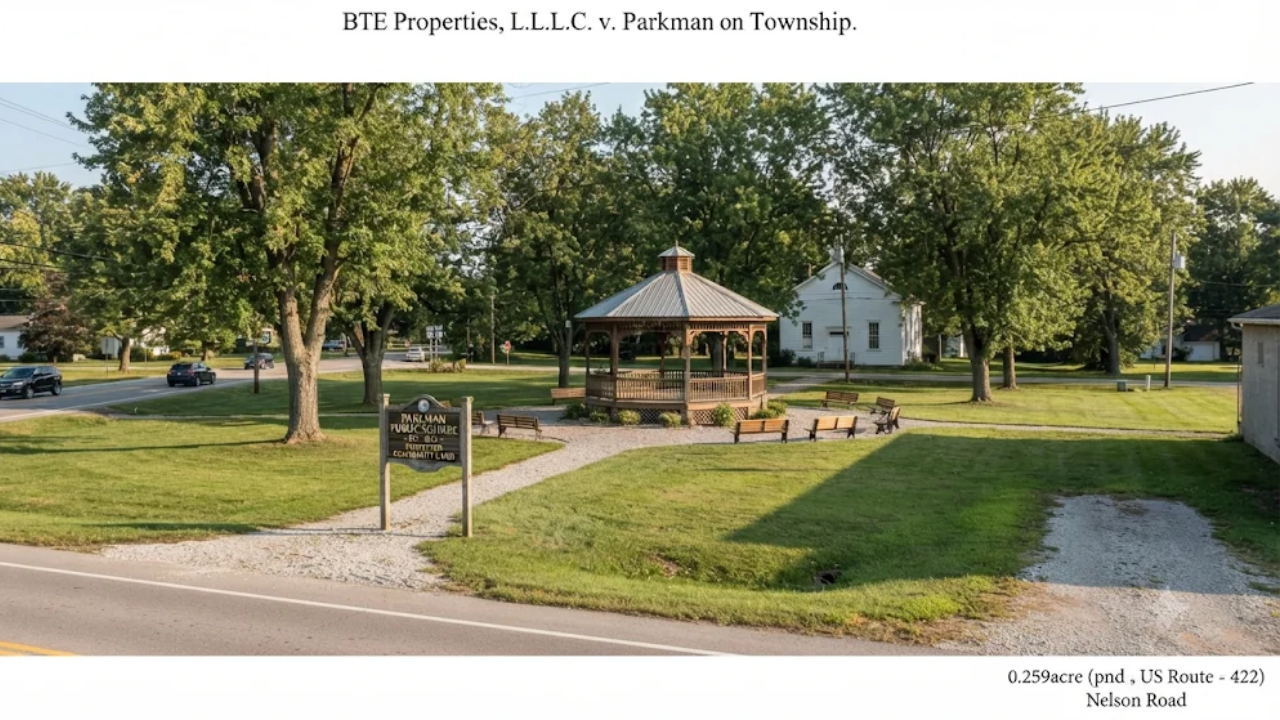
An Ohio appellate court has affirmed the enforcement of a 183-year-old deed restriction, blocking commercial real estate developers from using a historic public square as an access corridor for adjacent private construction. The ruling proves that nineteenth-century property covenants still carry absolute legal authority over modern municipal zoning and urban infill projects. While contemporary zoning boards frequently grant variances to accommodate commercial density, common-law property rights embedded in original town plats remain immune to administrative overrides. For real estate developers, title insurers, and municipal planners, the decision serves as a stark warning that historical encumbrances can permanently halt multi-million-dollar capital deployments.
Modern real estate development relies heavily on predictability. Developers acquire parcels, secure municipal rezoning, negotiate tax increment financing, and draft architectural plans under the assumption that local government approval equals a green light to build. That assumption breaks down when a project collides with restrictive covenants written before the invention of the automobile. In Ohio, as across much of the Midwest, original town founders frequently dedicated central plots of land to the public with strict, perpetual conditions attached to the conveyance. Meanwhile, you can explore related stories here: Pourquoi l'appel de Volodymyr Zelensky pour des missiles Patriot expose l'urgence de la défense aérienne ukrainienne.
The Legal Mechanics of Nineteenth-Century Plats
To understand why a 21st-century court sided with an 1840s land grant over contemporary economic development, one must examine the distinction between public zoning law and private property law. Zoning is an exercise of municipal police power. City councils can rezone a parcel from residential to commercial with a simple majority vote, altering what an owner is permitted to build.
Deed restrictions and plat dedications operate on an entirely different legal plane. They are contractual and proprietary rights attached directly to the land itself. When original proprietors platted towns in nineteenth-century Ohio, they utilized a legal mechanism known as statutory dedication or common-law dedication. By recording a plat map that designated a central parcel as a "public square" or "commons," the founders transferred the fee simple title—or at least a perpetual easement—to the local municipality in trust for a specific, limited purpose. To explore the complete picture, check out the recent article by The New York Times.
A city council cannot simply vote to undo the terms of that trust. Under Ohio property law, a municipality holds dedicated public square land as a fiduciary trustee for the benefit of the public and the adjoining lot owners who purchased their properties in reliance on that open space remaining intact. Converting a portion of a dedicated public square into a private driveway, delivery access road, or commercial thoroughfare constitutes a diversion from the original dedicated use.
Why Abandonment Arguments Rarely Succeed
Developers facing these historical roadblocks typically deploy a standard set of legal challenges to clear the title. The most common strategy is arguing changed conditions or abandonment. The developer contends that the surrounding neighborhood has evolved so dramatically over nearly two centuries—shifting from agrarian trading posts to dense commercial districts—that the original restriction no longer serves its intended purpose.
Courts set an exceptionally high bar for extinguishing a public dedication through changed conditions. As long as the public square continues to function as an open civic space, park, or community gathering point, the original purpose remains viable. The fact that adjacent commercial buildings desire modern vehicular access or loading zones does not invalidate the public's right to an unobstructed square.
Furthermore, Ohio courts strictly apply the doctrine that adverse possession and estoppel rarely run against the public interest in dedicated lands. Even if a municipality previously tolerated minor encroachments, such as temporary parking or informal foot traffic across the square, that tolerance does not legally erase the underlying deed restriction. When a developer attempts to formalize and expand that access to support high-intensity commercial traffic, adjoining landowners or civic preservationists gain immediate standing to sue for injunctive relief.
The Collision Between Urban Infill and Historic Preservation
The friction exposed by this Ohio ruling reflects a broader structural conflict playing out in downtown districts across the United States. Municipal leaders are desperate to revitalize aging town centers. They aggressively court private capital to redevelop underutilized buildings, construct mixed-use apartments, and attract retail tenants.
To make these urban infill projects financially viable, developers must solve modern logistical problems on footprints designed for horses and wagons. A mid-nineteenth-century commercial building did not require wide turning radii for semi-trucks, subterranean parking garage ramps, or dedicated fire lanes meeting twenty-first-century building codes. When developers assemble landlocked or narrow parcels bordering a historic town square, the square itself often looks like the only viable path for ingress and egress.
Consider a hypothetical example of how this trap springs shut during a typical redevelopment cycle. Imagine a development group acquires three contiguous, dilapidated buildings along the perimeter of a historic square. The acquisition price is $4 million, and the projected renovation budget is $12 million. The city planning commission enthusiastically approves the site plan, which routes resident parking and commercial deliveries across a fifteen-foot strip of the public square's border. Two months before groundbreaking, a neighboring property owner files a quiet title action, citing the 1843 town plat that restricts the square strictly to pedestrian promenade and civic assembly uses. Construction halts immediately. Carrying costs on the acquisition loan mount at thousands of dollars per day while the dispute winds through trial and appellate courts for three years.
In these scenarios, municipal support provides zero legal protection. City planners frequently review projects solely for compliance with the modern municipal code. They rarely conduct exhaustive historical title searches back to the founding of the county to verify whether the city actually possesses the legal authority to grant the curb cuts or access easements it just approved.
The Hidden Vulnerabilities in Title Insurance and Due Diligence
When a project gets derailed by a nineteenth-century restriction, the immediate question from investors is how the defect survived due diligence. The answer lies in standard commercial real estate practices and the limitations of title insurance.
Standard title commitments routinely list broad exceptions for matters appearing on the original town plat. During the rush to close an acquisition, acquisition teams and outside counsel frequently treat century-old plat references as boilerplate historical artifacts rather than active operational threats. Unless a surveyor specifically maps every historical easement and covenant against the proposed architectural site plan, the conflict remains invisible until a neighbor or preservation group raises an objection.
Even when a developer holds an owner's policy of title insurance, recovering losses from a blocked access plan is notoriously difficult:
- Schedule B Exceptions: Title insurers almost universally exclude coverage for restrictions, covenants, and dedications recorded in the original subdivision or town plat. If the restriction was properly recorded in 1843, it is an excluded matter of public record.
- Access Coverage Limits: Standard policies insure a general right of legal access to a public street, not a specific commercial access route across a restricted public square. If the property technically has pedestrian access or a narrow, unusable alley on another side, the insurer may argue the legal access requirement is satisfied.
- Consequential Damages: Title policies indemnify against the diminution in value of the insured land, not lost developer profits, architectural fees, or escalating interest expenses resulting from project delays.
Legislative Overrides and Marketable Title Acts
Developers often assume that Marketable Title Acts—statutes enacted in Ohio and roughly twenty other states to extinguish ancient, forgotten claims against real estate—will automatically wipe out nineteenth-century restrictions. The Ohio Marketable Title Act generally extinguishes property interests and claims predating a property's "root of title" (a recorded transaction at least forty years old).
However, statutory exceptions carve out massive loopholes that preserve historic public squares. Marketable Title Acts typically exempt:
- Easements and interests visible by physical inspection or clearly referenced in the muniments of title within the forty-year chain.
- Interests held by the state or political subdivisions, including municipal trusts over dedicated public lands.
- Specific reservations repeatedly cited by book and page number in subsequent deeds over the decades.
Because a public square is physically obvious and its status as public land is continuously recognized by the municipality, ancient plat restrictions governing that square routinely survive Marketable Title Act challenges. The legislature designed these acts to clear technical defects in private chains of title, not to hand public commons over to private developers.
Navigating Historic Core Developments Without Triggering Litigation
Real estate investors targeting historic downtowns cannot rely on municipal enthusiasm or modern zoning variances to override foundational property law. Avoiding a catastrophic court injunction requires restructuring how due diligence is conducted before earnest money goes hard.
First, legal counsel must perform a full-chain historical title examination extending back to the original sovereign patent or town plat, explicitly bypassing the standard forty-year Marketable Title Act shortcut whenever a parcel abuts a public square, park, or civic building. Second, civil engineers must overlay the original plat restrictions directly onto the ALTA/NSPS Land Title Survey, verifying that zero square footage of the proposed vehicular access, utility trenching, or staging area encroaches upon restricted public land.
Finally, if a project cannot function without crossing or utilizing a restricted public square, developers must accept that a city council vote will not secure the right. Extinguishing or modifying a dedicated public trust typically requires either the unanimous consent of all adjoining property owners who hold implied private easements over the square, or a formal judicial cy pres proceeding demonstrating that the original charitable or public purpose has become completely impossible to fulfill. Anything less leaves the entire capital stack vulnerable to a single lawsuit backed by two centuries of precedent.