The silence of a dead forest does not happen all at once. It arrives in the quiet space left behind when the Wompoo fruit dove stops calling, or when the wind no longer has leaves to rattle.
If you stood in the hinterland of Byron Bay two centuries ago, you would have been swallowed by the Big Scrub. It was the largest lowland subtropical rainforest in Australia. Seventy-five thousand hectares of ancient, muscular green. Towering red cedars, white booyongs, and massive strangler figs formed a roof thirty meters above the volcanic soil. The air was cool, thick with moisture, and heavy with the scent of deep humus. This was a direct, unbroken inheritance from the supercontinent of Gondwana. Its lineage stretched back 180 million years. Meanwhile, you can explore similar stories here: The Six Year Secret to Finding a Place That Feels Like Home.
Then came the axes.
In a terrifyingly brief window of colonial history, humans traded a prehistoric masterpiece for dairy pastures and cattle grazing. The rich basalt soil that fed the giant figs was perfect for grass. By the late twentieth century, ninety-nine percent of the Big Scrub was gone. To see the full picture, check out the excellent analysis by Vogue.
Imagine looking at a priceless, massive stained-glass window and smashing it with a hammer. That is what remained: a scattering of tiny, broken shards. Barely one percent of the forest survived, isolated in seventy pathetic fragments along roadsides, cemetery corners, and the edges of private farms. Suffocated by aggressive weeds and exposed to the searing heat of open pastures, these remnants were dying.
The tragedy of ecological collapse is that it usually feels inevitable. We watch the destruction, sigh at the statistics, and move on with our lives. But in 1993, a retired investment banker named Tony Parkes looked at those broken shards and decided to start piecing the window back together.
The Ledger of the Living World
Tony Parkes spent his first career managing millions of dollars, chairing corporate boards, and calculating risk. He understood how systems built wealth. When he and his wife, Rowena, left the corporate grind and bought a property in the Northern Rivers region of New South Wales, he applied that same sharp, analytical mind to a completely different kind of ledger.
He discovered that the local landscape was ghost-haunted by a forest that should have been there.
Planting trees is a lovely sentiment. It makes people feel good. Volunteers gather on a Saturday morning, put a few hundred saplings in the dirt, take a photo, and go home for lunch. But if you leave those saplings alone, the weeds will choke them by mid-spring. If cows break through a rusted fence, a decade of growth vanishes in an afternoon.
Tony brought the cold, relentless discipline of a merchant banker to the messy, unpredictable world of dirt and rain. He co-founded the Big Scrub Landcare Group—which later became the Big Scrub Rainforest Conservancy—and treated the recovery of a critically endangered ecosystem like a multi-decade corporate turnaround.
He didn't just ask for volunteers; he organized professional bush regenerators. He didn't just ask for donations; he built permanent funding structures like the Big Scrub Foundation. He sat in rooms with skeptical farmers, pragmatic scientists, and bureaucratic officials, speaking to each group in the language they understood. He handled the grueling paperwork of government grants with the precision of a man who used to oversee corporate mergers.
On his own property, Tony and Rowena started small, planting tens of thousands of trees across a cleared valley. They experimented with tree spacing, ground covers, and fertilizers, turning their own home into a living laboratory.
Slowly, the numbers on his spreadsheet began to transform into something beautiful.
When the Canopy Closes
There is a specific moment in rainforest restoration that feels like a miracle, though it is actually just physics and biology cooperating. It is the closing of the canopy.
For the first few years, a planted plot requires endless, backbreaking labor. You are constantly on your knees hacking away at invasive weeds, protecting vulnerable seedlings from the harsh Australian sun. But eventually, the young trees grow tall enough that their leaves touch. They form a shield. The sunlight is blocked from reaching the forest floor, starving the weeds of energy. Beneath the branches, a cool, damp microclimate forms. The soil changes. The forest begins to take care of itself.
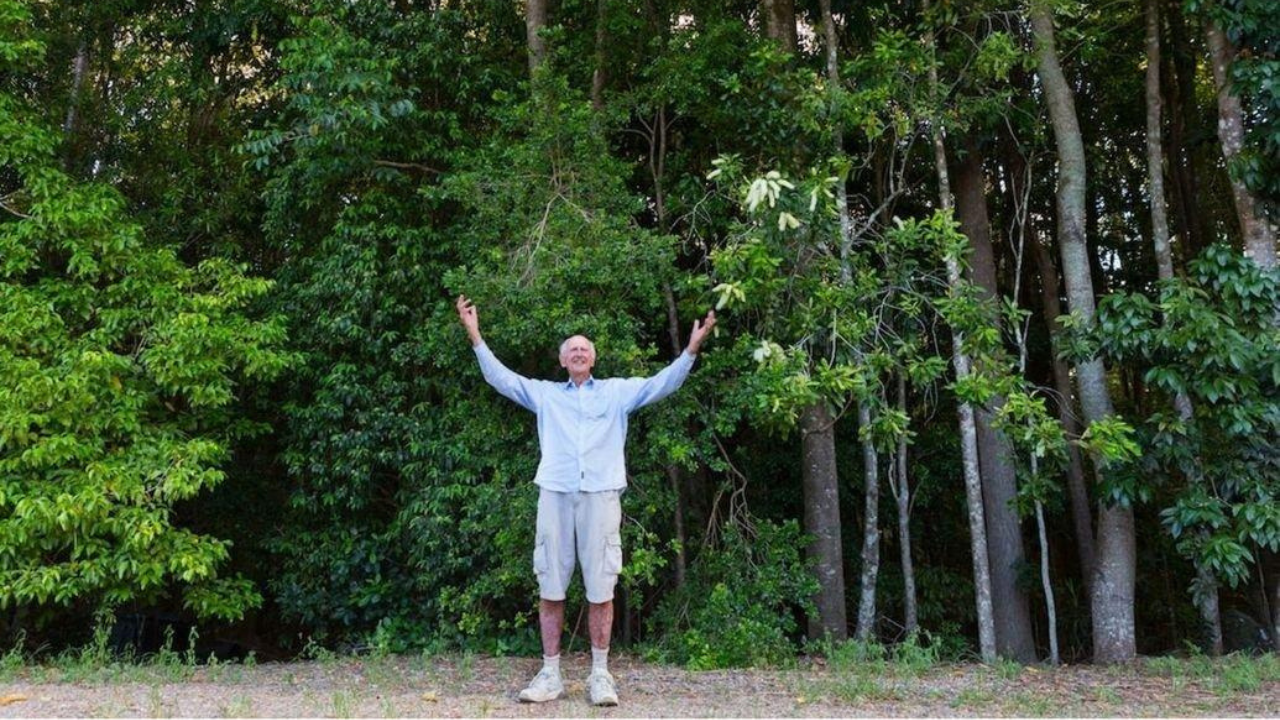
Today, Tony’s personal property features fourteen hectares of thriving, complex rainforest. He named it TARRA—an acronym using the names of his wife and children.
To walk through it is to step out of the hot, bright reality of modern agricultural Australia and into a deep, primeval peace. Emerald doves sit calmly on the path. Honeyeaters dart through the shadows. The air smells of wet earth and decay, the necessary precursors to new life.
Over the last thirty-plus years, the organization Tony built has cared for fifty distinct rainforest remnants. They have planted more than 2.5 million trees and restored roughly 700 hectares of forest. In doing so, they have essentially doubled the amount of Big Scrub left on earth.
But as the forest expanded, Tony and his team ran into a quiet, terrifying problem hidden inside the trees themselves.
The Ghost in the DNA
The issue with reducing a massive forest to tiny, isolated islands is that nature requires connection to survive.
Consider a small patch of twenty white booyong trees left on a roadside. Over decades, those trees can only reproduce with each other. The seeds they drop contain the exact same genetic code. It is an evolutionary dead end. This inbreeding makes the remaining fragments highly vulnerable to disease, insect outbreaks, and the unpredictable swings of a warming climate.
You can plant millions of trees, but if they all share the same weak genetic blueprint, a single new pathogen could wipe them out in a single season.
Tony, now in his early nineties, refused to let thirty years of calloused hands and muddy boots be undone by a flaw in the code. True to his scientific background—he holds a doctorate in organic chemistry—he helped push the conservancy into the future of conservation science.
Through a world-first initiative called the Science Saving Rainforests program, the conservancy partnered with geneticists at the Royal Botanic Gardens in Sydney. They collected and analyzed over 10,000 leaf samples from sixty different threatened tree species across the region. Using advanced DNA sequencing, scientists are mapping the genomes of these ancient trees to identify which individuals possess the most resilient and diverse genes.
The goal is brilliant and ambitious: building a living seed plantation. This plantation will produce seeds and saplings with optimal genetic diversity, specifically selected to withstand the threats of the next century. It is a literal investment fund for the future of the planet, managed not with currencies, but with chromosomes.
A Man Measured in Trees
We live in an era that worships speed. We want instant returns, rapid growth, and immediate answers. Environmental destruction happens at lightning speed; a bulldozer can clear a century-old grove in an hour.
Restoration asks for something different. It demands a quiet, stubborn humility. It requires you to look at a tiny seedling, barely a foot high, and accept that you might not be around to see it reach its full majesty.
Tony Parkes did not fix the Big Scrub by inventing a flashy new technology or delivering a viral speech. He did it by showing up, year after year, for more than three decades. He did it by looking past the cleared pastures and visualizing the ancient world that belonged there.
Nature does not care about our good intentions. It responds to structure, persistence, and time. When we remove the weeds, fix the fences, and give the earth a clean slate, the resilience of life takes over.
The Wompoo fruit dove has returned to the patches of forest Tony helped replant. It flies from one remnant to another, eating the wild fruits and dropping the seeds across the landscape, continuing a cycle that began millions of years before humans ever walked the continent. The bird is doing its job. The banker did his.
The remaining fragments of the Big Scrub are no longer just sad reminders of what we destroyed. They are anchor points for what we are bringing back.
Big Scrub Restoration - past, present and future
This video features Dr. Tony Parkes himself presenting the history of the Big Scrub Landcare group, explaining the practical challenges of rainforest regeneration and details on their innovative genetic rescue program.