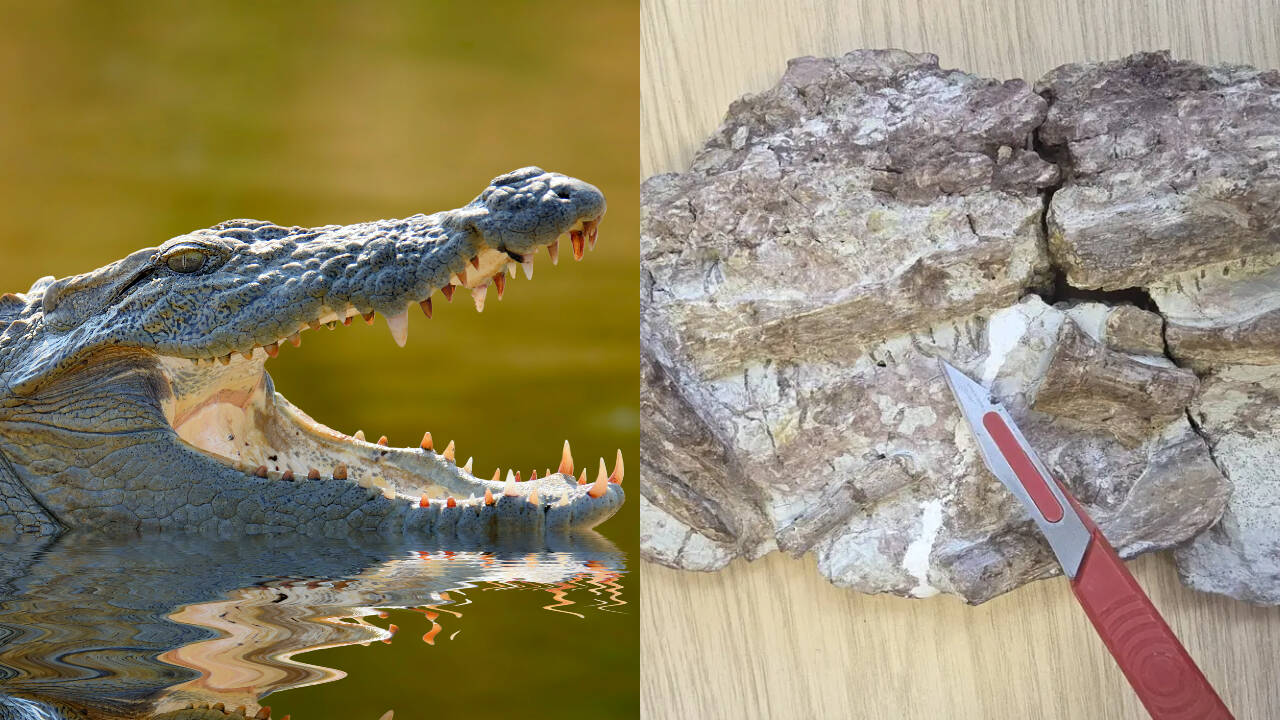
In the high-stakes world of vertebrate paleontology, the discovery of a new species is often heralded as a revolution. Most of the time, it is hyperbole. A slightly curved femur here, a fragmented vertebra there, packaged by university press offices to secure the next round of grant funding. But every once in a while, a fossil turns up that forces researchers to completely redraw the behavioral boundaries of an entire lineage.
That is precisely what happened in the red mudstone deposits of southeastern Morocco.
Buried within rocks dating back 170 million years to the Middle Jurassic, scientists have identified a new relative of ancient crocodiles that possessed a dental array unlike anything recorded in the fossil record. Formally named Ctenosuchus tenuidens, this creature breaks the mold of what we expect from prehistoric apex predators. Instead of heavy, bone-crushing jaws meant for subduing thrashing dinosaurs or large marine reptiles, this animal evolved a comb-like trap of hyper-slender teeth optimized for a life of micro-predation.
The animal belongs to the thalattosuchians, a remarkably successful group of marine and freshwater crocodile relatives that ranged widely during the age of dinosaurs. Yet, while its cousins were busy developing robust, serrated teeth to tear through heavy scales and thick flesh, Ctenosuchus tenuidens went in an entirely different evolutionary direction.
The Microscopic Clue That Changed the Story
The path to this discovery started with obscurity. The initial fossil material did not arrive in a pristine museum crate excavated by a multi-million-dollar expedition. It came from commercial fossil collectors who sourced slabs from the Talsint-Anoual area of eastern Morocco, eventually finding their way to researchers at the University of Portsmouth and Hassan II University of Casablanca.
To the untrained eye, the slab showed little more than faint, circular black marks embedded in the stone.
When lead author Hamzah Imran and his colleagues examined the fragments under powerful laboratory microscopes, those dark circles revealed their true identity. They were cross-sections of teeth. Using scalpels to painstakingly clear away the surrounding matrix, the researchers realized the structures extended far deeper into the rock than expected.
The teeth were astonishingly fine. Their height was roughly ten times greater than their width, and they were crammed together with an interdental spacing of just 2.3 millimeters. Crucially, the teeth lacked the carinae—the sharp, serrated cutting edges—found in nearly all other teleosaurids.
Morphology dictates ecology. Teeth that thin and closely packed could not withstand the violent, rotational thrashing of a large, struggling fish. Had Ctenosuchus attempted to clamp down on heavy prey, the lateral torque would have snapped its dental battery to pieces.
Instead, the animal occupied an entirely neglected ecological niche.
Rewriting the Jurassic Menu
Paleontologists are often guilty of projecting the behavior of modern fauna onto deep-time ecosystems. Because living crocodilians are formidable ambush predators that target large vertebrates, researchers spent decades assuming their Mesozoic ancestors operated under the same brutal rules of engagement.
Ctenosuchus tenuidens shatters that uniformitarian assumption.
With over forty teeth lining each side of its slender jaw, operating like an organic fine-toothed comb, the animal was built for speed and precision rather than brute force. Its prey base consisted of soft-bodied organisms that could be engulfed without a structural struggle. Think freshwater shrimp, segmented worms, aquatic insect larvae, and juvenile fish.
This feeding strategy bridges a fascinating evolutionary parallel. Modern juvenile Indian gharials (Gavialis gangeticus) rely heavily on tactile sensory pits along their elongated jaws to snap up tadpoles and tiny fish in shallow river systems. Similarly, certain prehistoric pterosaurs evolved specialized jaws and dense, comb-like teeth for filter-feeding or suspension-feeding in ancient bodies of water.
The discovery of Ctenosuchus demonstrates how repeated ecological pressures drive disparate animal groups—flying reptiles and aquatic crocodylomorphs alike—toward convergent anatomical solutions. When a specific food source is abundant in a freshwater lake system, evolution will find a way to strain it out of the water column.
The Gondwana Blindspot
Beyond the biomechanics of its jaws, this discovery highlights a glaring geographical bias in the historical study of thalattosuchians. For generations, the vast majority of well-preserved marine and freshwater crocodile fossils have been pulled from European strata—the Jurassic coasts of England, France, and Germany.
As a result, European specimens disproportionately shaped scientific models of what these animals looked like and how they lived.
Morocco changes the equation entirely. Ctenosuchus tenuidens represents the only known freshwater teleosauroid from Gondwana—the southern supercontinent—and only the second teleosaur species ever identified in the Jurassic of Morocco.
The presence of non-marine armor plates and localized freshwater sediment matrices indicates that these animals were not restricted to coastal marine environments. They pushed deep inland, exploiting river systems and lake networks that spanned the African landmass 170 million years ago.
This realization underscores how much of the Mesozoic fossil record remains obscured by sampling bias. When research teams look exclusively in traditional European quarries, they find European fauna. When they turn their attention to North African exposures—where political stability, extensive sedimentary basins, and rugged terrain create prime conditions for fossil preservation—entirely new chapters of evolutionary history open up.
What the Skull is Hiding
Despite the clarity of the dental evidence, significant gaps remain. The recovered material consists primarily of jaw and dental fragments; the complete cranium has yet to be unearthed.
Without the rest of the skull, certain hypotheses must remain provisional. While the spacing and fragility of the teeth strongly point toward micro-phagy or suspension feeding, definitive proof of complex filtering mechanisms requires cranial structures that can house the necessary soft tissues and nerves.
Furthermore, phylogenetic placement of Ctenosuchus reveals a persistent headache in modern cladistics. The genus currently sits in a polytomy—a portion of an evolutionary tree where the branching relationships cannot be fully resolved with current data, clustering awkwardly alongside forms like Steneosaurus megistorhynchus within the tribe Aeolodontini.
Resolving where Ctenosuchus fits relative to its contemporaries will require more fieldwork in the Atlas Mountains. It will require field paleontologists to return to the remote red beds of eastern Morocco, bypass the commercial market, and locate articulated skeletons still locked in the bedrock.
Until then, this needle-toothed anomaly stands as a warning against generalizing the past. The Jurassic was not just a theater for giant sauropods and armored carnivores. It was a complex, highly specialized world where even the crocodile relatives were finding bizarre, delicate ways to carve out a living in the shallows.