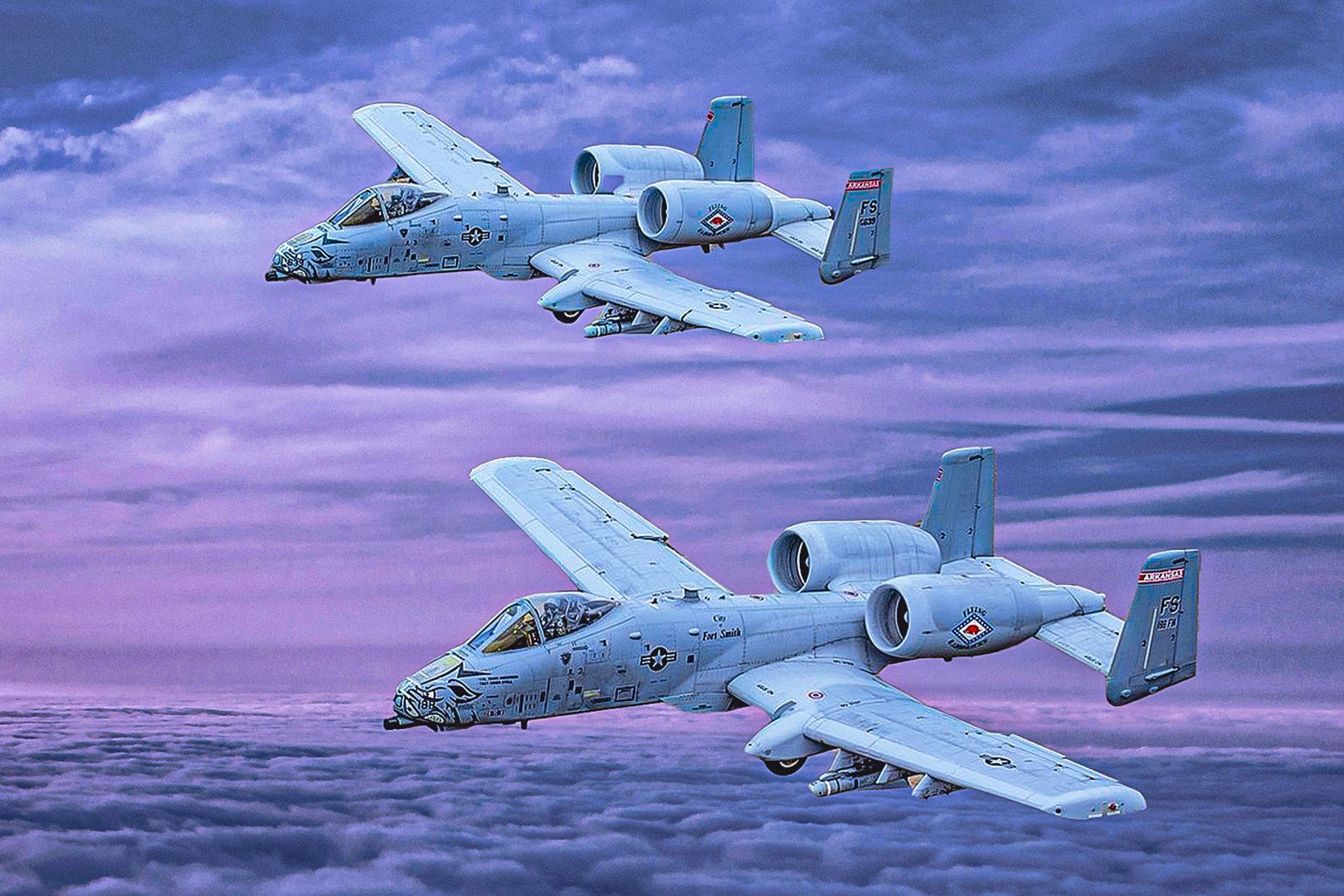
The United States Air Force has finally admitted what ground troops have suspected for years. Despite decades of trying to send the A-10 Thunderbolt II to the boneyard, the "Warthog" will remain in the active inventory through at least 2030. This is not a victory for nostalgia. It is a confession of a strategic vacuum. For forty years, the Pentagon has chased stealth and high-altitude dominance, yet they still cannot find a way to replace a titanium bathtub wrapped around a 30mm cannon that flies low enough to see the enemy’s eyes.
The survival of the A-10 into the next decade reflects a deep-seated anxiety within the Department of Defense. While the Air Force leadership desperately wants to pivot toward a high-end conflict with China, the reality of global brushfire wars and the sheer inefficiency of the F-35 in close-quarters support have forced their hand. They are stuck with the Warthog because they failed to build its successor.
The Myth of the Universal Fighter
The push to retire the A-10 has always been driven by the "Universal Fighter" doctrine. This is the idea that a single, multi-role stealth platform can handle everything from nuclear deterrence to picking off a technical truck in a desert. It is a beautiful theory on a spreadsheet. In practice, it has created a massive capability gap.
The F-35 Lightning II is a marvel of sensor fusion, but it is fragile. It is designed to kill what it cannot see from miles away. The A-10 was built to get hit, stay in the air, and return fire. When the Air Force argues that the A-10 cannot survive in "contested environments" filled with modern Russian or Chinese surface-to-air missiles, they are technically correct. But they ignore the fact that not every square inch of the globe is a high-threat zone. By trying to retire the A-10, the Air Force was essentially proposing to use a $100 million scalpel to do the work of a $10 sledgehammer.
Economics of the GAU-8 Avenger
You cannot discuss the A-10 without the GAU-8 Avenger. This seven-barrel Gatling gun defines the aircraft. It doesn't just provide fire support; it provides psychological dominance.
From a purely fiscal perspective, the A-10 remains the most efficient killing machine in the arsenal for low-intensity conflict.
- Cost per flight hour: The A-10 costs roughly $20,000 per hour to operate.
- The F-35 alternative: The F-35 remains north of $35,000, even with optimistic accounting.
- Loiter time: An A-10 can circle a battlefield for hours. A stealth jet, burning fuel to maintain high speeds and internal weapon temperatures, has a much shorter window of relevance for a platoon pinned down on the ground.
The decision to keep the fleet through 2030 is a nod to the "low-end" fight. The Pentagon has realized that while they prepare for a Great Power War, they are still embroiled in counter-insurgency and regional stability missions where a stealth jet is overkill and a drone is too easily jammed.
The Wings That Refused to Fold
The physical lifespan of the A-10 was supposed to end a decade ago. The only reason these planes are still airworthy is a massive, multi-billion dollar re-winging program. Boeing was contracted to build new wings for 173 of the aircraft, ensuring the airframes wouldn't literally snap under the stress of high-G maneuvers.
This was a pivot point. If the Air Force were truly committed to the F-35 as the sole provider of Close Air Support (CAS), they never would have spent the money on the wings. The fact that they did shows a lack of confidence in the F-35’s ability to perform the "danger close" missions that the Army and Marines demand.
The Congressional Shield
The A-10 has survived not because of Pentagon love, but because of a fierce political wall. Lawmakers, many with veterans on their staffs who owe their lives to a Warthog gun run, have repeatedly blocked the Air Force's divestment plans.
This creates a strange friction. The Air Force views the A-10 as a "legacy asset" that eats up budget units which could be spent on Next Generation Air Dominance (NGAD). Congress views the A-10 as a non-negotiable insurance policy for the boots on the ground. This tug-of-war has resulted in the current compromise: a slow, managed fade-out rather than a sharp execution.
The Ukraine Factor and the Modern Battlefield
Recent conflicts have complicated the narrative surrounding the Warthog's "obsolescence." In Ukraine, we have seen that slow, low-flying assets are incredibly vulnerable to Man-Portable Air Defense Systems (MANPADS). This bolsters the Air Force's argument that the A-10 is a "sitting duck" in a modern war.
However, the counter-argument is found in the evolution of electronic warfare. As GPS-guided munitions and high-tech drones are increasingly neutralized by sophisticated jamming, the "dumb" reliability of a pilot with a visual on the target and a massive gun becomes relevant again. The A-10 doesn't need a satellite link to shred a column of armored vehicles. It just needs a pilot who can see.
The 2030 Deadline is a Mirage
Setting a 2030 retirement date is a classic bureaucratic move. it satisfies the reformers who want to move on, while keeping the capability alive for the current commanders. But history suggests this date is written in pencil.
If the US finds itself in another regional conflict in the next five years—be it in the Middle East, Africa, or Eastern Europe—the A-10 will be the first plane requested by ground commanders. The Air Force has no replacement for the specialized training of A-10 pilots. These aren't just pilots; they are CAS specialists who speak the language of the infantry. You cannot simply download that institutional knowledge into an F-35 squadron and expect the same results.
The Pentagon is currently gambling that by 2030, autonomous collaborative platforms (loyal wingman drones) will be ready to take over the CAS role. This is a massive "if." If the drone programs stumble, or if the AI cannot distinguish between a friendly unit and an enemy one in the chaos of a "danger close" fire mission, the Warthog will get another lease on life.
The Institutional Failure of CAS
The real story isn't about a plane. It is about an institutional failure to value the mission of protecting the soldier on the ground as much as the mission of shooting down enemy fighters. The Air Force has always been an organization that prizes "Air Superiority" above all else. Close Air Support is seen as a secondary, almost subservient task.
This cultural bias is why we don't have an "A-11." There is no successor in the pipeline because the Air Force doesn't want to build one. They want to move out of the mud and into the stratosphere. By keeping the A-10 until 2030, they are admitting they haven't earned the right to leave the mud yet.
The Warthog is a relic, yes. It is ugly, it is slow, and it is a nightmare to maintain. But in the brutal logic of the battlefield, "legacy" is just another word for "proven." Until the Pentagon can prove that a stealth drone or a $100 million fighter can loiter over a mountain pass and provide the same umbrella of safety for a squad of Rangers, the 30mm gun will continue to have the final word.
The 2030 retirement date isn't a funeral notice. It is a deadline for the Air Force to finally figure out how to do its job without the one tool it has spent forty years trying to throw away.


:strip_icc()/pic2513216.jpg)